






















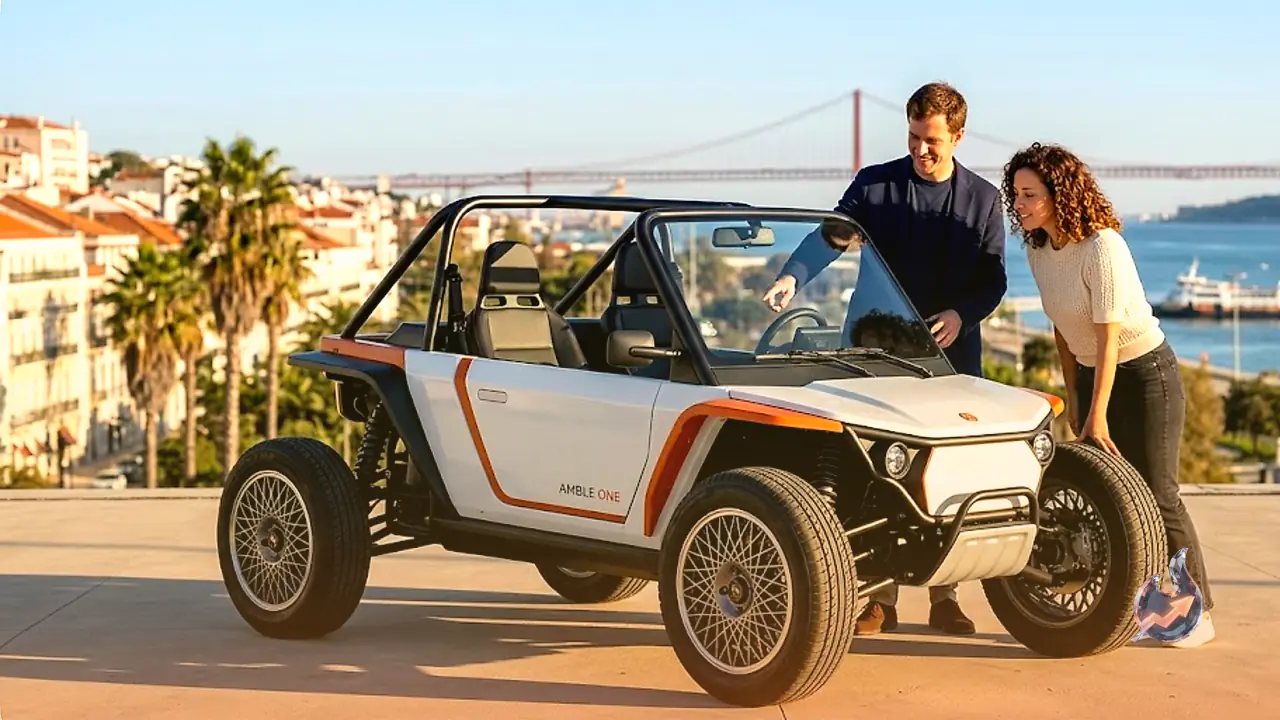

Amble, a young company out of Lisbon, Portugal, has launched an electric buggy that looks like it rolled straight out of a design lab in Cupertino. A big reason is the team behind it. Amble's design lead, Julian Hoenig, worked on the infamously canceled Apple car, which goes a long way toward explaining the look of the $25,000 Amble One.
The Amble One is a street-legal, stripped-down electric buggy built for the kind of places where a normal car feels out of place: coastal paths, private estates, and the dusty tracks that run between luxury hotel villas and the sea. Picture Apple deciding to design a golf cart, then pushing the idea even further.
The weight problem
The company calls the One a new category of lightweight electric vehicle for short-range mobility, and the specs give reason to take it seriously. It offers a range of more than 60 miles, a top speed capped at 40 mph, a five-hour charge from any standard home socket, and a curb weight under 450 kilograms (992 pounds).
That final number matters more than it sounds. To qualify as an L7e vehicle in Europe, the category that lets it drive on public roads without being treated as a car, the Amble One has to stay under 450 kilograms. “This is really hard,” says Adrien Roose, CEO and cofounder. “If you take a car and just shrink it, it doesn't work.” The open, doorless design is not simply an aesthetic nod to rivals such as the electric Moke; it is part of what makes that weight target achievable.
A team with pedigree
The founding team brings deep experience. Roose cofounded Cowboy, one of the better-known premium electric bike brands. Hoenig spent years at Audi working on the RSQ, A4, R8, and Q3, then joined Apple's design team, where he worked on the Apple Watch, Vision Pro, and Apple's Project Titan car program. Michael Tropper cofounded Forpeople, a 120-person creative agency whose clients include InterContinental Hotels. Keeping with the tourism theme, José António Uva, who serves as Amble's chairman, restored São Lourenço do Barrocal, a 1,927-acre luxury Alentejo estate in Portugal that has become one of Europe's most acclaimed rural retreats.
Aluminum, leather, and orange screws
That blend of premium and Cupertino shows up clearly in the Amble One's design language. Hoenig has made liberal use of aluminum, leather, cotton, and cork. According to Hoenig, the flat windscreen echoes the classic Mercedes G-Wagon. The interior dashboard bar is deliberately the same diameter as motorcycle handlebars, so any standard bike accessory mounts directly onto it, should you want to clip on your phone. Large, friendly orange screws across the vehicle mark every element that can be removed or reconfigured.
Straight from the moon buggy
Hoenig says the One is directly inspired by none other than the NASA moon buggy. “I always loved the lunar rover, the moon buggy,” he says. “It is fantastic, and there's not much to it, four wheels and the skateboard. Could we have this feeling of a skateboard, but extreme, where it's not hidden by your typical exterior sculptural shape?” So here, just as with NASA's $38-million Lunar Roving Vehicle, the electric platform is deliberately left visible rather than buried beneath bodywork. “You see the skateboard,” Hoenig says. “And then we put toppings on it.”
Hoenig is clear that nothing from Apple's canceled Project Titan made its way into this vehicle. What did carry over was a philosophy: pick the material suited to the job, and let manufacturing drive the form.
Configurable from the start
The Amble One can be reshaped from day one. The rear seats fold flat. A canvas weatherproofing option is on the way. For urban buyers, a lockable front box will replace the standard basket. Hard doors are not planned, but a second platform, already in design and targeting a 2029 release, will move closer to conventional-car territory, with removable doors, a lower roofline, and a hardtop. Cleverly, it aims to replace not a family's primary car, but its second one.
That coming “Amble Two” is clearly the bigger bet. “Most families do not need twice that $50,000 BYD or Tesla,” Roose says. “The second vehicle for families could be something that is designed for purpose, designed for shorter trips, and that can be much simpler, way more fun, way more open, and also more affordable.”
Carmakers chasing the same market
Car brands have models trying to crack this market too. The 28-mph Citroen Ami, with its 46-mile range, is a prime example. Stellantis, which owns Citroen, recently announced plans to expand capacity for its supermini electric cars. “This is the beginning of a turning point,” Roose says.
Even so, Amble may have a real shot. The company has 12 signed clients, more than 500 vehicles committed, and over €10 million in signed revenue, according to Roose. Properties including Amangiri in Utah, Mustique Island, Six Senses Les Bordes in the Loire Valley, and Uva's own Na Praia in Comporta have placed orders. The first hospitality deliveries of the Amble One begin in mid-2027, while consumer preorders for Europe and the US are now open, with deliveries in 2028 and prices starting from $25,000.
“A lot of companies in micromobility start in the urban market and want to compete with everyone, and we all know that this did not work out so far,” Hoenig says. “We're taking a different approach: build our brand as a premium brand, and then step by step go more into this urban market.”
Could this “luxury” lunar-inspired supermini EV be the ride that finally convinces us to drop our combustion-engine second car and embrace micromobility? Whatever the answer, the Amble One is a far more appealing prospect than the contenders that came before it.