






















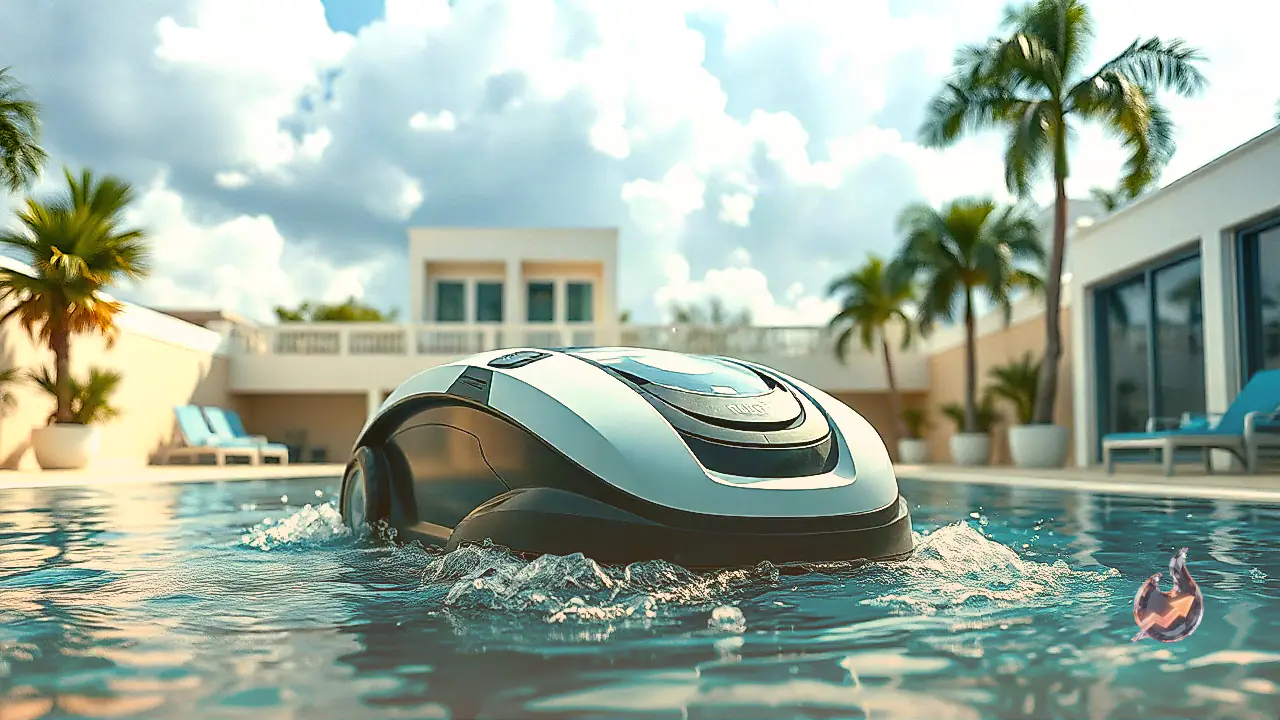

Maintaining a swimming pool often requires choosing between tedious manual vacuuming and investing in expensive robotic cleaners that can cost upwards of a thousand dollars. Entering this market at a fraction of the cost is the Poolease X1, an entry-level pool cleaning robot priced at just over 100 dollars. Weighing merely 9 pounds and featuring a compact frame roughly the size of a standard lunch box, this budget device promises to automate floor cleaning for pool owners looking for a low-cost maintenance solution. However, operating at a 110 dollar price point inevitably requires engineering compromises, raising questions about whether such an inexpensive device can deliver meaningful real-world performance.
Design, Build, and Water-Jet Propulsion
The overall architectural approach of the Poolease X1 differs significantly from traditional high-end robotic pool cleaners. Rather than relying on heavy motorized treads, rubber tracks, or actively rotating scrub brushes, the X1 utilizes a lightweight propulsion mechanism clearly inspired by Dyson fluid dynamics. The robot relies entirely on internal water jets to propel itself across the pool floor. As water is pulled through the intake on the bottom of the device, it is expelled through exhaust ports, driving the 9-pound unit forward in a continuous motion while simultaneously sucking up debris from the floor.
Because the propulsion system depends exclusively on water jet force without dedicated drive motors or high-friction tracks, the structural capabilities of the Poolease X1 are inherently restricted. The device is strictly engineered for flat pool floors and cannot climb vertical walls, clean waterlines, or navigate stepped entries. Furthermore, the absence of motorized roller brushes means the X1 does not scrub the pool surface to remove algae or stuck-on grime; it acts purely as a suction device. To keep production costs low, advanced connectivity features such as Wi-Fi, Bluetooth, or smartphone application controls are completely omitted from the design.
Unboxing, Assembly, and Initial Setup
Out of the box, the Poolease X1 requires some basic initial assembly before it can be deployed into a pool. Users must install four caster-style wheels, which are provided in two distinct sizes to ensure proper positioning on the base of the chassis. Additionally, the setup requires snapping two brushlike scraper components onto the underside, along with inserting two internal plastic plates inside the body of the unit. While none of these assembly steps are overly complicated or technical, having to assemble components manually straight from the package feels like an unnecessary extra chore for the consumer.
Charging Mechanism, Battery Life, and Power Controls
Power management on the Poolease X1 is controlled via a simple button situated on the bottom surface of the robot. Turning on the unit requires holding this underside button down before submerging the device in water. Placing the charging interface on the underside, however, presents a practical drawback: users must flip the entire unit upside down to connect the power supply, creating a recurring risk of scratching the robot's distinctive purple paint finish against concrete or deck surfaces.
The charging connection itself does not use a conventional sealed plug socket. Instead, it consists of two bare metal posts recessed within a narrow channel on the bottom chassis. To prevent corrosion and short circuits while underwater, this channel must be sealed using a separate rubber stopper. Crucially, this rubber stopper is completely unattached to the robot body, making it susceptible to being misplaced or lost during routine handling, though a single spare cover is included in the packaging. The stopper is also physically challenging to pry loose and press back into place. Electrical charging is handled by a standard 1.8 amp power adapter, which replenishes the 4300mAh internal battery in approximately three hours. Although official manufacturer specifications claim a 90-minute operational runtime per charge cycle, practical testing revealed that the battery consistently lasts closer to two hours continuous operation underwater.
Navigation Dynamics and Coverage Capabilities
Manufacturer specifications state that the Poolease X1 is rated to clean pool surfaces measuring up to 861 square feet, an area roughly equivalent to a large 30 by 30-foot pool. Despite this generous coverage claim, the internal navigation system lacks microprocessors, sensors, or intelligent mapping algorithms. Once submerged and active, the robot moves in a random, unguided zigzag pattern across the pool floor, altering its trajectory primarily when it makes physical contact with a surrounding pool wall.
Real-World Cleaning Performance and Suction Limitations
Because the X1 relies on random movement rather than structured grid navigation, its cleaning efficiency is essentially a race against time before its battery depletes. In practical evaluations involving both organic leaves and synthetic debris, the Poolease X1 successfully captured approximately 70 to 80 percent of the matter resting on the pool floor. While collecting up to 80 percent of loose floor debris is a respectable outcome for a 110 dollar machine, leaving 20 to 30 percent of dirt scattered randomly leaves the pool visibly incomplete, similar to a lawn care service leaving one-fifth of a yard uncut. Furthermore, the suction force generated by the water jet system is relatively modest, proving incapable of pulling up fine dirt, sand, or heavy silt from the bottom surface.
Drain Obstacles, Retrieval, and Maintenance Process
Physical clearance between the underside of the X1 and the pool floor is extremely narrow. During operation, this low clearance creates navigation hurdles on common pool fixtures, particularly circular floor drains. Main drain covers that rise less than one inch above the pool surface are at the exact height to beach the robot, lifting its wheels slightly off the ground and trapping it in place. While the X1 can eventually dislodge itself using jet propulsion, it frequently wastes several minutes struggling over drain covers during a cleaning cycle.
Once the battery is exhausted, the robot must be retrieved manually from the bottom of the pool using an included hook attached to a standard pool pole. Maintenance of the collected debris is relatively straightforward but carries some messy inconveniences. The device does not feature a removable internal filter basket; instead, the entire body unclips into top and bottom halves secured by four outer clips. Leaves and larger matter accumulate inside the central cavity, trapped against a simple mesh filter screen. Cleaning involves unclipping the halves and rinsing them with a garden hose. However, leaves frequently wedge into narrow internal crevices within the plastic frame, requiring users to either pick them out by hand or blast them with high-pressure hose sprays, which often splashes dirty water back onto the user.
Final Verdict: Value Proposition and Practical Utility
Ultimately, the Poolease X1 falls short of being a comprehensive cleaning solution for medium or large in-ground swimming pools, despite its 861 square foot factory rating. Its limited suction power, lack of wall-cleaning capabilities, and random navigation make it insufficient for heavy-duty maintenance. However, given its minimal 110 dollar price point, the X1 represents a low-risk purchase that can serve effectively as a secondary backup cleaner or an automated helper for small above-ground pools. Expecting flawless coverage from this budget model is unrealistic; much like assigning a young child to tidy a bedroom, the Poolease X1 makes a commendable effort, but the final outcome remains noticeably incomplete.