























Selecting the right indoor air purifier often involves balancing aesthetic design, filtration efficiency, and smart automated features. The Coway Airmega Halo presents itself as a compelling, compact option promising powerful room purification and whisper-quiet operation. However, rigorous real-world evaluations reveal a distinct gap between laboratory specifications and everyday practical performance. While the device succeeds in many fundamental aspects, critical issues surrounding sensor responsiveness, physical accessibility, and user-interface transparency raise serious questions about its overall efficacy in managing sudden spikes in domestic air pollution.
Design, Portability, and Physical Accessibility Hurdles
At a weight of 9.7 pounds, the Coway Airmega Halo is notably lightweight compared to many heavy-duty air purifiers on the market. This makes it theoretically highly portable, allowing users to transport it between bedrooms, living spaces, and offices. However, the physical design lacks essential human-centered accessibility features, such as a sturdy top-mounted carrying handle or integrated wheels. Instead, the manufacturer has opted for a small, recessed cutout grip at the rear of the unit.
For users with physical limitations, upper-limb disabilities, or weaker grip strength, this minimalist grip is insufficient. Moving the unit requires wrapping one's arms around the cylindrical chassis, a highly awkward maneuver for anyone without a wide hand span or robust physical strength. The inability to easily lift or glide the purifier severely limits its utility as a multi-room appliance for vulnerable demographics.
The Science of HyperVortex 360-Degree Filtration
The physical structure of the purifier utilizes a cylindrical design that facilitates a complete 360-degree air-intake system. This design choice is highly advantageous as it allows the device to pull in contaminated air from all directions, minimizing the spatial restrictions that often plague flat, wall-facing purifiers. Inside this cylindrical shell lies Coway's proprietary HyperVortex filtration system.
According to the manufacturer, this aerodynamic fan and duct structure is inspired by natural and sports engineering, specifically the wing dynamics of eagles and the surface aerodynamics of golf balls. The internal fan blades are designed to stabilize incoming airflow, while the generator fan's aerodynamic shape pushes clean air upward with immense force. Additionally, specialized dimpled patterns on the internal surfaces mimic golf balls to reduce air resistance, promoting a smoother and more efficient intake process.
Acoustic Performance and Touchscreen Controls
The upper surface of the Coway Airmega Halo features an elegant touchscreen control panel that serves as the primary interface for managing fan speeds, timers, and specialized modes. When set to its quietest sleep setting, the device is practically silent. Standard decibel monitoring applications register no perceptible increase in sound above the normal ambient noise of a quiet household, even when surrounding electronic appliances are fully powered down.
The manufacturer claims a noise level of 17 decibels in this mode, a figure that real-world testing supports given its complete auditory imperceptibility. Conversely, when the device is pushed to its maximum turbo setting, the acoustic profile increases dramatically. On turbo, noise levels hover around 75 decibels, which is loud enough to be comparable to a running kitchen dishwasher or an active vacuum cleaner, making it less suitable for quiet relaxation periods.
Smart Features and Energy-Saving Automation
The Airmega Halo is equipped with a suite of automated functions designed to optimize power consumption and minimize user intervention. In addition to its exceptionally quiet operation, the sleep mode activates a soft, warm yellowish night light on the top console, which can be fully deactivated if the user prefers absolute darkness. An integrated ambient light sensor monitors room brightness; when dark conditions are detected, the system automatically transitions into sleep mode, dimming all indicators and dropping the fan speed to its lowest setting.
Under standard smart mode operations, if the room remains dark for more than three minutes, the purifier automatically initiates this sleep cycle. Furthermore, if the internal sensor registers the ambient air quality as "good" for a continuous duration of three minutes, the fan shuts down entirely to conserve electrical energy, instantly resuming operation only when the sensor detects a rise in particulate matter.
Under the Lens: Putting the Sensors to the Test
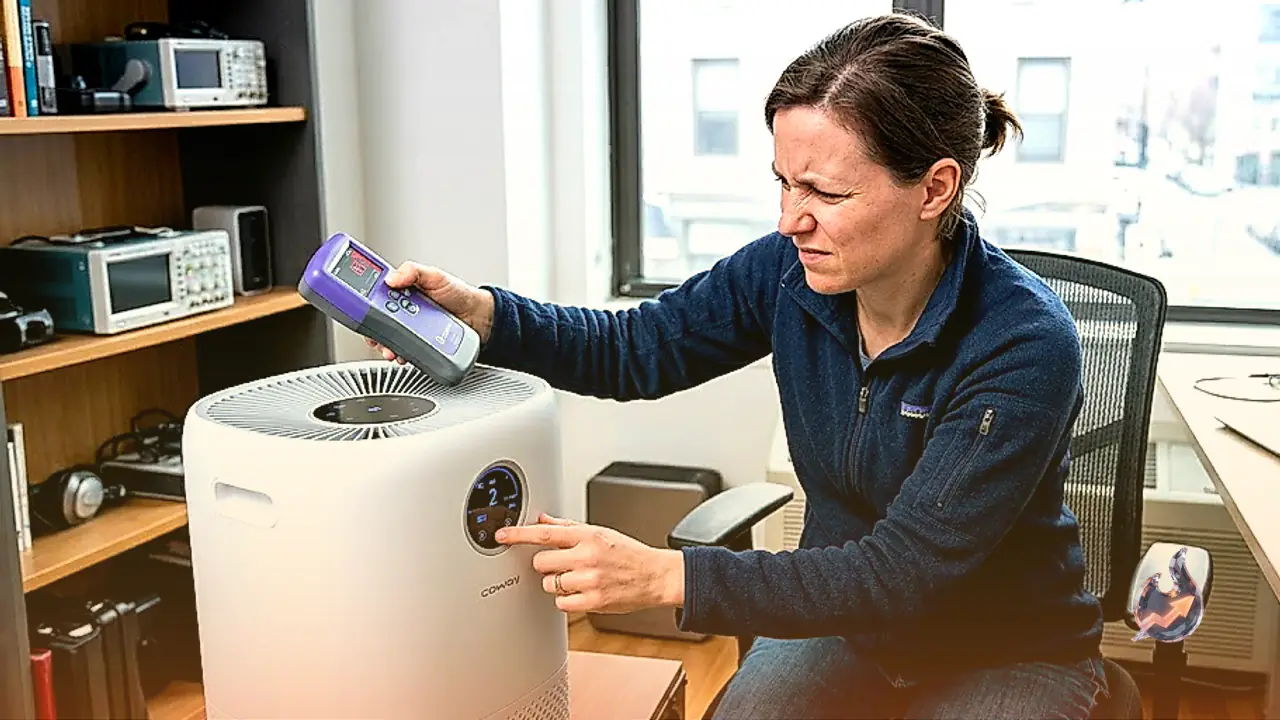
To assess the real-world performance of the air purifier, the unit was subjected to extreme conditions inside a sealed, heavily smoke-filled test tent. This environment is designed to push air-cleaning sensors and filters to their absolute limits, far beyond typical household dust or pet dander. When placed in auto mode inside the smoky tent, the machine successfully cleared the visible smoke within one minute and 21 seconds. However, during this rapid clearance process, the system never automatically engaged its maximum turbo mode, instead capping its performance at the highest standard speed setting. This suggests that turbo mode is programmed to remain a strictly manual selection, rather than an automatic response to extreme air degradation.
More concerning was the behavior of the built-in air quality indicator lights. Throughout the dense smoke exposure, the LED ring on the device failed to flash red or yellow, which represent dangerous and highly unhealthy air quality levels. Instead, the light remained green, indicating only moderate pollution. Given that a literal smoke pellet was burning inside a sealed environment, any standard, high-quality sensor should have registered off-the-charts hazardous levels. After one minute and 45 seconds of operation, the indicator light turned a solid blue, which signifies perfectly clean and healthy air. However, this visual reassurance was highly misleading.
The Post-Test Aftermath and Maintenance Issues
Following the visual clearing of the smoke, the purifier automatically throttled down to speed setting 1, the lowest level of its smart mode. It did so despite the fact that the surrounding air still carried a heavy, acrid smell of burnt smoke, and the external sensor was reading dangerous pollutant levels. It took nearly six minutes overall for the external monitor to return to normal baseline readings, revealing a startling four-minute discrepancy between the purifier's internal sensor and actual room conditions. Such a large delay is highly unusual, as high-end air purifiers typically synchronize closely with independent monitoring tools.
To eliminate the persistent smoke odor, the purifier was subsequently set to manual turbo mode and left to run overnight in a bedroom alongside another secondary air purifier. Despite these efforts, the strong smell of the smoke pellet remained trapped in the room and within the machine's body. An attempt to remove the air filter to vacuum away the lingering soot and odors revealed another structural flaw: the screw-off bottom panel became tightly stuck and could not be unscrewed. This was likely due to the panel being slightly misaligned or overtightened during initial assembly. For users who suffer from physical conditions that limit hand strength, accessing the internal filter for routine maintenance or replacement under these circumstances would be exceptionally difficult, if not impossible.
Expert Perspectives and the Final Verdict
When consulting industry experts regarding these notable sensor discrepancies, the general consensus remains that established manufacturers like Coway conduct thorough, certified laboratory evaluations to ensure their internal systems operate safely and within standard parameters under normal household conditions. In everyday residential environments, users are unlikely to expose the purifier to the extreme, rapid-onset pollution of a concentrated smoke pellet.
Structurally, the Airmega Halo represents a cost-effective option for its mechanical power, boasting the capacity to clean a massive 1,898-square-foot area within a single hour. However, consumers should note that this rating is somewhat theoretical. To achieve the medically recommended four to five air changes per hour for optimal respiratory health, the device is best suited for rooms closer to 474 square feet.
Ultimately, the Coway Airmega Halo is an attractive and exceptionally quiet device that is perfect for nurseries, bedrooms, or homes with light sleepers who prioritize silence and gentle night lighting. Nevertheless, the lack of a precise, numerical particulate display, combined with the significant sensor lag and physical accessibility drawbacks, means that buyers should carefully weigh their specific health needs before relying entirely on its automated color-coded indicators to judge their indoor air quality.