





















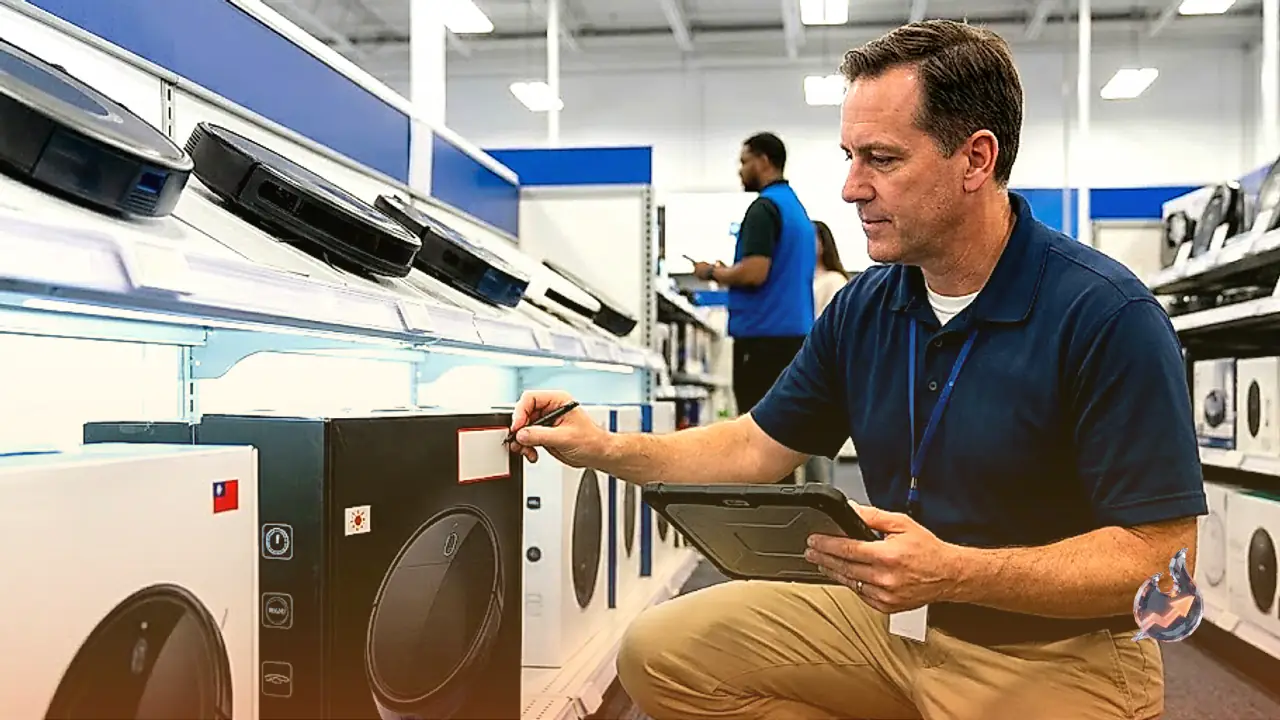

A major regulatory shift is under way in the smart home technology landscape. Tightening its oversight of foreign hardware, the Federal Communications Commission (FCC) in the United States has expanded its security restrictions to cover foreign-manufactured autonomous mobile robots. Under these updated guidelines, newly produced foreign robot vacuum cleaners and automated cleaning equipment will face severe hurdles in obtaining regulatory authorization for American market distribution. Crucially, however, the newly enacted provisions do not apply retroactively to devices currently operating inside consumer homes or units presently available on store shelves.
National Security Directives and Section 2 of the 2019 Communications Act
The regulatory authority updated its official Covered List to encompass foreign-produced advanced mobile robotic systems. Maintained pursuant to Section 2 of the Secure and Trusted Communications Networks Act of 2019, this restricted inventory identifies communications equipment and associated technical services determined to pose unacceptable threats to the national security of the United States or the personal safety of its residents.
This enforcement action represents a broader policy push to secure connected home hardware against external network vulnerabilities. It follows a similar administrative ban implemented in May targeting foreign-manufactured internet routers. Regulatory scrutiny over household technology items featuring integrated networking components has steadily intensified throughout the year.
Technical Specifications Benchmark Restricted Mobile Robots
According to administrative documentation issued by the National Security Determination, an executive branch interagency body, specific hardware metrics define which advanced robotic devices fall under the restricted classification. The criteria cover self-contained mobile robots capable of ground locomotion, spatial navigation, and automated obstacle avoidance. Furthermore, the rule specifies equipment designed to operate at a distance without direct, continuous oversight from a human supervisor.
Physical and computational parameters are explicitly detailed in the directive. Devices having a combined total weight exceeding 4.4 pounds when paired with their charging dock trigger inclusion. Additionally, systems incorporating environmental perception sensors, network communication modules such as Wi-Fi or Bluetooth, and software or firmware running local or remote AI and machine-learning model weights for movement control meet the regulatory definition.
Exempted Transportation Systems vs Affected Household Appliances
The National Security Determination explicitly clarified that several categories of mobile transportation technology remain outside the scope of the restriction. Connected passenger vehicles, rail transit vehicles, commercial and civil aircraft, unmanned underwater vehicles, and fixed stationary industrial robots are explicitly exempted from the ban.
Conversely, domestic cleaning appliances manufactured overseas face immediate regulatory barriers. Alongside foreign-made robot vacuum cleaners, automated swimming pool cleaners and robotic lawn mowers fall directly into the restricted category. Authorities cited concerns that networked communication channels in autonomous hardware create attack vectors capable of compromising stored data or manipulating physical device operations.
Privacy Concerns Over Integrated Cameras, Sensors, and Audio Inputs
Government security analysts centered their evaluation on integrated optical cameras, spatial mapping sensors, and base station microphones utilized for voice-command execution. Placing internet-connected equipment with visual sensors inside residential spaces presents potential data privacy risks, particularly when operating on unsecured home Wi-Fi networks.
In practice, standard robot vacuums do not stream live visual feeds across external servers. They create internal floorplan maps primarily to identify room boundaries, carpeted zones, and furniture placement. While official regulatory documentation cited risks associated with live video feeds and humanoid robot vulnerabilities, no specific instance of a robot vacuum data breach was highlighted. Nevertheless, shared sensor architecture led to their inclusion in the security listing.
Practical Implications for Existing Owners and Future Buyers
For current owners of robot vacuums, the immediate operational impact remains negligible. Devices already purchased or currently stocked by retailers have previously secured official regulatory clearance, allowing them to remain fully functional without mandatory product recalls or service interruptions.
Smart home manufacturer Eufy addressed the policy change in an official statement, noting that based on their current understanding, the updated rule does not affect the continued availability, use, or support of products presently sold within the United States. The company confirmed these existing models will remain on sale while continuing to receive software updates and customer support services. Meanwhile, Roborock declined to comment on the matter, while Shark and Dreame provided no public statement.
Market Competition, Trade Events, and Potential Pricing Pressures
The regulatory shift coincides with the upcoming IFA Berlin trade show starting September 4, an international event where manufacturers traditionally unveil next-generation robotic floorcare lineup. Due to the updated approval requirements, new foreign models introduced at the exhibition are unlikely to secure US commercial distribution, significantly restricting future product selections for American consumers.
Domestic brands such as Shark and Matic could potentially navigate around the restrictions, though manufacturing locations for specific component parts remain complex. Industry experts observe that a shrinking pool of market competitors typically reduces product variety while driving up retail prices on basic, lower-spec appliances due to supply constraints.