
























Smart wearable devices have transformed how individuals monitor their personal health, and smart rings like the Ultrahuman Ring Air and the Ring Pro have become key tools for biometric tracking. The companion smartphone app provided by Ultrahuman offers an extensive array of charts, recovery scores, and analytical graphs. However, navigating this abundance of information can sometimes feel overwhelming for users trying to extract practical daily value. Even prior to enabling modular add-ons known as PowerPlugs, the platform houses several hidden settings and software features designed to optimize data collection. By mastering specific configuration shortcuts and secondary integrations, users can significantly enhance heart rate accuracy, refine circadian routine tracking, and extend overall battery longevity without sacrificing core health insights.
Evaluating Long-Term Trajectories Through the Longevity Tab
Following recent updates to the Ultrahuman application layout, users gained access to a dedicated Longevity tab. While the estimated biological age metric displayed within this section might initially seem like an entertaining gimmick, the underlying dashboard serves a far more critical function. It aggregates continuous daily inputs into comprehensive long-term health trends. While the standard primary tab concentrates on immediate, day-to-day metrics alongside daily recovery suggestions, the Longevity tab compiles these daily data points to illustrate cumulative physical changes over weeks and months.
One of the central features housed inside the Longevity tab is an estimate of VO2max, which measures an individual's maximal oxygen consumption and overall cardiovascular fitness capacity. Monitoring this metric provides valuable feedback regarding cardiorespiratory endurance over extended training periods. Additionally, the dashboard incorporates a specialized Sleep Debt card. This metric tracks cumulative sleep deficits by analyzing bedtime consistency. For instance, if sleep schedules drift later over the course of a busy week, the app calculates the exact deficit, such as a one-hour sleep debt. More importantly, the system offers actionable clarity by indicating how many consecutive on-time bedtimes are required to fully erase the accumulated sleep debt and restore optimal baseline recovery.
Enhancing Workout Heart Rate Accuracy with External Sensor Pairing
Smart rings offer exceptional convenience for sleep and passive daily tracking, yet they face physical constraints when utilized as standalone workout trackers. High-impact exercises, heavy weightlifting, or rapid wrist movements often require removing the ring for comfort or safety. Furthermore, motion artifacts and shifting skin contact can compromise optical heart rate readings during intense exertion. To address these inherent hardware limitations, the Ultrahuman companion app incorporates a built-in integration setting that allows users to offload heart rate tracking to more precise external equipment.
Users can initiate workouts directly from the application by selecting the plus sign menu and designating an alternative heart rate source. This feature enables the app to record exercise duration while pulling real-time heart rate streams from high-precision devices such as dedicated chest strap monitors or GPS sports watches. The software supports a wide spectrum of external gear capable of broadcasting heart rate telemetry. Step-by-step connection instructions are available within the app for devices including Polar sensors, Garmin wearables, Whoop bands, Apple Watch, and AirPods Pro 3. By pairing the ring with a specialized external chest strap or smartwatch during training, users maintain accurate cardiovascular intensity tracking without relying solely on ring optical sensors during high-movement sessions.
Algorithm Recalibration via Emerald Update Training Features
Software evolution plays a vital role in refining wearable precision, and the Emerald update introduced a key functionality centered on algorithm training. This feature allows users to actively train the smart ring's heart rate detection algorithm to better adapt to individual physiological characteristics. The process involves wearing a secondary precision device simultaneously with the ring during an active session. As both devices record biometrics, the Ultrahuman application performs side-by-side signal comparisons to calibrate its optical detection models against the reference readings.
At present, algorithm training support is available for specific Polar heart rate monitors. However, expanded compatibility is slated for future rollouts, with support for Garmin devices currently in development. Beyond heart rate refinement, future software updates are also scheduled to introduce algorithm training capabilities tailored specifically for step counting accuracy. This ongoing algorithmic tuning ensures that sensor interpretation grows progressively more accurate over time as multi-device comparison data is processed.
Optimizing Solar Exposure and Circadian Routines with the Vitamin D Plugin
A primary strength of the Ultrahuman ecosystem is its focus on temporal hygiene and circadian rhythm optimization. By default, the application delivers structured recommendations regarding optimal daily timing. These include alerts indicating when to eliminate screen exposure before sleeping, target step counts for early morning hours and sunset golden hour windows, and specific time frames for safe caffeine consumption to protect sleep architecture. To expand upon these environmental insights, users can access the PowerPlugs section and enable the dedicated Vitamin D plugin.
Activating the Vitamin D plugin embeds a specialized sunlight timeline directly onto the primary schedule view. The smart ring automatically detects ambient natural light exposure, while users can also manually log outdoor time when working toward specific daily solar exposure targets. Customized to the user's precise geographical location, the timeline displays exact daily sunrise times alongside designated partial sunlight intervals during late afternoon hours. While similar circadian guidance can be inferred from the Circadian Windows plugin, maintaining a separate sunlight column provides clearer visibility for planning late-day outdoor activities. For instance, knowing the precise onset of partial evening sunlight helps users determine whether outdoor trail runs will require carrying additional illumination like a flashlight. Users can view all active routine schedules side-by-side by opening the Active Windows card on the main screen dashboard.
Extending Battery Lifespan Through Chill Mode Configuration
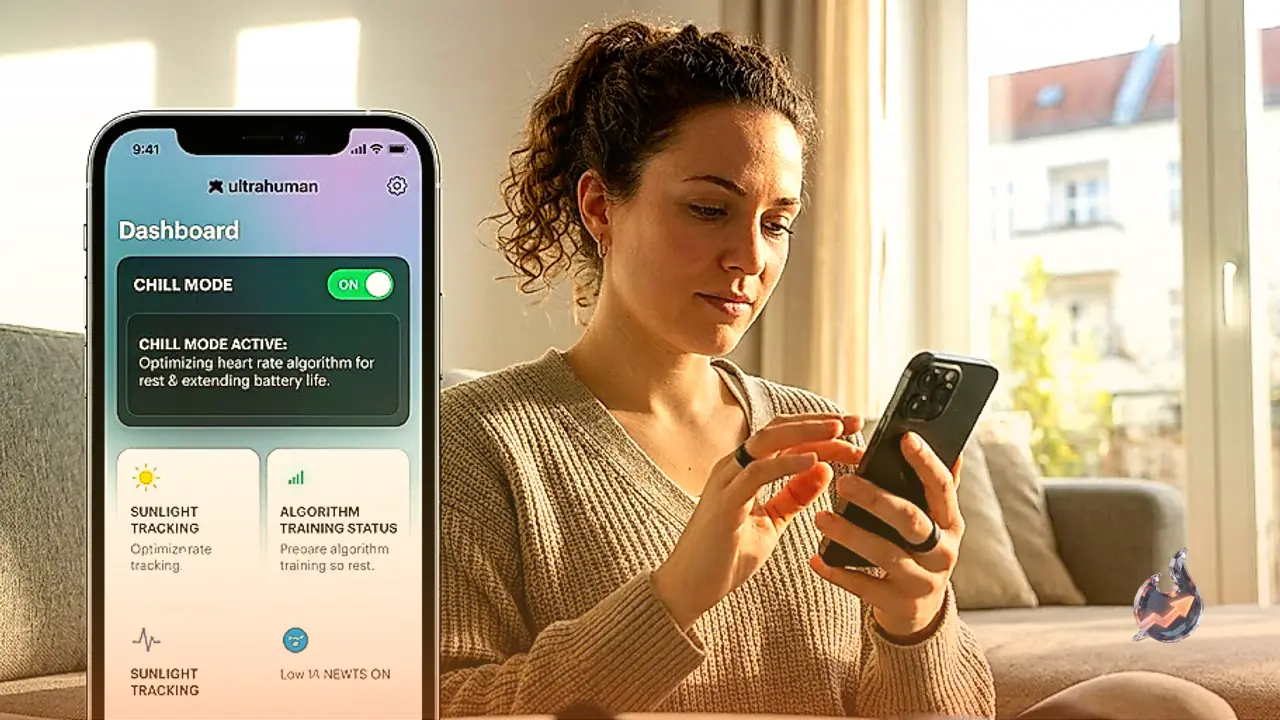
Battery performance is a crucial consideration for wearable device management, and the Ultrahuman application includes an optional power setting that optimizes energy consumption. Upon initial setup, the smart ring operates by default in Turbo Mode. In this configuration, all optical and motion sensors run at maximum intensity to deliver continuous continuous tracking and live home screen heart rate displays. While Turbo Mode offers maximum data density for new users exploring their initial metrics, it places a continuous strain on battery reserves.
For sustainable everyday usage, switching the ring to Chill Mode provides a balanced alternative. When active, Chill Mode continues to monitor critical health events, including total sleep duration, restful recovery phases, and exercise sessions, while scaling back intensive continuous sampling during routine non-active hours. By reducing unnecessary sensor polling during low-activity periods, Chill Mode significantly extends total battery life per charge cycle. This adjustment preserves all essential sleep and recovery insights while eliminating the need for frequent battery recharging.