






















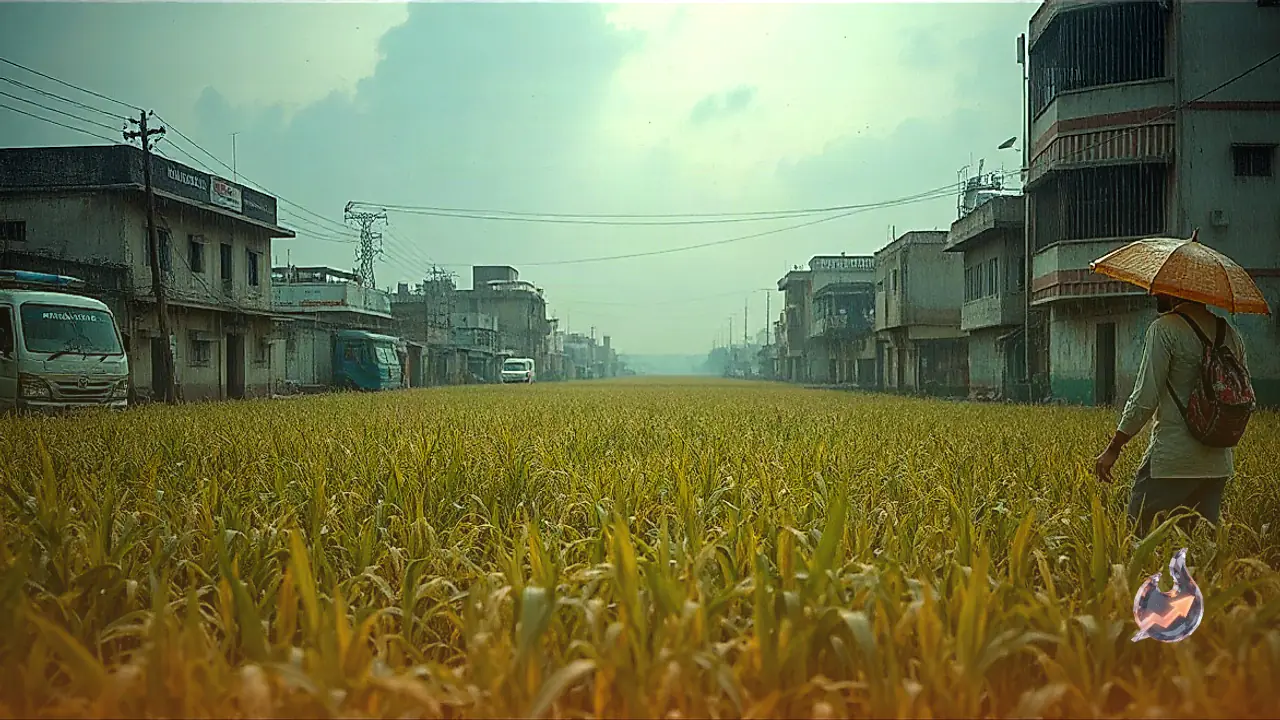

In Faridabad, Haryana, relentless and untimely rainfall has brought severe distress to local farmers, devastating their ready-to-harvest paddy crops. The agricultural sector in the region, which was already reeling from massive losses during the previous wheat season, is now facing another catastrophic economic setback as fields of ripening paddy lie flattened on the muddy ground. This ongoing meteorological crisis has left cultivators staring at empty pockets and mounting debts just as the festive season approaches.
Double Blow of Nature After Wheat Disaster
Farmers in the region are experiencing a devastating double blow of nature within a single year. Earlier, during the spring season, just as the wheat crop was nearing maturity and getting ready for harvest, sudden torrential rain coupled with highly destructive hailstorms battered the fields. That disaster destroyed the standing wheat, resulting in losses worth lakhs of rupees for families dependent entirely on agriculture. Now, history is repeating itself with the paddy crop in a highly distressing manner. The current paddy harvest, which is in its final ripening phase, has been flattened to the ground due to the continuous downpour and strong winds, rendering the grains highly vulnerable to spoilage.
The Heavy Toll on Deeg Village Fields
Among those severely affected is Kunwarpal, a resident and farmer from Deeg village. Kunwarpal had cultivated his paddy on leased land, which significantly increases his financial vulnerability since land lease rates must be paid to owners regardless of the ultimate harvest yield. The torrential rain has completely ruined his crop across one acre of land, resulting in a direct loss of around 50 percent of his expected yield. Having already suffered losses worth lakhs of rupees during the previous wheat season, the destruction of his paddy crop on rented land has put immense financial pressure on him, making it extremely difficult to even recover basic expenses.
Soaring Input Costs and Vanishing Returns
Another local farmer, Rambabu, shared detailed insights about the worsening situation. The crisis actually began about fifteen days ago when heavy downpours first lashed the area, causing massive waterlogging in the agricultural fields. With subsequent continuous rainfall over the following weeks, the standing water could not drain out, causing a major portion of the paddy crop to rot directly in the fields. Managing, draining, and saving the crop under these swampy conditions has become nearly impossible for the manual workforce.
Rambabu noted that he had cultivated the 1509 variety of paddy this season, which is known for its quality but remains sensitive to excess water during maturity. The financial input required to prepare just one acre of this paddy is extremely high, costing around 33,000 rupees in terms of labor, high-quality seeds, chemical fertilizers, pesticides, and irrigation. With 50 percent of his overall crop destroyed and one acre entirely ruined, recovering these input costs has become an impossible task. The escalating cost of modern farming combined with unpredictable weather cycles is making agriculture increasingly unsustainable for these local cultivators.