






















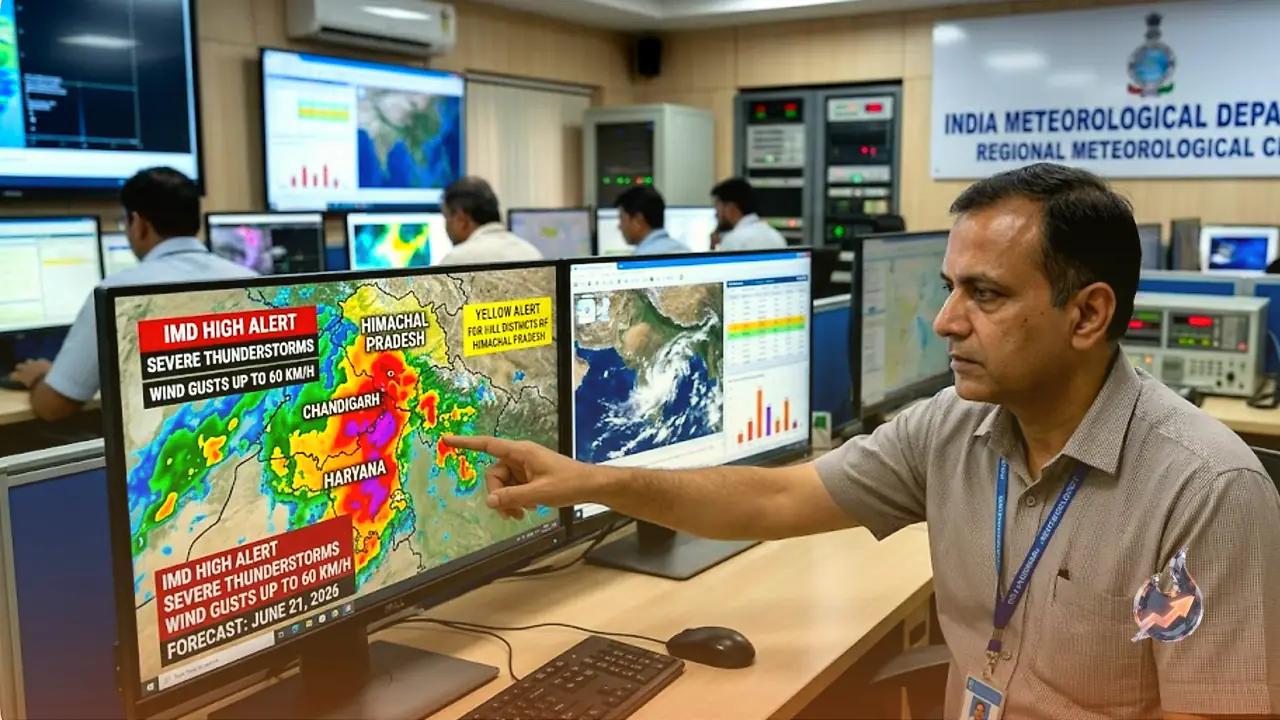

Anyone in Haryana, Chandigarh or Himachal Pradesh with plans to travel or step outdoors on Sunday, June 21, 2026 should pay close attention to the latest IMD advisory. The India Meteorological Department has flagged these regions as being on a high-danger weather watch, pointing to the activation of a powerful weather system that will bring thunderstorms, intense lightning and destructive squall winds to both the plains and the hills.
Haryana and Chandigarh Face the Severest Warning
The strongest alert applies to Haryana and the Union Territory of Chandigarh. According to the latest IMD bulletin, different parts of both these regions will be hit by intense thunderstorms with lightning on June 21. Sustained wind speeds during the storm are forecast at 40 to 50 km/h, with sudden gusts capable of reaching 60 km/h. Winds of that strength pose a serious threat to semi-permanent structures, trees and electricity poles.
The broader IMD outlook covering the period from June 20 to June 23 also points to scattered to widespread rainfall across Haryana, Chandigarh, Delhi and Punjab during these days.
Yellow Alert Declared for Higher Reaches of Himachal Pradesh
Himachal Pradesh will not escape this weather event either. The state's meteorological centre has issued a Yellow Alert for Sunday, warning of worsening conditions at higher elevations across the state.
- Lahaul-Spiti and Kinnaur: These high-altitude districts are likely to receive light precipitation, which may include snowfall.
- Chamba, Kullu and Shimla: Upper reaches of these three districts will bear the brunt of the deteriorating conditions, while lower and mid-altitude pockets can expect gusty winds of 30 to 40 km/h accompanied by thunder and rain showers.
The Science Behind This Sudden Weather Shift
Two intersecting weather systems are driving this dramatic change. First, a potent Western Disturbance is currently active as a cyclonic circulation between altitudes of 3.1 and 5.8 kilometres over North Pakistan and the adjoining Jammu region. Second, a robust seasonal trough line is cutting across Haryana and Uttar Pradesh, stretching from Punjab in the west all the way to Bihar in the east. Moisture drawn in from the Arabian Sea is interacting with both of these systems, generating intense weather activity across the plains and the mountains alike.
When Can Residents Expect Temperature Relief?
Maximum temperatures are not projected to shift significantly in the next 48 hours. After that window, however, readings could dip by 2 to 3 degrees Celsius, bringing some measurable respite from the prevailing heat.
IMD Safety Guidelines Everyone Should Follow
- Do not shelter under a tree or stand against a concrete wall during lightning or a storm.
- Unplug all valuable electronic and electrical appliances at home before the storm arrives.
- Stay well away from rivers, streams and ponds, as water bodies can attract lightning strikes.
- Livestock owners should move their animals out of open spaces and into secure, covered sheds without delay.