






















With the onset of the winter season, rural settlements witness the vibrant revival of traditional jaggery production directly from freshly harvested sugarcane. Even though packaged jaggery and a vast array of processed sweets are widely accessible in modern retail markets, rural communities continue to rely on ancestral techniques to make authentic desi jaggery. Farmer Jagat Narayan Pathak from Sultanpur shared details on the entire rustic procedure, from harvesting cane in the fields to simmering juice for hours over open furnaces.
Harvesting Sugarcane and Extracting Pure Juice
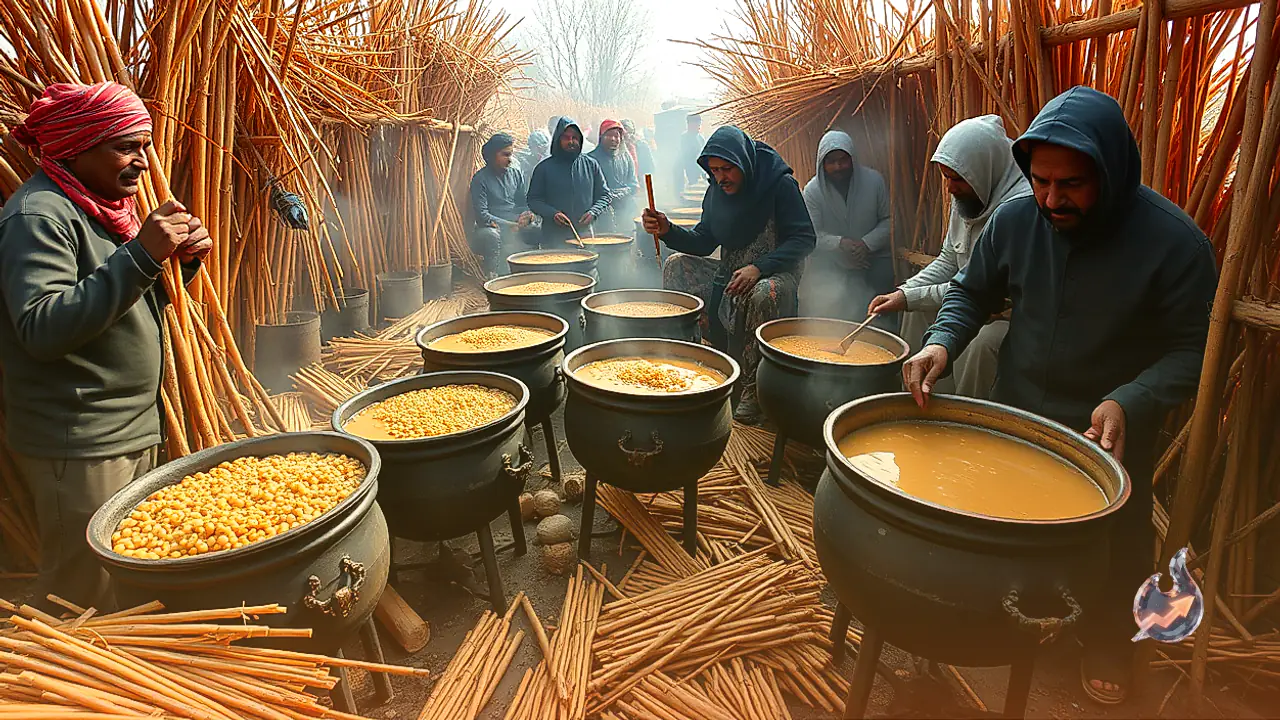
The jaggery-making process begins right in the agricultural fields with the harvesting of mature sugarcane stalks. Once cut, the canes are transported to mechanical crushers or traditional kolhus to press out the fresh sweet juice. This raw liquid is thoroughly strained to filter out coarse particles and transferred directly into massive iron cauldrons. The cleanliness of the raw juice remains central to final quality, as fresh and uncontaminated extract ensures superior flavor, appealing natural color, and unmatched purity in the finished product.
Boiling in Massive Iron Cauldrons Over High Heat
After initial filtration, the large iron cauldron loaded with raw juice is placed over intense fires in specially built earthen furnaces. As the liquid comes to a rolling boil, frothy scum and floating impurities steadily surface on top. Farmers stand vigilantly beside the cauldron, scooping away this foam using large perforated ladles. Constant manual stirring is essential throughout this cooking phase to prevent the viscous liquid from scorching or sticking to the bottom of the vessel.
Steam Evaporation and Thickening of the Juice
Through persistent boiling across multiple hours, the moisture present in the sugarcane juice evaporates as steam, leaving behind a dense, concentrated golden syrup. Relying on accumulated ancestral knowledge and keen observation, experienced farmers monitor the exact consistency to decide the precise moment the cauldron must be lifted from the flames. The boiling, thickened concentrate is then carefully transferred to a secondary clean container or dedicated cooling trough.
Cooling Technique and Shaping Solid Bheli Cakes
While the extracted concentrate gradually cools down, it is stirred continuously to develop the proper texture, smooth grain, and characteristic hue. Once the mixture reaches a workable semi-solid state, it is shaped according to local commercial preference. Farmers typically shape the warm mass into classic round lumps known as bheli, or divide it into compact, bite-sized blocks suitable for household consumption.
Hard Labor, Traditional Knowledge, and Rural Livelihoods
Crafting authentic desi jaggery demands relentless physical toil combined with decades of practical expertise. From cutting down thick sugarcane stems and crushing them, to enduring blistering heat beside boiling cauldrons and molding the settling paste, farmers invest steady manual effort at every junction. After setting and hardening completely, the chemical-free jaggery is packaged for local agricultural markets, sustaining the livelihoods and household incomes of numerous farming families across northern villages.