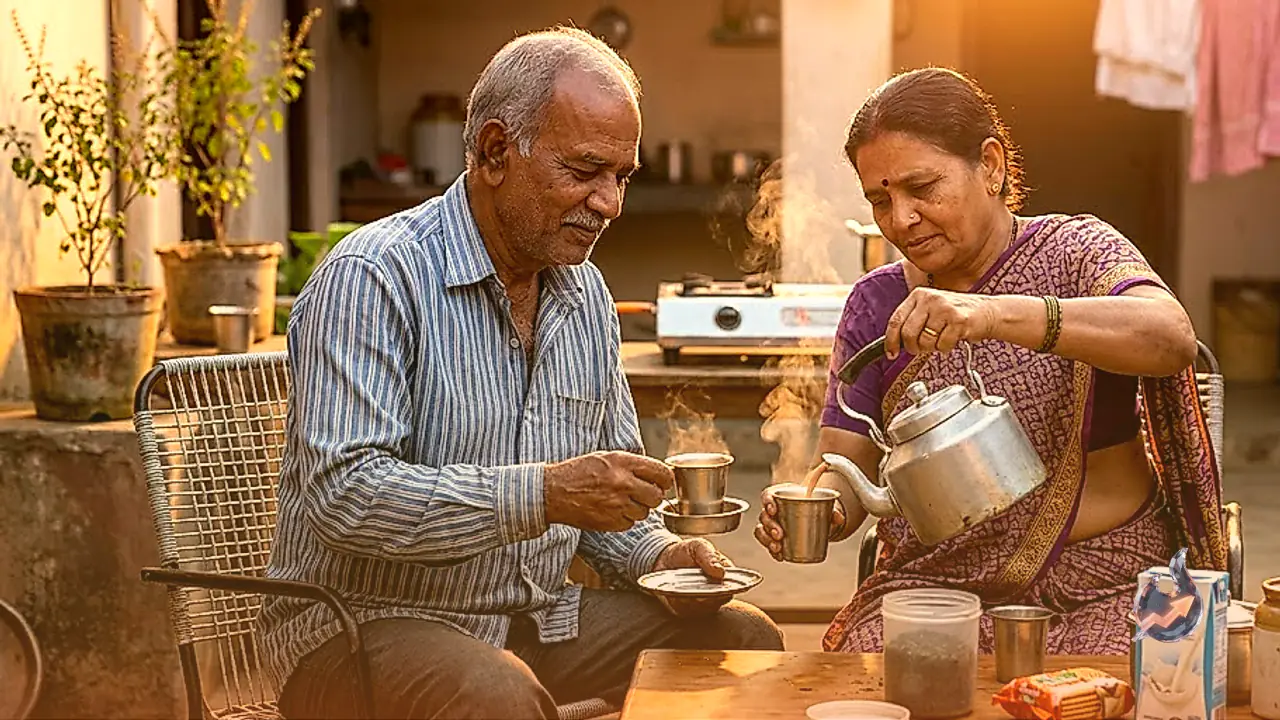

For most Indians, the first thought that crosses the mind after the alarm goes off is not the day's to-do list, it is a steaming cup of tea. Whether at home, at the office or on a long journey, tea shows up everywhere, and that habit has turned into the biggest morning necessity for millions of people. What is striking is that the drink without which an Indian day now refuses to begin was never originally part of Indian culture at all. Its story began thousands of years ago in China and it arrived in India only during the British era. Over time Indians reshaped it completely by adding milk, ginger, cardamom and spices, and it eventually became a fixture in every kitchen in the country.
Why the craving hits the moment you wake up
The body takes a little time to become fully alert after waking up, and that is exactly when the aroma and taste of hot tea deliver an instant sense of freshness. The caffeine in tea helps the brain feel alert, which is why many people feel their sleep has not truly broken until a cup is in their hand. Experts point out, however, that caffeine is not the whole story. Years of repetition play just as big a role. When someone drinks tea at the same time every single day, the body and mind get conditioned to that exact routine. That is why craving a cup the moment you wake up is considered completely normal.
A nearly five-thousand-year-old history
According to historians, the discovery of tea goes back close to five thousand years. A popular account holds that around 2737 BC, China's Emperor Shen Nung was drinking hot water when a gust of wind blew a few leaves from a nearby tree into his water. When he tasted it, he liked it so much that this moment is regarded as the first discovery of tea. From there, the habit of drinking tea slowly spread across China, and over the centuries it travelled to other parts of the world as well.
How tea gardens arrived in India
In the early 19th century, China's grip on the global tea trade began to weaken. The British East India Company seized the opportunity and set out to grow tea on a massive scale on Indian soil. Vast tea gardens came up in the 1830s across regions like Assam and Darjeeling. Notably, most of the tea produced there in that period was not meant for Indians at all, it was shipped to Britain. Ordinary Indians barely drank tea at the time.
How free tea rewired a whole country's habits
Once the British realised that tea consumption within India was extremely low, they rolled out a deliberate campaign to popularise it. Free tea began being handed out at railway stations, giving travellers a chance to taste it without paying a single rupee. Slowly, people developed a taste for it. From railway platforms, tea made its way into shops, markets and eventually into homes across the country. In a fairly short span, it became the drink of choice for people of every age and every background.
Indian kitchens gave it the masala twist
In its earliest form, tea was made simply by steeping leaves in hot water, with no milk and no spices involved. Indians, though, moulded it entirely to their own taste. Milk, sugar, ginger, cardamom, cinnamon, cloves and a host of other spices went into what became masala chai, a version with an identity all its own. Even today, the way tea is brewed and served changes from state to state. In some places, tea served in clay kulhads is the local favourite, while elsewhere a strong cutting chai remains the first choice.
More than a drink, it is a bond
In India, tea is never just about quenching thirst. Whether it is friends catching up, a long conversation with family, an office meeting or welcoming a guest at home, tea is expected to be present at every occasion. From a tiny roadside stall in a village to a sleek café in a big city, tea has become the excuse people use to connect and talk to one another. That is likely why it is regarded as such a central part of the Indian lifestyle.
Why moderation still matters
Experts agree there is nothing wrong with drinking tea in moderate amounts, but making a habit of drinking far too much of it can cause problems. Having large quantities of tea on an empty stomach in particular can leave some people dealing with gas, acidity or general discomfort. That is why experts recommend sticking to a reasonable quantity and drinking it at sensible times, so that the pleasure of a cup does not come at the cost of one's health.