






















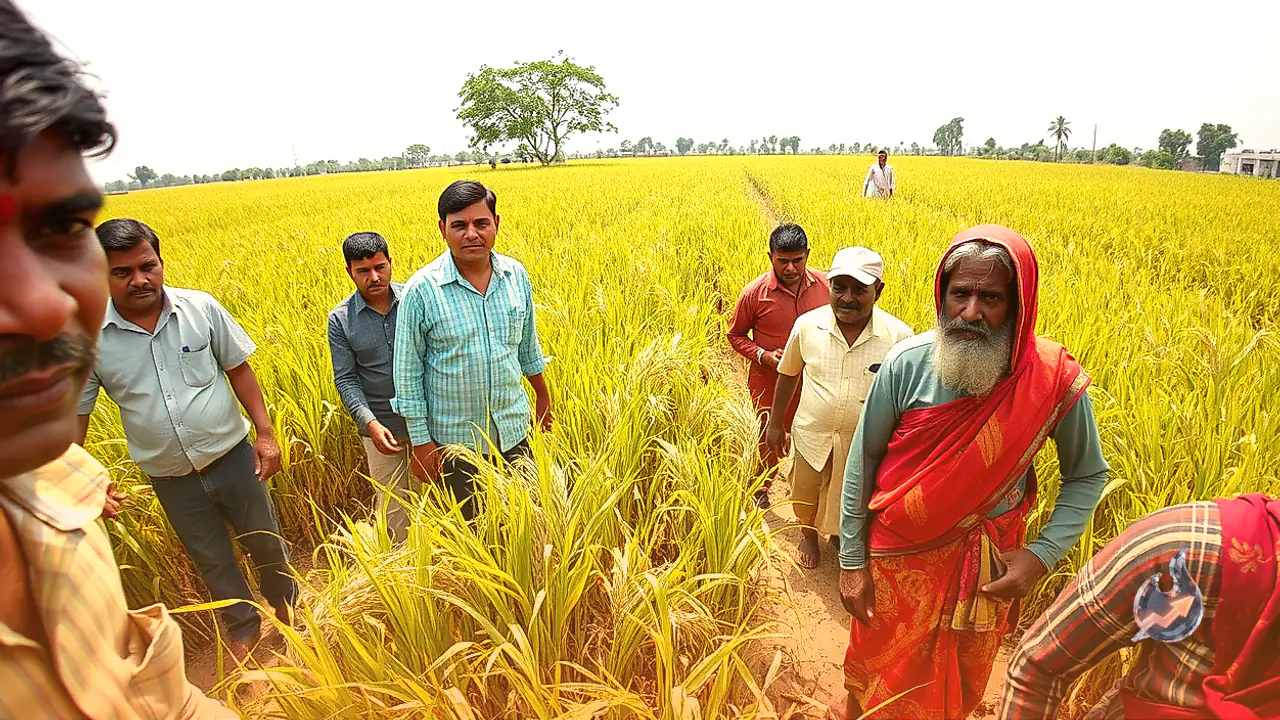

Across the agricultural landscapes of Rohtas and the broader Shahabad belt, an evolving economic calculus is prompting cultivators to reassess their staple crop preferences. While Nati Mansoori paddy has long dominated fields due to its sheer volume, Sonachur paddy is demonstrating that premium quality can vastly outperform gross yield. Although the harvest volume of Sonachur remains noticeably smaller, its commanding market value turns agricultural economics decisively in favor of high-value native cultivation.
Yield Volumes Versus Mandi Economics
Agricultural scientist Dr. Prakash Singh from the Paddy Research Centre in Rohtas provides clear comparative data on both varieties within the Shahabad agro-climatic zone. On average, one hectare planted with Nati Mansoori generates between 70 and 75 quintals of raw paddy, which mills down to roughly 55 to 60 quintals of consumable rice. By comparison, Sonachur delivers only 32 to 35 quintals of harvest per hectare, yielding just about 25 quintals of polished rice. While Nati Mansoori decisively leads on the weighbridge, the monetary return at market tells an entirely different story.
The ₹85,000 Revenue Advantage Per Hectare
The decisive factor rests entirely on the price per kilogram fetched in the commercial grain trade. Dr. Prakash Singh points out that Sonachur rice consistently trades at or above ₹100 per kilogram. Consequently, selling 25 quintals of Sonachur rice yields a gross market realization of approximately ₹2.50 lakh from a single hectare. Conversely, standard Nati Mansoori rice trades around ₹28 to ₹30 per kilogram. Even when calculating a substantial 55 quintals of milled rice at the top rate of ₹30 per kilogram, the total gross value reaches roughly ₹1.65 lakh. Thus, despite producing less than half the rice volume, Sonachur generates an estimated ₹85,000 more in gross market proceeds per hectare.
Lower Chemical Inputs and Organic Advantages
Beyond raw trade revenues, input costs play an equally vital role in determining overall profitability. Dr. Singh highlights that Sonachur can be successfully cultivated with substantially reduced chemical fertilizers. Growers who tailor soil nutrition to natural requirements and adopt organic farming methods can lower initial outlay while positioning their harvest as a specialty grain. Because Sonachur possesses distinct aromatic and culinary characteristics, targeting quality rather than pursuing massive tonnage offers cultivators a much stronger commercial buffer against input inflation.
Final Stages of Geographical Indication Registration
Efforts to secure institutional backing and brand protection for this regional heirloom are already at an advanced stage. According to Dr. Prakash Singh, required documentation to grant Sonachur its Geographical Indication (GI) status has already been submitted to the designated authority in collaboration with local farmers. The verification process is currently entering its final leg, with official certification expected within the next month.
Unlocking Broader Markets and Authenticity
Securing a certified GI tag is set to validate the provenance of Shahabad Sonachur, preventing generic counterfeits from eroding farmer earnings. Legal recognition will establish a distinct identity on consumer shelves, unlocking premium pricing across regional and national retail channels. For growers in Rohtas and neighboring tracts, transitioning toward authenticated Sonachur demonstrates how traditional crops can yield superior financial resilience when aligned with market valuation.