






















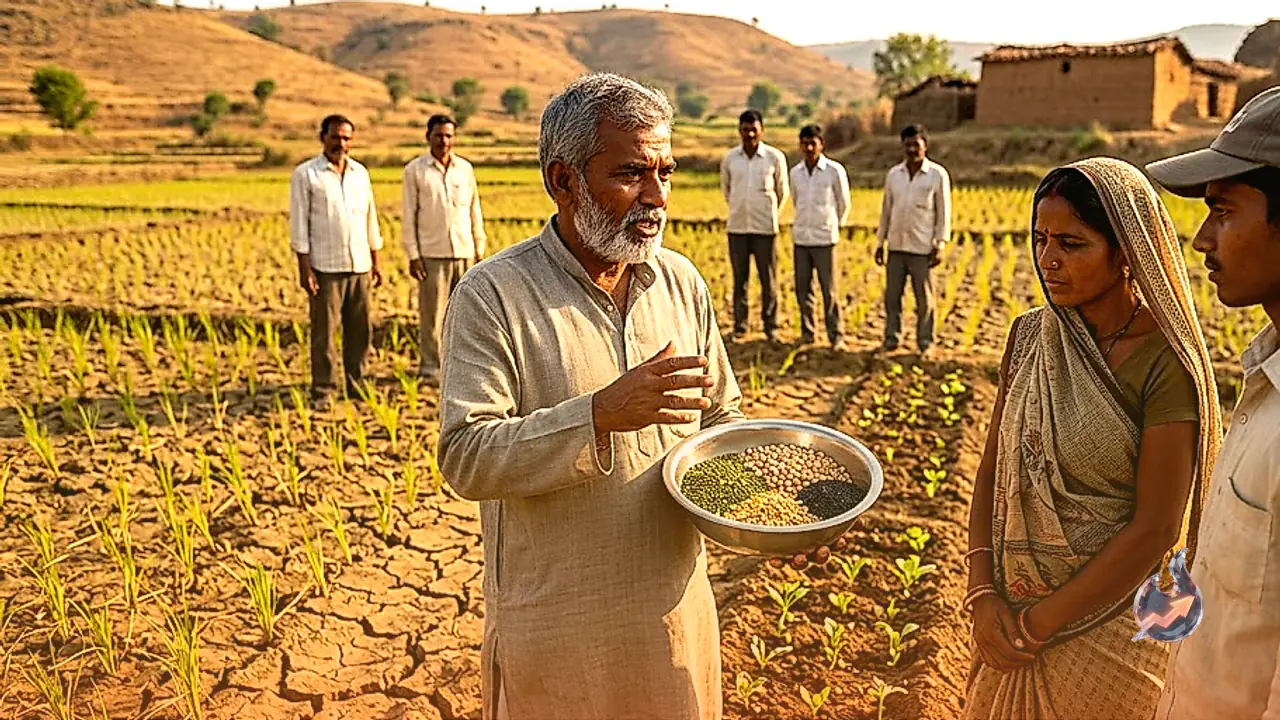

Farmers in Sidhi district of Madhya Pradesh are growing anxious as the monsoon has slowed down considerably this season. The Vindhya region has not received adequate rainfall so far, and this shortfall is directly hitting the sowing of kharif crops, including paddy. With soil moisture running low across fields, many farmers are unsure how to plan their next steps. Amid this uncertainty, Rajendra Prasad Singh, a progressive farmer from Veerkham village in Rewa district, has advised fellow farmers to adjust their cropping strategy according to the weather.
Shift toward short-duration varieties
Rajendra Prasad Singh says that if there is a likelihood of below-normal rainfall in the coming days, farmers should avoid long-duration paddy varieties and instead switch to varieties that mature in a shorter period, calling it a far safer choice. According to him, the delayed arrival of the monsoon has meant that fields have not yet built up sufficient moisture. In such conditions, if farmers go ahead and plant traditional long-duration paddy varieties, the overall yield could suffer badly if the weather turns unfavourable later. Short-duration varieties, on the other hand, not only cut down this risk but also tend to deliver better output within the available time.
Advice to intercrop pulses and oilseeds with paddy
Rajendra Prasad Singh has also suggested that, alongside paddy, farmers should definitely sow pulses and oilseeds such as arhar, soybean, moong and sesame. His reasoning is that if rainfall stays below normal, these crops will become an additional source of income and help offset the potential losses in paddy production. In effect, farmers would no longer be relying on a single crop but would be spreading their risk across multiple ones.
If rain improves, the crops still pay off as green manure
Rajendra Prasad Singh explains that if good rainfall arrives later and the paddy crop reaches a satisfactory stage, farmers need not harvest the pulse and oilseed crops for grain at all. Instead, these can be ploughed back into the field as green manure. Doing so raises the level of organic carbon in the soil, improves its fertility, and leaves the field more productive for the crops grown in subsequent seasons. In other words, crops sown as insurance against a poor monsoon are never wasted, they end up benefiting the farmer either way.
How nitrogen fixation boosts soil fertility
Agricultural experts also agree that pulse crops fix atmospheric nitrogen into the soil. This is precisely why growing them naturally improves soil fertility and reduces farmers' dependence on chemical fertilisers over time. The direct benefit of this is lower cultivation costs, along with better long-term production capacity of the land. This approach, therefore, pays off not just in the current season but across several seasons to come.
A dual safety net amid an unpredictable monsoon
In this period of shifting weather patterns and an uncertain monsoon, intercropping paddy with pulses and oilseeds is emerging as a kind of dual safety net for farmers. When rainfall falls short, these crops become a source of extra income; when rainfall is good, the same crops improve soil health and make future farming more profitable. This is why farmers across the Vindhya region are adopting this advice in an effort to protect both their income and their soil amid the ongoing monsoon uncertainty.