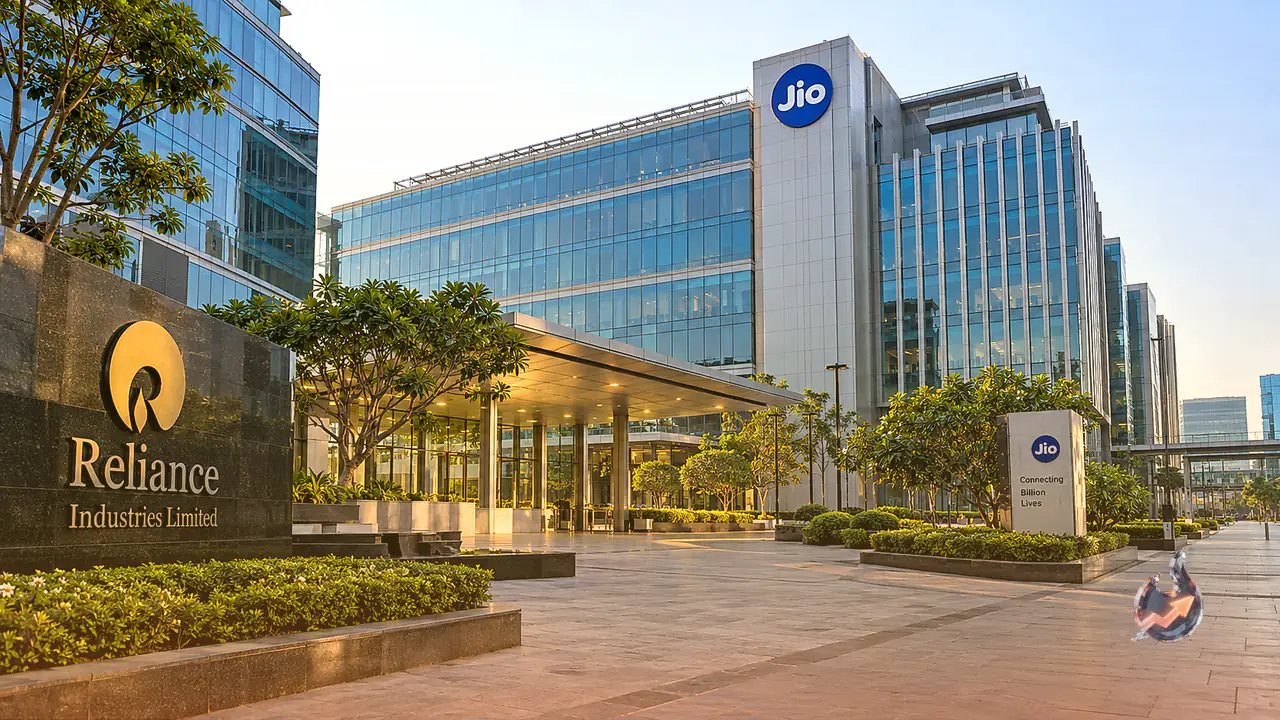
























Having completely reshaped India's digital landscape by commoditizing high-speed mobile data, Jio Platforms is executing a strategic pivot designed to elevate the enterprise onto the world stage. Strong participation from domestic and global institutional investors during its initial public offering has affirmed Wall Street's confidence in the group's long-term commercial trajectory. Rather than settling for the identity of a conventional telecommunications carrier, the company is assembling an expansive ecosystem spanning artificial intelligence (AI), cloud architecture, Internet of Things (IoT), satellite connectivity, and 6G research. This coordinated technological push mirrors the historical rise of Asian conglomerates such as South Korea's Samsung and SK Hynix, as well as Japan's Sony.
The central ambition behind this capital deployment is the creation of homegrown software, hardware protocols, and digital platforms engineered to contest market share outside domestic borders. By engineering solutions capable of holding their own against established multinationals, the conglomerate seeks to position India as a premier hub for globally competitive tech enterprises. Its massive customer base, extensive physical fiber networks, and in-house development talent provide the foundational leverage required to transition from a regional utility into an international powerhouse.
Landmark Market Capitalization and Asian Standing
On its first day of trading following the listing, Bloomberg tracking data revealed the entity reached an equity valuation hovering around $131 billion. That capitalization instantly turned it into the sixth-largest publicly listed telecom operator on the planet. The milestone allowed the company to leapfrog Bharti Airtel and take the second spot in Asia, trailing solely behind China Mobile.
Certain financial analysts place the current valuation closer to $135 billion, noting that the pricing reflects a premium usually reserved for diversified tech conglomerates rather than capital-intensive network providers. The market is pricing in the combined strength of vast consumer distribution channels, green-powered physical compute hubs, and homegrown intellectual property. Moving forward, the objective is taking platforms refined across millions of domestic users and pitching them directly to international enterprise clients.
Executive Vision for the Coming Decade
Articulating the strategic blueprint guiding this expansion, Managing Director Akash Ambani contrasted the past decade of democratization with future operational goals. Highlighting the ambition to push beyond baseline connectivity, Ambani stated, “In the next 10 years, we want to bring every technology that can transform the lives of Indians to the common people.”
This corporate mandate centers on integrating advanced machine intelligence, distributed cloud storage, connected consumer hardware, and space-based data links into daily workflows. Management is also targeting the commercialization of digital services that remain largely unimagined in mainstream enterprise settings today. The overarching goal is ensuring that ordinary consumers and small businesses access sophisticated productivity tools through seamless, indigenous digital pipelines.
The SpaceX Hybrid Approach and Telecom Infrastructure
Neil Shah, co-founder and research analyst at Counterpoint Research, observes that sophisticated capital markets have discarded the notion that this enterprise is merely a pipe provider. The corporate architecture combines high-speed 5G terrestrial spectrum with low-Earth orbit (LEO) satellite communications, proprietary AI modules, and proprietary media distribution. Furthermore, the group controls dedicated gigawatt-scale data center infrastructure powered by captive green energy supplies. According to Shah, unifying space-linked transmission, machine intelligence, and media brings the operational framework exceptionally close to the integrated blueprint pioneered by Elon Musk's SpaceX.
Shah further points out that by developing an in-house 4G and 5G network stack, automated network management algorithms, and active 6G patents, the enterprise has emerged as a direct technological alternative to legacy equipment vendors such as Ericsson, Nokia, and Samsung. Collaborations with international tech partners are already underway. The primary commercial upside now lies in productizing these proprietary telecom stacks and licensing them to foreign carriers, unlocking high-margin enterprise software revenue streams across global markets.
Engineering Scale Meets Western Market Headwinds
Analyzing the operational capabilities of the enterprise, Ambit Capital Research analyst Vivekanand S points to the organization's technical depth and historical talent for resolving large-scale infrastructural bottlenecks. The company commands an internal force of roughly 12,000 software and systems engineers, which sharply limits reliance on foreign third-party vendors and enables the rapid fabrication of custom solutions. The exact bundling play that captured the home broadband market by combining fiber connections with streaming entertainment is now poised for deployment across newer technical categories.
Nevertheless, significant structural hurdles remain before global leadership can be claimed. Vivekanand emphasizes that engineering a working system within a controlled domestic sandbox is fundamentally different from designing a universally adopted global product. Penetrating mature economies across North America and Western Europe presents immense competitive barriers due to the presence of entrenched legacy incumbents. To succeed, the group will have to isolate niche international pain points that are currently underserved. Only if an indigenously developed product achieves widespread cross-border adoption will the company firmly cement its status as a premier global tech titan.