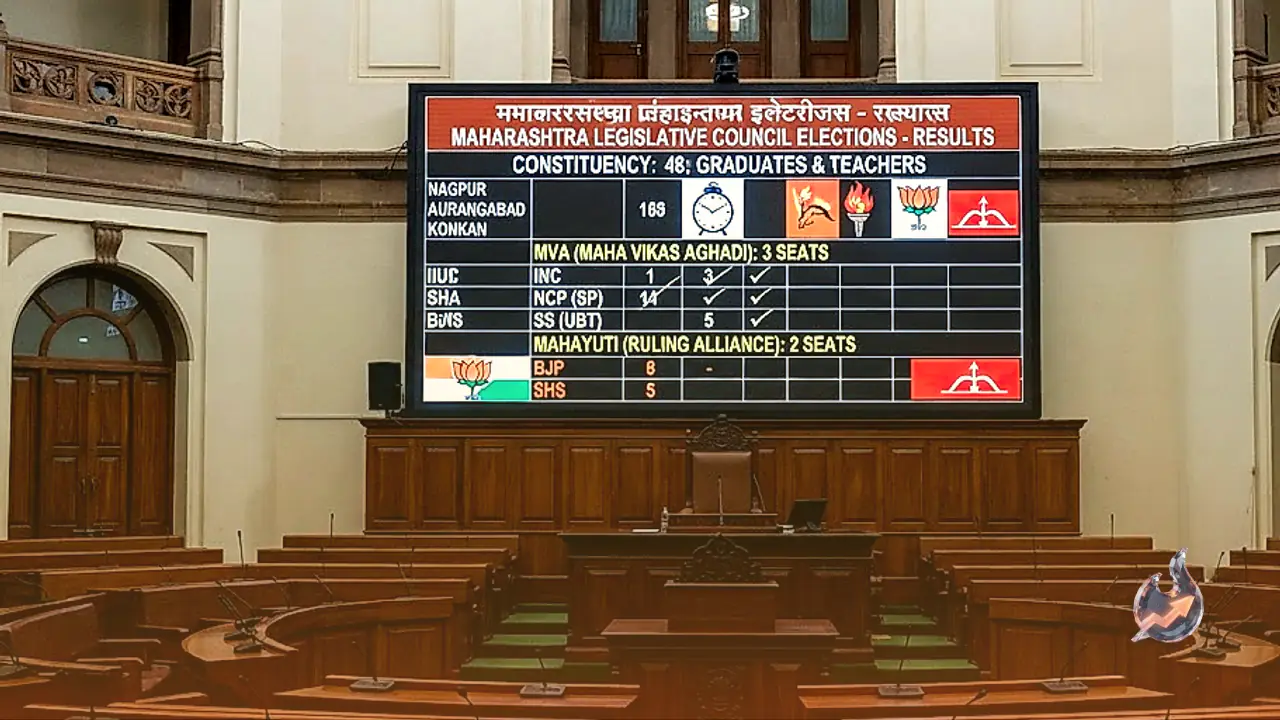



















The Bharatiya Janata Party has faced a significant electoral setback by losing the Nagpur division graduates constituency in the Maharashtra Legislative Council for the second consecutive term. The defeat has triggered deep introspection among the senior party leadership, primarily because Nagpur represents the geographical and ideological nerve centre of the organization as the headquarters of the Rashtriya Swayamsevak Sangh. Across the six districts comprising this division, the ruling Mahayuti coalition commands a massive legislative presence of 31 legislators spanning both the Legislative Assembly and Legislative Council. Despite having the Chief Minister, an influential Union Cabinet Minister, and multiple state ministers leading from the front, the party failed to recapture its historical bastion. Senior functionaries are now raising difficult questions with the state leadership, asking why 31 sitting lawmakers relied almost entirely on Chief Minister Devendra Fadnavis, Union Minister Nitin Gadkari, and Revenue Minister Chandrashekhar Bawankule rather than deploying their own localized machinery to secure a victory.
Why the Nagpur Defeat Resonates as a Massive Blow
In conventional Indian political discourse, an adage long applied to the Congress party was that only internal sabotage, not external rivals, could defeat it. Following the latest outcome in Nagpur, political commentators have begun applying that exact maxim to the Bharatiya Janata Party. The narrative gaining ground is that factional friction, open dissent, and sabotage from within have started undermining the party in its safest redoubts. The election laid bare deep fissures that had been simmering beneath the surface for months, manifesting as overt defiance once candidate tickets were finalized.
The symbolic importance of Nagpur makes this loss particularly stinging. Beyond serving as the headquarters of the RSS, Nagpur is the personal fortress of Chief Minister Devendra Fadnavis and Union Minister Nitin Gadkari. Ever since the party unveiled its official nominee, the local cadre fractured into competing factions. While a segment of the leadership expressed its resentment behind closed doors, another influential section moved into open confrontation. Despite the high decibel claims of data-driven booth management and sophisticated micro-planning, the election machinery failed to translate paper calculations into actual votes on ballot day.
Candidate Selection Turmoil and Internal Revolt
The groundwork for this electoral debacle was inadvertently laid nearly eighteen months prior to polling day. The party had entrusted the leadership of the graduate voter registration drive to Sudhakar Kohle, implicitly signalling that he would be rewarded with the official nomination. However, as the formal notification approached, several established stalwarts began actively staking their claims, including former legislator Anil Sole, Sudhir Dive, and Girish Deshmukh. The prospect of anointing a single aspirant without broad consensus ignited widespread friction across district units.
By the time nominations closed, open revolt broke out across multiple local committees. The situation deteriorated to such an extent that Chief Minister Devendra Fadnavis and Union Minister Nitin Gadkari had to personally intervene to douse the flames and appease disaffected leaders. Among grassroots foot soldiers, a feeling of alienation was pervasive. Many veteran workers felt sidelined by modern organizational shifts, perceiving the ticket allocation to Sudhakar Kohle as an outcome of Revenue Minister Chandrashekhar Bawankule's personal persistence rather than democratic consensus. Feeling discarded, a substantial number of dedicated booth-level cadres withdrew from active campaigning and confined themselves to their homes.
Disruption of Caste Equations and Core Voter Discontent
For decades, the Nagpur division graduates constituency possessed a distinct political identity rooted in continuous representation from the Brahmin community, dating back to the era of the Bharatiya Jana Sangh. Stalwarts such as former Jana Sangh president Bachhraj Vyas, the Chief Minister's father Gangadhar Rao Fadnavis, Union Minister Nitin Gadkari, and former legislators Anil Sole and Sandeep Joshi all hailed from this demographic. This continuity established a rock solid foundation that weathered numerous political shifts across six uninterrupted decades.
The electoral balance was disrupted in 2020 when the Congress shattered that 58-year hegemony by framing the contest around a Brahmin versus Other Backward Class binary, successfully capturing the seat. In an attempt to reclaim ground and assimilate the broader backward class vote bank, the BJP chose to nominate Sudhakar Kohle, a prominent leader from the Kunbi community. However, this demographic recalibration backfired strategically. The core Brahmin electorate felt alienated after decades of unconditional loyalty, interpreting the move as an abandonment of their community's historical representation. Consequently, traditional party sympathizers displayed evident apathy during both voter enlistment and final turnout.
Preferential Voting Blunders and Strategic Overconfidence
Elections for graduates constituencies follow the single transferable vote system, where mastering the math of second and subsequent preference votes is essential for victory. The campaign leadership exhibited profound overconfidence, directing its entire grassroots effort solely toward securing first preference votes. Campaign managers operated under the mistaken conviction that Sudhakar Kohle would cross the statutory victory threshold in the very first round of counting, entirely neglecting secondary preference outreach.
Because the party remained convinced of a first round knockout, it never established communication channels with independent aspirants or minor contenders to negotiate mutual second preference support. Conversely, Congress nominee Abhijit Vanjari implemented a highly methodical, inclusive campaign. Vanjari systematically approached graduate voters who favoured alternative candidates, persuading them to mark Congress as their second preference. When independent candidate Nitesh Karale emerged as a potent challenger, amassing more than 26,066 votes, Vanjari's outreach delivered massive dividends. Roughly 80 percent of Karale's second preference ballots transferred directly to the Congress nominee, neutralizing the BJP's initial margins and handing the opposition a decisive victory.
The Mystery of 9,000 Invalid Ballots Marked with Number Two
The statistical breakdown of rejected ballots revealed an extraordinary anomaly that has become the focal point of post-poll investigations. Out of 15,032 invalid ballots recorded during counting, approximately 9,000 were disqualified for an identical technical error: voters had marked the numeral 2 instead of 1 against the BJP candidate's name. In an electorate composed exclusively of formally educated degree holders, such an overwhelming concentration of basic clerical errors raised serious suspicions of coordinated sabotage.
City party president Dayashankar Tiwari admitted that significant confusion had unfolded at polling booths. On the ballot paper, Sudhakar Kohle's name was printed at serial position 2. Tiwari revealed that numerous polling personnel inside the booths were themselves unacquainted with the mechanics of preferential voting. When confused voters inquired how to cast their vote for their favoured nominee, officials instructed them to write the candidate's serial number against their name. Misled by this directive, thousands of pro-BJP voters penned the number 2 instead of indicating their first choice, rendering their ballots completely void. Tiwari emphasized that had those 9,000 ballots correctly registered the numeral 1, the party would have easily coasted to victory.
Congress Unity and the Educational Influence Network
While the Congress party in the Vidarbha region is historically plagued by internal rivalries, its leadership demonstrated unprecedented cohesion throughout this election cycle. Prominent factional leaders submerged their personal rivalries to present a completely unified front. Lawmakers including Vikas Thakre, state unit chief Nana Patole, senior leader Vijay Wadettiwar, and former minister Nitin Raut actively took charge of campaigning within their respective geographic pockets, ensuring total cadre mobilization.
In addition to political harmony, Abhijit Vanjari leveraged an extensive professional ecosystem. As the head of several major educational institutions across Nagpur and surrounding districts, Vanjari maintains deep ties with thousands of academicians, non-teaching personnel, and alumni associations. This social network, colloquially known as the Mitra Parivar, transcends formal party boundaries and includes influential leaders from diverse political factions. The quiet, personalized mobilization orchestrated through these collegiate circles yielded an organic wave of non-partisan support that the BJP's institutional machinery completely failed to counter.
Party Office Bearers Acknowledge Planning Deficiencies
In the aftermath of the verdict, organizational heads have conceded serious shortcomings in ground execution. Nagpur city BJP president Dayashankar Tiwari stated that the leadership had calculated an intake of 75,000 votes through its micro-planning model, but the candidate managed to secure only 67,000 valid votes. Tiwari acknowledged that booth workers fell short in educating registered graduates on the fundamental mechanics of marking ballot papers outside the polling stations.
Tiwari also conceded that completely disregarding second preference votes was an unforced tactical error. He explained that because all independent and opposition contestants appeared ideologically aligned against the ruling party, planners prematurely assumed that secondary preferences would never flow toward the BJP. Tiwari reflected that had the campaign systematically courted second preference ballots, securing the requisite 3,000 additional votes was entirely feasible. He affirmed that the organizational failure lay in neglecting basic voter education prior to polling day rather than widespread individual desertions.
Administrative Obstacles for Veteran Core Graduates
Former Nagpur West legislator Sudhakar Deshmukh, who previously served as the election coordinator for Union Minister Nitin Gadkari across multiple campaigns, illuminated a critical systemic reason behind voter attrition. Deshmukh explained that following administrative reforms introduced around 2020, the Election Commission mandates the creation of entirely fresh electoral rolls before every graduates constituency poll, dissolving all legacy voter lists.
According to Deshmukh, a major portion of the party's ideological base consists of senior citizens and professionals who graduated 40 to 45 years ago. Under the assumption that their names remained permanently enrolled as in general parliamentary or assembly elections, many core supporters did not take the initiative to register afresh. When party volunteers reached out, several elderly graduates were unable to locate their four-decade-old graduation degree certificates or found the verification process cumbersome. Consequently, thousands of reliable, lifelong party loyalists were completely excluded from the electoral rolls, substantially shrinking the core turnout on voting day.