























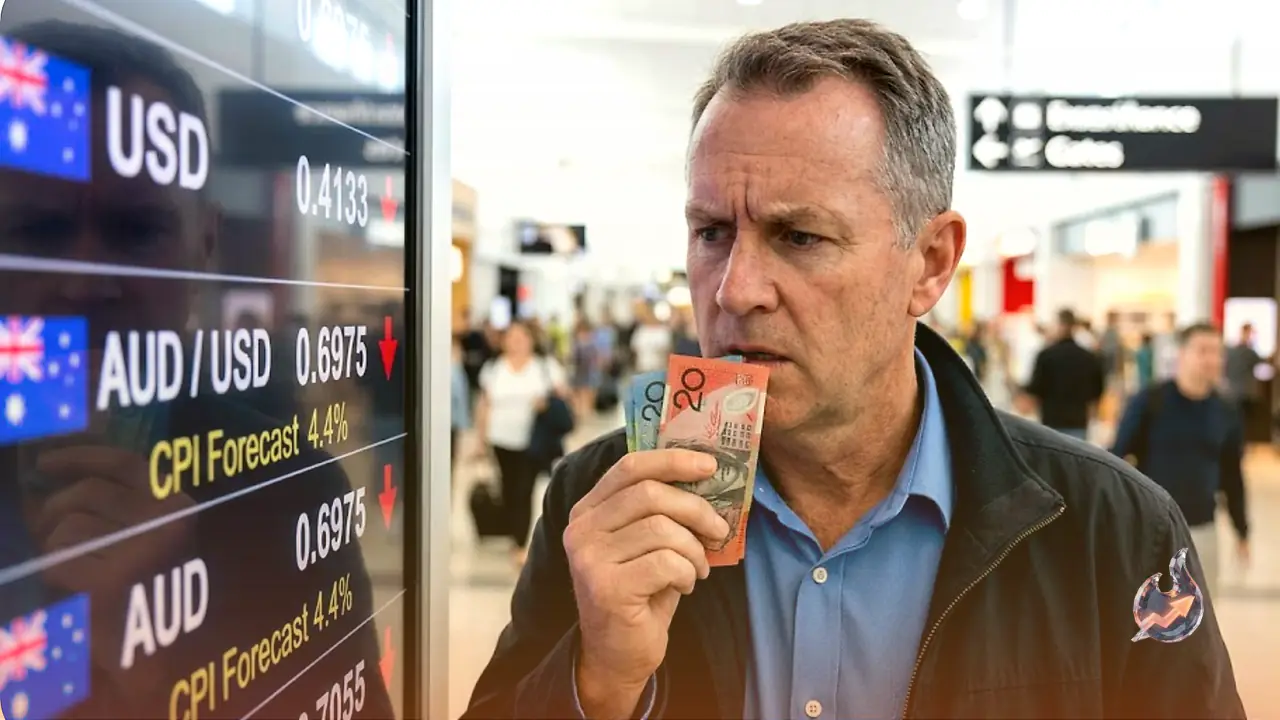

At 01:30 GMT on Wednesday, the Australian Bureau of Statistics (ABS) will release the high-impact Consumer Price Index (CPI) for May, and markets are bracing for the result. Walking into the test, the Australian Dollar is already at its weakest against the US Dollar in two months, having given up the psychologically important 0.7000 mark.
What the May numbers may reveal
Australia's annual CPI is expected to climb to 4.4% in May, up from 4.2% in April, edging closer to the near three-year high of 4.6% recorded in March. Curiously, the monthly CPI is seen falling by 0.3% over the same period, a sharp turn from the 0.4% increase reported earlier.
The measure the Reserve Bank of Australia (RBA) watches most closely, the Trimmed Mean CPI, is also tipped to firm slightly. It could rise to 3.5% year-over-year (YoY) from 3.4%, while the month-over-month (MoM) reading is expected to hold steady at 0.3%.
Why the annual and monthly figures point different ways
With annual inflation accelerating but the monthly figure falling, the split comes down largely to fuel. Petrol prices dropped roughly 12% over the month, helped by easing global oil prices and a domestic fuel excise cut that is set to expire this month.
On the other side of the ledger, new dwelling costs and rents are likely to push housing inflation higher. That is why the Trimmed Mean figures will be picked apart closely, to gauge whether the second-round pass-through from the Middle East energy shock is spreading into the broader services and housing basket.
The RBA's balancing act
The data lands just after the RBA kept the Official Cash Rate (OCR) at 4.35% last week, pausing after three consecutive rate hikes since the start of the year. The bank made its concern plain, saying the board remains focused on ensuring that inflation does not become embedded once the impulse from higher oil prices has passed through.
If the headline looks soft purely because of cheaper fuel while underlying inflation stays stubbornly high, the RBA will stay on high alert and the prospect of further hikes will remain alive. If, instead, price pressures genuinely ease, expectations of the RBA resuming rate hikes later this year would fade, adding further weight on the Australian Dollar.
Oil and the Middle East factor
Since the RBA's policy meeting, geopolitical tensions have cooled somewhat. The United States and Iran struck a peace deal, sending oil prices sharply lower. That could help relieve pressure on Australian inflation in the months ahead.
Where the Aussie Dollar stands on the charts
The near-term bias for AUD/USD stays bearish. The pair is holding beneath the 21-day, 50-day and 100-day Simple Moving Averages (SMAs), clustered between 0.7070 and 0.7135. It sits only above the 200-day SMA at 0.6855, the last meaningful layer of trend support, while the Relative Strength Index (RSI) at 32 is approaching oversold territory, hinting that downside momentum is stretched but not yet exhausted.
On the topside, initial resistance lines up with the 21-day SMA at 0.7077, followed closely by the 100-day SMA at 0.7085, with the 50-day SMA higher up at 0.7136 reinforcing a broader cap on recovery attempts. On the downside, the 200-day SMA at 0.6855 is the key support to watch. A decisive break below this longer-term level would likely open the door to a deeper slide in the coming sessions.
What really drives the Australian Dollar
The single biggest factor for the Australian Dollar is the level of interest rates set by the RBA. Relatively high rates compared with other major central banks support the AUD, while lower rates do the opposite. The RBA's main goal is to keep inflation stable at 2-3% by moving rates up or down, and it can also use quantitative easing and tightening to shape credit conditions, the former negative for the AUD and the latter positive.
Because Australia is a resource-rich country, the price of its biggest export, Iron Ore, matters too. According to 2021 data, Iron Ore accounts for $118 billion a year in exports, with China as the primary buyer. As a rule, when Iron Ore prices rise the AUD tends to rise with them, and the reverse is true when they fall. Higher prices also raise the odds of a positive Trade Balance, another plus for the currency.
China is Australia's largest trading partner, so the health of the Chinese economy weighs directly on the AUD. When China is doing well, it buys more raw materials and goods from Australia, lifting demand for the currency, and weaker-than-expected Chinese growth does the opposite. The Trade Balance, the gap between export earnings and import spending, is another key lever: a surplus strengthens the AUD, a deficit weakens it. Market sentiment also plays a part, with a risk-on mood, when investors reach for riskier assets, being positive for the Aussie.