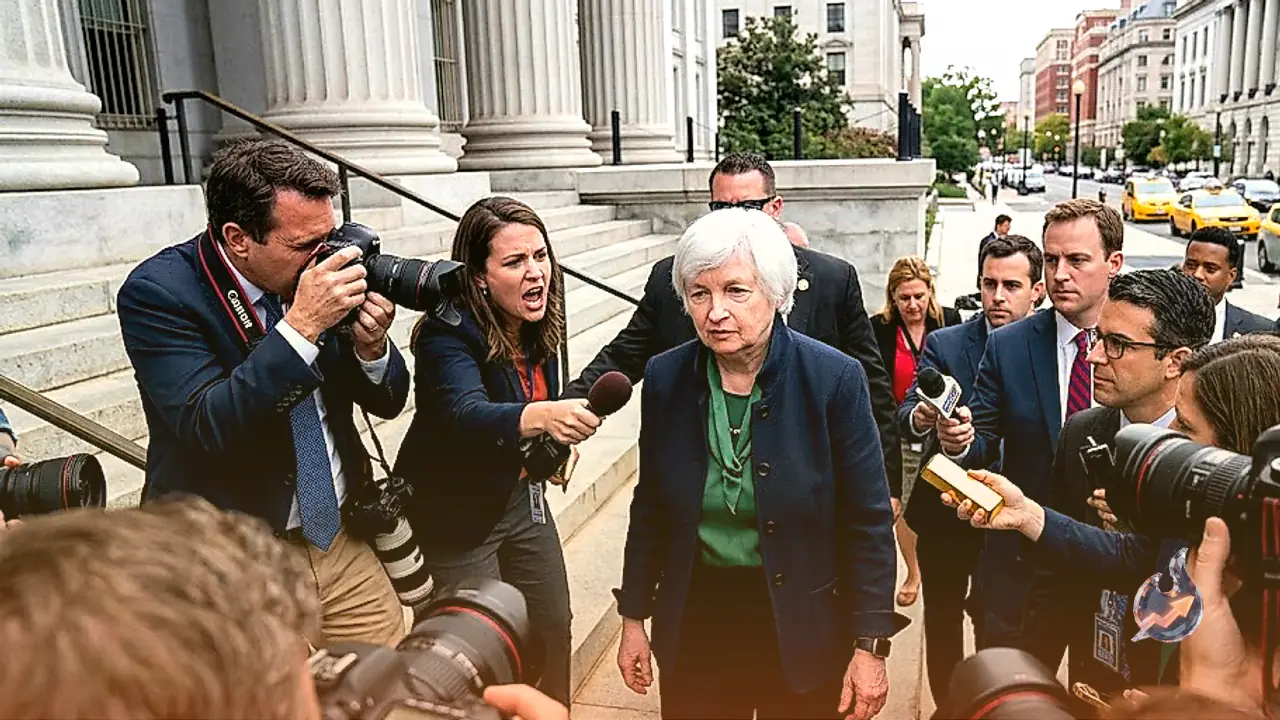

























The British Pound witnessed a strong rally against the US Dollar during Friday trading, climbing past 1.3670 to hit its highest level in six months. The impressive surge in GBP/USD was primarily fueled by upbeat business activity data from the United Kingdom, which offset weaker performance in retail sales. At the same time, the US Dollar faced sustained downward pressure as financial markets reacted to plans announced by the US Treasury regarding an expansion of its long-term bond buyback operations.
Strong UK Services Output Lifts Sterling to Multi-Month Highs
The primary driver behind the Sterling rally was the preliminary Purchasing Managers Index (PMI) survey released by S&P Global for July. The data revealed that business activity in the UK services sector expanded at its fastest pace since February. July's Services PMI rose to 52.8, up from 52.1 recorded in June. This reading comfortably surpassed consensus market forecasts, which had anticipated a slight decline to 51.8.
In contrast to the buoyant services economy, UK manufacturing activity experienced a slowdown during the same period. The Manufacturing PMI dipped to 51.5 in July from 51.9 in June. However, this moderation was fully in line with market expectations. Combining both sectors, the Composite PMI ticked upward to 52.5 in July from 52.2 in the previous month, easily outperforming market projections of a slowdown to 51.6. The robust composite figure underscored underlying resilience in the broader UK business landscape, giving foreign exchange traders fresh confidence to bid up Sterling.
Retail Sales Contract and Net Borrowing Exceeds Forecasts
The strong PMI performance stood out against a backdrop of mixed economic indicators released earlier in the trading session. Figures published by National Statistics showed that UK retail consumption contracted by 0.5% on a month-on-month basis in July. This contraction met consensus forecasts and marked a sharp reversal from the 0.7% growth recorded in June.
On an annualized basis, UK retail sales grew by 1.6% in July, reflecting a substantial deceleration from the 3.8% annual pace registered in June. This figure also fell short of market expectations, which had penciled in a 2.2% expansion. Meanwhile, public finance data indicated that UK Public Sector Net Borrowing increased by GBP 1.8 billion in July. Although this figure represented a dramatic reduction from June's borrowing total of GBP 12.78 billion, it nevertheless exceeded analyst expectations of GBP 0.3 billion. Despite these fiscal and retail headwinds, currency markets remained focused on the positive momentum in the services sector.
US Treasury Buyback Expansion Keeps Dollar on the Defensive
While UK economic data provided fundamental support to Sterling, ongoing weakness in the US Dollar added further momentum to the GBP/USD pair. The greenback remained on the defensive across major currency pairs following recent developments involving the US Treasury Department. US Treasury Secretary Scott Bessent confirmed on Thursday that future bond buyback operations could increase beyond the limit announced earlier in the week.
The Treasury Department had shifted off its standard operational calendar on Wednesday at 12:32 GMT by announcing plans to double its liquidity support buybacks for long-term government debt. Specifically targeting the 10-year to 20-year and 20-year to 30-year maturity sectors, the department decided to raise the maximum purchase threshold from $2 billion per operation to at least $4 billion. Scheduled to take effect on September 9 and run through November 4, this significant expansion in bond buybacks injected additional liquidity into US debt markets, weighing heavily on Treasury yields and dampening demand for the US Dollar.
Broader Market Impact: EUR/USD and Gold Hold Firm
The persistent weakness in the US Dollar resonated across wider global markets during the European session on Friday. EUR/USD consolidated its recent weekly gains around the 1.1700 level following mixed preliminary PMI reports from Germany and the broader Eurozone. Market participants kept a close watch on upcoming US preliminary PMI surveys, with the dollar's subdued tone providing underlying support for the euro.
Commodity markets also reflected the soft dollar environment. Gold maintained modest gains near its highest level since early June, holding firm just above $4,550 per ounce. The precious metal built upon its technical breakout above the 200-day Simple Moving Average (SMA). Gold's upward trajectory was further reinforced after traders scaled back expectations of an immediate interest rate hike by the Federal Reserve, following last week's US inflation data that signaled easing price pressures.
Technical Analysis and Key Currency Levels
From a technical standpoint, GBP/USD currently trades around 1.3650 after posting a 0.30% gain for the session, operating well within its 52-week trading range of 1.30 to 1.38. The technical structure remains firmly constructive, with price trading above key moving averages. The 20-day Exponential Moving Average (EMA) stands at 1.35, while both the 50-day EMA and 200-day EMA are aligned at 1.34, maintaining a bullish golden cross configuration.
Momentum indicators point to strong bullish action. The 14-day Relative Strength Index (RSI) reads at 69, nearing overbought territory, while the Moving Average Convergence Divergence (MACD) shows a bullish value of 0.01 above its signal line of 0.00. The Average Directional Index (ADX) sits at 30, confirming an active directional trend. Bollinger Bands bound price between 1.33 and 1.37. Key levels for traders to monitor include the central pivot level at 1.36, immediate resistance targets at R1 and R2 around 1.37, and technical support levels at S1 and S2 around 1.36.