























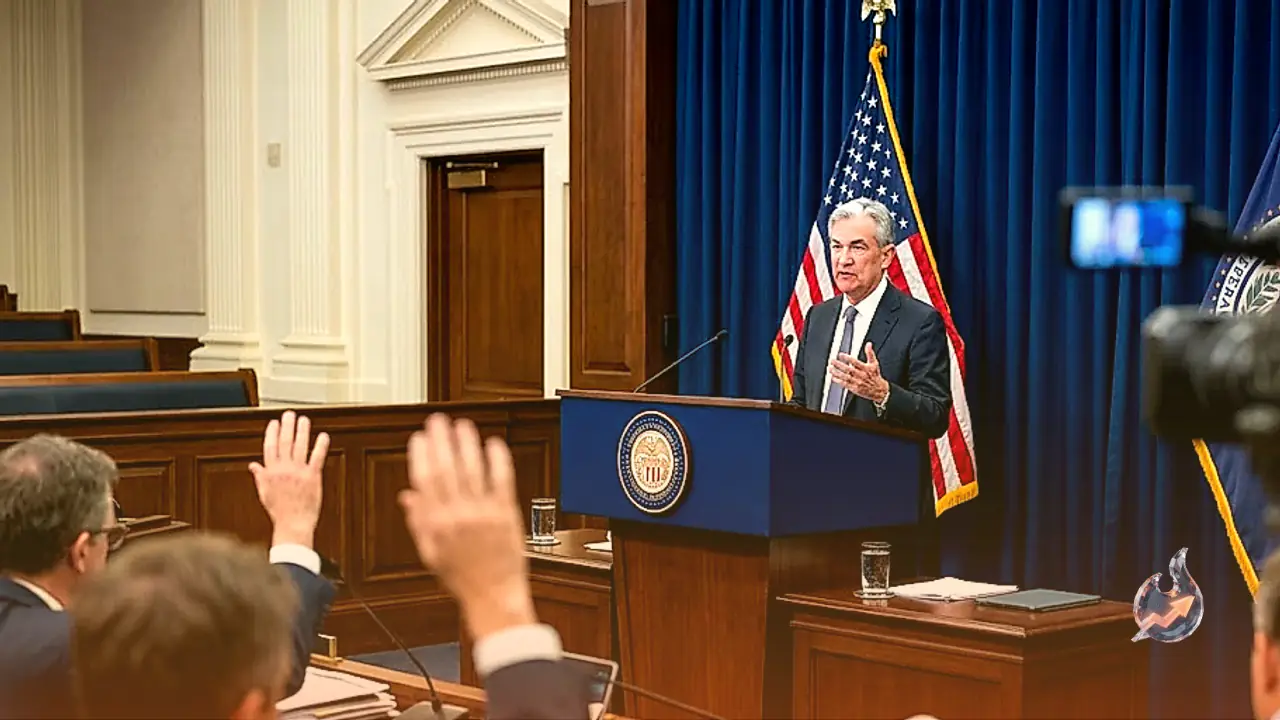

The United States Federal Reserve is scheduled to publish the official minutes of the September Federal Open Market Committee (FOMC) meeting on Wednesday at 18:00 GMT. Financial market participants across global asset classes are closely watching the document to gauge the speed, magnitude, and potential schedule of further interest rate hikes, following the central bank's decision in September to execute its first monetary policy tightening move in three years.
September Rate Increase and Hawkish Guidance
During the September 15-16 policy meeting, the FOMC aligned with broad market projections by unanimously voting to lift the benchmark federal funds rate by 25 basis points to a target band of 3.75% to 4.00%. In the subsequent press briefing, Chair Kevin Warsh delivered an unequivocally hawkish message, marking a notable departure from his standard hesitation toward providing extensive forward guidance. Warsh underlined that inflationary pressures have remained excessively elevated for too long.
The formal policy statement reinforced this stance, reiterating the committee's strict objective of achieving price stability and steering inflation back toward its 2% benchmark target. The decisive communication bolstered market confidence in the institution's policy independence, triggering a broad-based rally in the greenback. The US Dollar Index (DXY), which tracks the currency against a basket of six major international peers, climbed roughly 3.4% across a four-week span, touching an 18-month peak of 102.50.
Economic Data and Shifting Hike Probabilities
Initial signs of robustness across the employment landscape had initially stoked market expectations for consecutive rate increases across successive meetings. However, incoming macroeconomic data has prompted investors to recalibrate those assumptions. Based on the CME FedWatch Tool, the probability of the central bank keeping the benchmark rate unchanged at its October gathering has increased to 78%, up from 50% in the prior week, leaving the implied odds of an immediate October hike at just 20%. Conversely, expectations for at least one additional rate increase before the end of the year remain firmly anchored at an 80% to 85% probability, centering attention primarily on the December gathering.
The August Personal Consumption Expenditures (PCE) Price Index indicated that underlying inflation held steady, affording policymakers room to observe the lagged effects of the September tightening move. Furthermore, the September Nonfarm Payrolls figures introduced caution regarding the resilience of the labor market, adding weight to the prospect of an October pause. At the same time, broader business conditions remain relatively sturdy. The US ISM Services Purchasing Managers' Index (PMI) moderated slightly but retained levels reflective of sustained business expansion. Concurrently, the Atlanta Fed's GDPNow forecasting model projected third-quarter annualized economic expansion at 3.7%, accelerating from the 2.2% pace recorded in the second quarter.
Diverging Perspectives Among Policy Officials
Speeches from high-ranking Federal Reserve policymakers over recent days have highlighted differing views regarding the immediate sequence of policy adjustments. Chicago Fed President Austan Goolsbee expressed the view that prevailing inflation dynamics currently take precedence over labor market concerns. Dallas Fed President Lorie Logan similarly argued that further rate increases will likely be necessary to bring price growth sustainably back toward target levels.
In contrast, Vice Chair for Supervision Michelle Bowman suggested that there is no pressing requirement to implement additional rate hikes within the remainder of the calendar year, a perspective echoed by New York Fed President John Williams. Research analysts at ING characterized recent macroeconomic releases as moderately hawkish without structurally changing the broader policy framework. ING noted that market participants will likely remain comfortable with an October hold provided that the September core Consumer Price Index prints near the consensus expectation of 0.2% month-over-month, maintaining a December rate hike as the primary baseline scenario.
Dollar Technical Structure and Key Price Levels
From a technical analysis perspective, the daily chart of the US Dollar Index displays an upward channel originating from early September troughs. While the 14-day Relative Strength Index (RSI) in overbought territory flags the possibility of temporary consolidation or a modest technical pullback, the Moving Average Convergence Divergence (MACD) indicator maintains a positive configuration, suggesting underlying buying appetite on price dips.
The DXY advance encountered intermediate resistance around the 102.50 threshold, corresponding to the 127.7% Fibonacci retracement of the July-August downswing. On extended upside momentum, the 103.20 region (the March 2025 lows) and the 161.8% Fibonacci level at 103.60 stand as subsequent hurdles. On the downside, pullbacks remain supported above former year-to-date highs near 101.80, with a decisive break below that zone bringing the September 25 low at 100.90 and the psychological 100.00 level back into technical consideration.
Global Market Dynamics: Currencies, Gold, and Digital Assets
The interplay of firm Treasury yields and the robust US Dollar continues to reverberate across multiple international asset classes
- Gold and Precious Metals: Gold retreated toward the $4,000 per troy ounce threshold following earlier gains, pressured by the climb in sovereign bond yields and Dollar strength. Higher interest rates elevate the opportunity cost of maintaining non-yielding bullion holdings. Live market pricing places Gold at $4,123, down 1.53% from its previous close of $4,187, with daily trading bounded between key support at $4,077 and resistance at $4,183.
- Forex Pairs: The AUD/USD pair faced persistent downside bias below 0.7000 in Asian market trading. Meanwhile, USD/JPY hovered near a one-and-a-half-week peak around 158.50, influenced by dovish remarks from Bank of Japan officials and elevated US yields.
- Cryptocurrency Markets: Major digital tokens experienced downward corrections. Bitcoin (BTC) pulled back following resistance near $87,200, while Ethereum (ETH) moved toward support at $2,600 and Ripple (XRP) softened toward the $1.45 demand zone.
- European Central Bank: The European Central Bank faces policy friction as wider bond market developments execute tightening mechanics independently while regional inflation hovers near double the central target.