
























The Swiss Franc has recovered its poise against the US Dollar, regaining upward momentum following a temporary corrective pause. Downward pressure on the US currency continues to build as global market participants focus on the ballooning state of United States government debt. Concurrently, expectations that the Federal Reserve will hold benchmark interest rates steady at its upcoming September meeting are curbing attempts by the Greenback to stage a decisive rally.
US Treasury Debt Buyback Strategy and Yield Reactions
In a direct move to manage rising borrowing costs, the US Department of the Treasury revealed details on Wednesday at 12:32 GMT regarding an expansion of its debt repayment and market liquidity support operations. The department will double its buyback pace across 10-year to 20-year and 20-year to 30-year bond sectors, increasing the maximum threshold from $2 billion to at least $4 billion per operation. This active phase will run from September 9 through November 4. The initial market reaction triggered a sharp pullback in both US Treasury yields and the US Dollar index.
However, bond yields subsequently recovered a substantial portion of their declines as institutional investors observed that the government's bond-buying initiative acts primarily as a short-term liquidity mechanism rather than a structural fix for federal debt expansion. Analysis from BBH points out that the additional buyback volume will likely be funded at the margin via expanded Treasury bill issuance. While the combination of increased short-term bill supply and long-bond purchases suggests a flatter yield curve, BBH highlights that the total operational footprint remains modest relative to the broader $31.4 trillion Treasury market. Meanwhile, broader debt levels approaching the $40 trillion threshold continue to draw attention toward risks in the $1.4 trillion private credit sector.
Technical Structure and Live Levels for USD/CHF
On the daily chart, USD/CHF trades around the 0.7990 pivot mark, with live market pricing holding near 0.7997 (+0.24% over the previous close of 0.7978). The currency pair remains constrained beneath its 20-day Exponential Moving Average (EMA) located at 0.8080 (live EMA at 0.8088), maintaining a clear bearish near-term bias. The 52-week trading bounds span between 0.7629 and 0.8205. Although a foundational long-term uptrend support line extending from 0.7609 remains intact beneath current spot prices, trading below short-term moving averages indicates that upside attempts face overhead supply.
The Relative Strength Index (RSI) at 38.8 (live RSI at 39) continues to drift in bearish territory without reaching oversold levels, implying that selling pressure can persist without immediate momentum exhaustion. Primary downside support is established at 0.7990 (live S1 at 0.7987, S2 at 0.7976), followed by the former trendline breakdown zone near 0.7922. Conversely, the 20-day EMA at 0.8080 serves as the primary resistance ceiling (live R1 at 0.8006, R2 at 0.8015). Only a sustained daily close above this resistance hurdle would alleviate current downside risks and open room for structural recovery.
Federal Reserve Policy Mandate and Dollar Reserve Status
Monetary policy directed by the Federal Reserve remains the primary fundamental driver of US Dollar valuations. Operating under a dual mandate from Congress, the Fed seeks to maintain price stability by targeting 2% inflation while promoting maximum employment. When inflationary forces exceed the 2% threshold, the Fed implements interest rate hikes to bolster currency value. Conversely, economic slowdowns or elevated unemployment prompt rate reductions, which tend to weaken the currency.
Under extreme economic stress, the Fed can resort to Quantitative Easing (QE), creating liquidity to purchase government bonds directly from financial institutions, a strategy deployed extensively during the 2008 Great Financial Crisis that expanded money supply and weighed on the Dollar. In contrast, Quantitative Tightening (QT) reduces bond holdings and reinvestments, providing underlying support to currency valuations. As the world's primary reserve currency since replacing the British Pound post-World War II and departing the Gold Standard via the 1971 Bretton Woods Agreement, the US Dollar continues to dominate foreign exchange, accounting for over 88% of daily turnover across an average of $6.6 trillion in daily transactions based on 2022 benchmarks.
Cross-Asset Movements in Foreign Exchange and Commodities
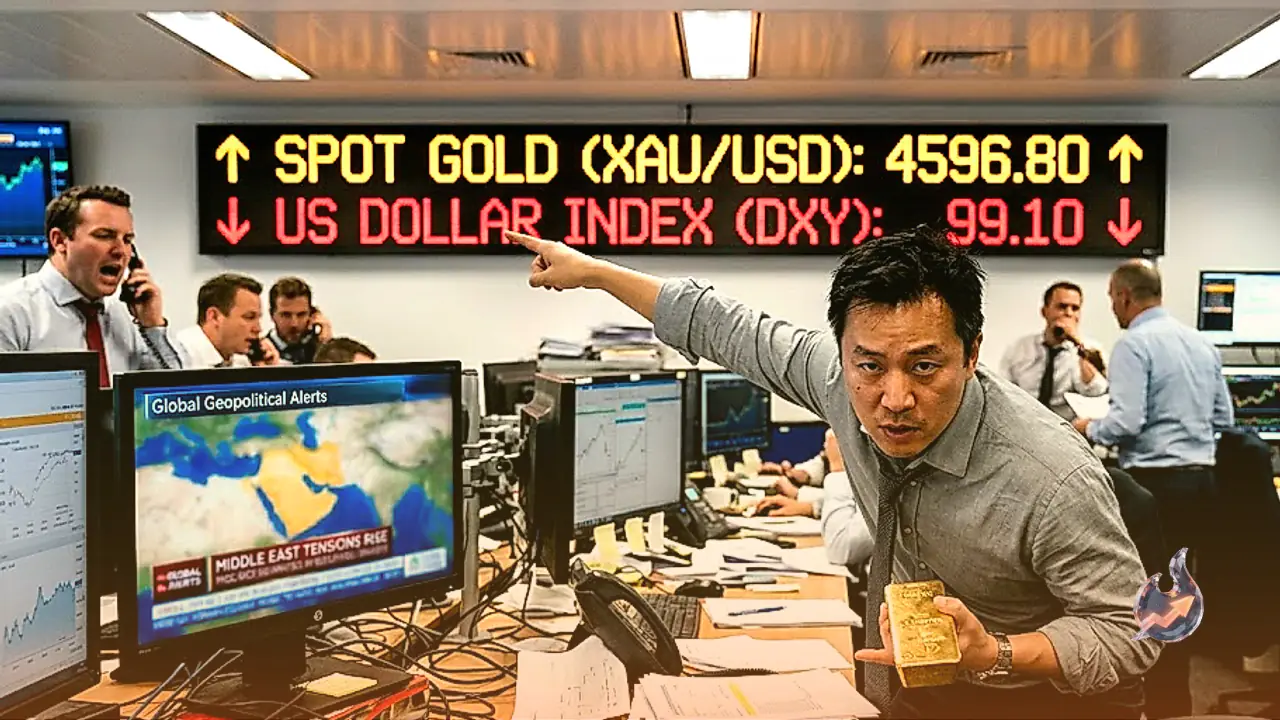
Across the wider currency landscape, GBP/USD gave back portion of its earlier gains to retreat toward the 1.3630-1.3620 range on Thursday as traders await key UK economic releases. EUR/USD similarly relinquished early advances, slipping back into the sub-1.1700 area ahead of preliminary S&P Global Manufacturing and Services PMI reports. In commodity markets, Gold (XAU/USD) traded steadily above $4,500 during Friday's Asian session, remaining on track for its third consecutive weekly gain. While expectations of a Fed rate pause support non-yielding bullion, elevated Treasury yields driven by energy price volatility from the US-Iran standoff continue to influence broader market dynamics.