























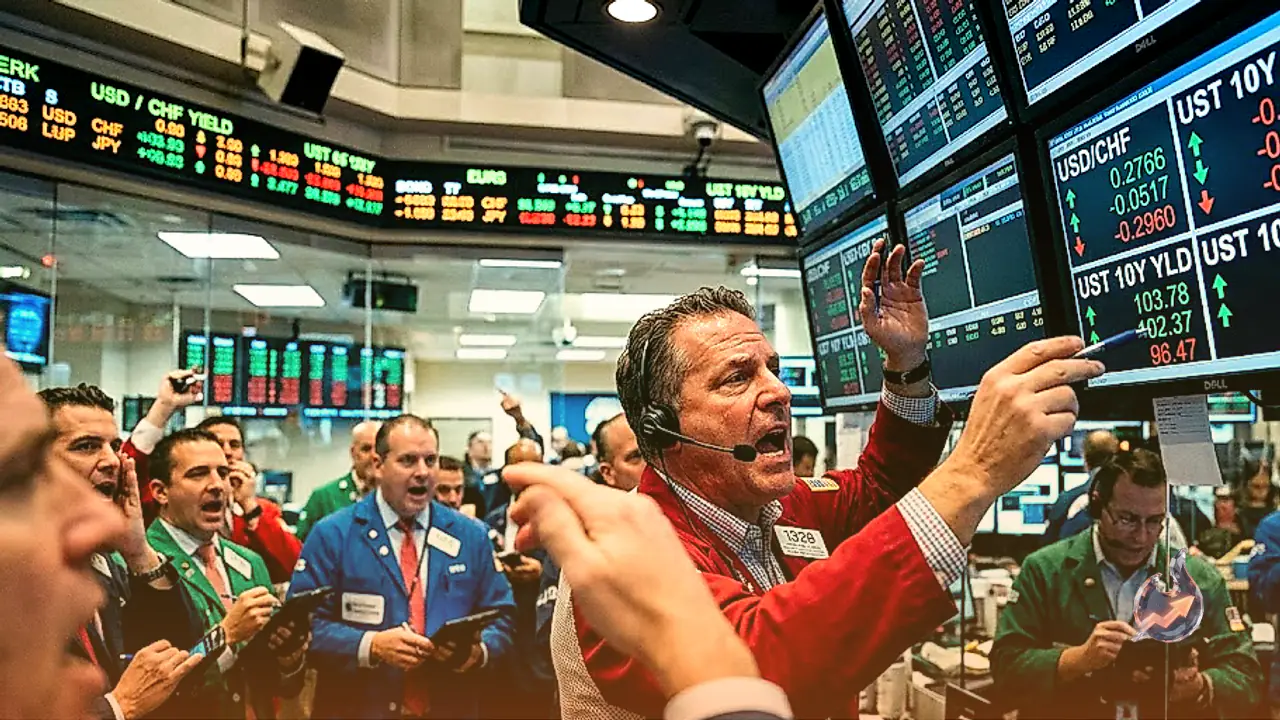

The US Dollar is gaining notable traction across global foreign exchange markets, causing the USD/CHF currency pair to advance for a second consecutive trading session. During Wednesday's Asian trading hours, USD/CHF hovered around the 0.8130 region. This upward movement in the greenback is primarily propelled by a sharp escalation in US Treasury yields alongside surging crude oil prices. Together, these developments have reignited market anxieties over persistent inflationary pressures and heightened the likelihood of further interest rate increases by the Federal Reserve.
Global Bond Selloff and Energy Price Shock
A widespread selloff in the international fixed-income market drove the benchmark US 10-year Treasury yield up to 4.80%, marking its highest point since early 2025. Adding fuel to these inflationary concerns, crude oil prices experienced a sharp rise following intensified military friction between the United States and Iran in the Middle East. Concerns regarding potential disruptions to regional energy supply routes have mounted rapidly. Higher energy expenses inevitably filter into transportation, manufacturing, and consumer prices, creating a challenging environment for central banks seeking to anchor inflation expectations. In response, market participants have pivoted toward the US Dollar, seeking both higher yields and safe-haven backing.
Swiss Economic Data vs Monetary Policy Realities
On the domestic front, economic activity indicators from Switzerland demonstrated resilience. The Swiss SVME Purchasing Managers' Index (PMI) bounced back strongly to 57.1 in August, rebounding from July's five-month low of 53.2 to register its strongest reading since May. Complementing this manufacturing rebound, July Real Retail Sales grew by 2.3% year-over-year, comfortably outperforming the consensus forecast of 1.3% and building upon June's revised 1.9% expansion rate. Nevertheless, these positive economic indicators have failed to provide substantial support to the Swiss Franc in FX markets.
Elias Haddad, Senior Currency Analyst at Brown Brothers Harriman, highlighted that Switzerland's subdued domestic inflation backdrop and the Swiss National Bank's (SNB) decision to maintain its policy rate at 0.00% continue to drag on the currency. Haddad pointed out that the Swiss Franc has earned the title of the worst-performing G10 currency during the current quarter. In an environment where major global central banks offer elevated yield returns, a zero-interest-rate regime weakens institutional appetite for holding CHF, leaving the currency vulnerable to capital outflows.
The Structural Mechanics of the Swiss Franc
The Swiss Franc (CHF) serves as the official legal tender of Switzerland and stands among the top ten most actively traded currencies worldwide. The daily transaction volume of CHF far exceeds the nominal size of the Swiss national economy. Its valuation is shaped by broad global market sentiment, domestic macroeconomic fundamentals, and monetary policy directives executed by the Swiss National Bank. Between 2011 and 2015, the SNB maintained a minimum exchange rate floor (peg) linking the Franc to the Euro (EUR). The sudden abandonment of this peg in January 2015 triggered a massive surge of over 20% in the Franc's value within minutes, sending shockwaves through global financial markets. Although the currency peg is no longer active, the Franc remains deeply connected to economic conditions within the Eurozone, with correlation models estimating an interdependence of over 90% between EUR and CHF trends.
Traditionally, international investors classify the Swiss Franc as a premier safe-haven currency. During periods of global economic turmoil, geopolitical escalation, or systemic market stress, capital historically flows into Switzerland. This reputation is anchored in Switzerland's robust macroeconomic environment, strong trade surplus, substantial central bank foreign exchange reserves, and long-established geopolitical neutrality. However, when global interest rate differentials widen significantly in favor of competing currencies like the US Dollar, the relative appeal of holding low-yielding safe-haven assets diminishes accordingly.
Swiss National Bank Policy Framework
The Swiss National Bank convenes its monetary policy assessment meetings four times per year—once every quarter—which is less frequent than the meeting schedules of the US Federal Reserve or the European Central Bank. The SNB operates with a clear mandate to maintain annual consumer price inflation below the 2% threshold. When inflationary pressures threaten to breach this target, the central bank responds by tightening policy rates. Higher interest rates enhance returns on Franc-denominated assets, attracting international capital. Conversely, when the policy rate remains anchored at 0.00%, the yield deficit discourages investment inflows, placing downward pressure on the currency's foreign exchange valuation.
Cross-Currency Dynamics: GBP/USD and EUR/USD
The broad strength of the US Dollar is exerting pressure across major currency pairs. The GBP/USD exchange rate retreated toward 1.3500 during early European trading on Wednesday. Heightened geopolitical anxiety in the Middle East provided safe-haven backing to the Dollar relative to the British Pound, with market participants eagerly awaiting the release of the US August non-farm payrolls report later on Friday. Similarly, the EUR/USD pair lost ground, easing toward 1.1575. A combination of a hawkish Federal Reserve outlook and ongoing geopolitical risks weighed heavily on the Euro. Traders are monitoring upcoming Eurozone Retail Sales data and US employment metrics for further directional cues.
Commodities Breakdown: Gold Decline and Crude Oil Rally
Precious metals faced renewed selling pressure as US Treasury yields surged. Gold extended its downward trajectory on Wednesday, burdened by the benchmark 10-year US Treasury yield climbing to a record high of 4.81% in Asian trading—the highest level recorded since November 2023. Precious metal investors are tracking the upcoming US ADP Employment Change figures for August to gauge economic momentum. In contrast, West Texas Intermediate (WTI) crude oil continued its upward trajectory, advancing for a third consecutive trading session and securing positive moves in five out of the last six sessions. WTI prices reached fresh peaks not seen since July 24, driven by market fears of energy supply disruptions in the Middle East.
Record Diesel Crack Spreads and Cryptocurrency Headwinds
While crude oil markets reflect heightened volatility, refined product markets are exhibiting even more dramatic movements. The US diesel crack spread—measuring the price margin between ultra-low sulfur diesel futures and WTI crude oil—surpassed $100 per barrel for the first time on record, climbing to an intraday high of just over $102.00. This historic spread underscores severe tightness in middle distillate refining capacity and industrial fuel supply chains.
Concurrently, the digital asset market experienced a pullback following significant gains earlier in August. Leading cryptocurrencies including Bitcoin (BTC), Ethereum (ETH), and Ripple (XRP) exhibited technical signs of momentum exhaustion. Ethereum suffered a sharp rejection near the $2,500 psychological resistance level, while XRP consolidated beneath critical support zones. Across all asset classes, global market behavior remains strongly influenced by US bond market yields, energy supply dynamics, and Federal Reserve interest rate expectations.