























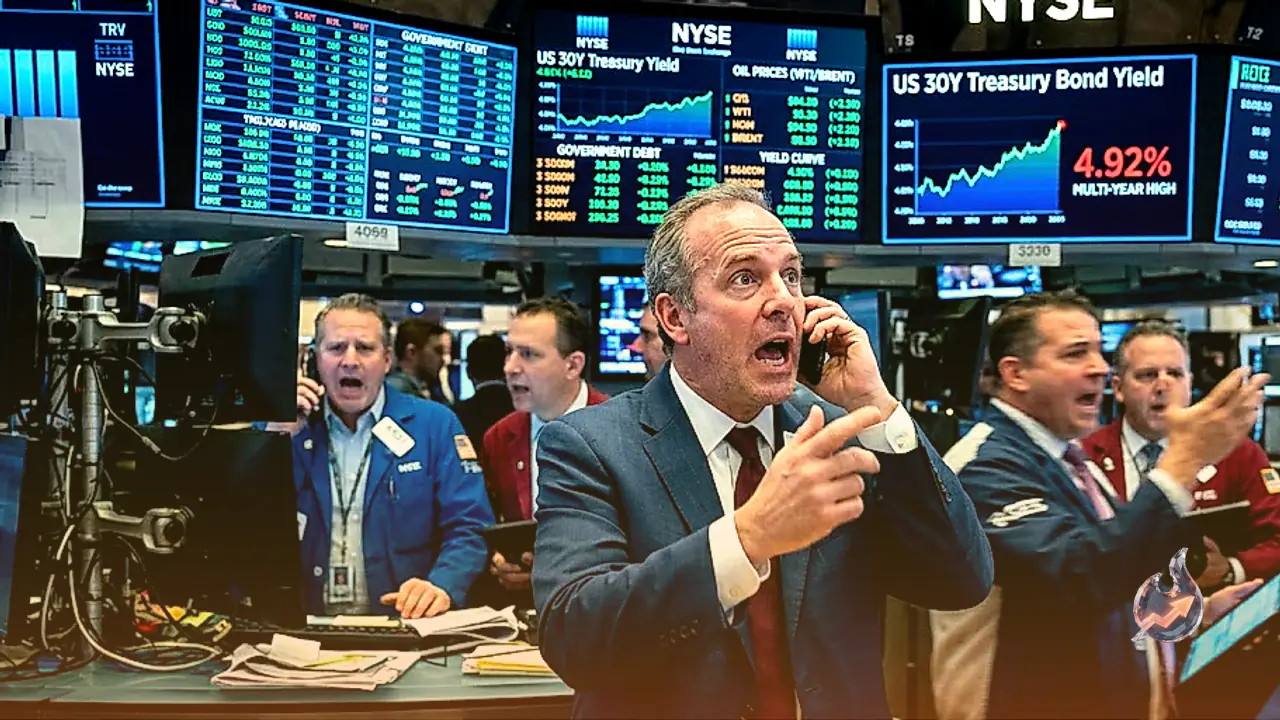

The United States fixed-income market is experiencing severe volatility as benchmark yields climb to levels not seen in over a decade and a half. Yields on 30-year US Treasury bonds have rallied sharply to reach their highest mark since the global financial crisis. Market participants attribute this upward pressure primarily to the ballooning volume of US government debt and widespread disappointment surrounding the Treasury Department's ongoing debt buyback initiatives. Compounding these fiscal pressures, crude oil prices marching toward the 100-dollar threshold are adding further strain to the broader bond market.
Surging Yields Across Multiple Maturities
The yield on the 30-year US Treasury note is currently trading above 5.3 percent, moving uncomfortably close to the historic highs recorded back in 2007 right before the collapse of Lehman Brothers. Meanwhile, the benchmark 10-year US Treasury yield touched a high of 4.865 percent during recent sessions, accumulating a substantial 25-basis-point rally in less than a fortnight and a full half-point increase since late June. Shorter-term maturities are also reflecting this aggressive shift, with two-year yields breaching the upper boundary of their established trading range for the past two years, hovering just below 4.5 percent.
Diverging Perspectives on the Bond Rally
While many observers point to fiscal credibility concerns, alternative viewpoints suggest different underlying drivers for the rally. Stephen Miran, appointed in 2025 as the chief of US economic advisors, argued in a financial commentary that the sharp increase in yields is a direct response to investor optimism regarding long-term economic growth prospects rather than any underlying anxiety regarding the credibility of fiscal authorities or central banking policies.
Estimates on Treasury Buyback Operations
Financial analysts at MUFG have evaluated the potential market impact of government intervention, estimating that if the Treasury maintains a consistent schedule of nine bond buybacks every quarter while purchasing up to 6 billion dollars in each operation, the total annual purchases could approach slightly over 200 billion dollars. However, experts caution that the longevity of these expanded purchase programs remains highly uncertain, leaving open the possibility that the scale of future operations could be adjusted upward.
Crude Oil Pressures and Regional Transit Risks
Adding fuel to the fire, surging crude oil prices are directly inflating the carrying costs of US government debt through persistent inflationary pressures. Brent crude prices have climbed to just cents below the closely monitored 100-dollar mark following reported military altercations involving oil tankers in the Middle East. These developments have severely disrupted maritime transit through the Strait of Hormuz, a critical trade corridor that historically accounted for roughly 20 percent of global oil supplies prior to the outbreak of regional conflicts.
Monetary Policy Mechanics at the Federal Reserve
United States monetary policy is steered by the Federal Reserve, which operates under a dual mandate to pursue price stability and foster maximum sustainable employment. To achieve these statutory objectives, the central bank primarily utilizes interest rate adjustments. When consumer prices accelerate too rapidly and inflation outpaces the established 2-percent target, the central bank typically raises interest rates to cool economic activity and increase borrowing costs across the board. This restrictive stance generally bolsters the US dollar by making domestic fixed-income assets more lucrative for global institutional investors.
Conversely, when price growth slows beneath the 2-percent objective or labor market conditions deteriorate significantly, the central bank may lower borrowing costs to stimulate economic expansion, a move that typically weighs on the currency. The policy-setting Federal Open Market Committee convenes eight times annually to review economic indicators and determine appropriate monetary adjustments.
Quantitative Measures and Balance Sheet Policy
In extraordinary financial circumstances, the Federal Reserve retains the authority to deploy non-standard monetary tools such as quantitative easing. This mechanism involves expanding credit availability within a locked financial system by printing new currency to purchase high-grade securities from financial institutions, a policy famously deployed during the 2008 financial crisis that generally exerts a softening effect on the US dollar. The inverse operation, known as quantitative tightening, involves allowing maturing assets to roll off the balance sheet without reinvestment, a process that typically strengthens the currency.