























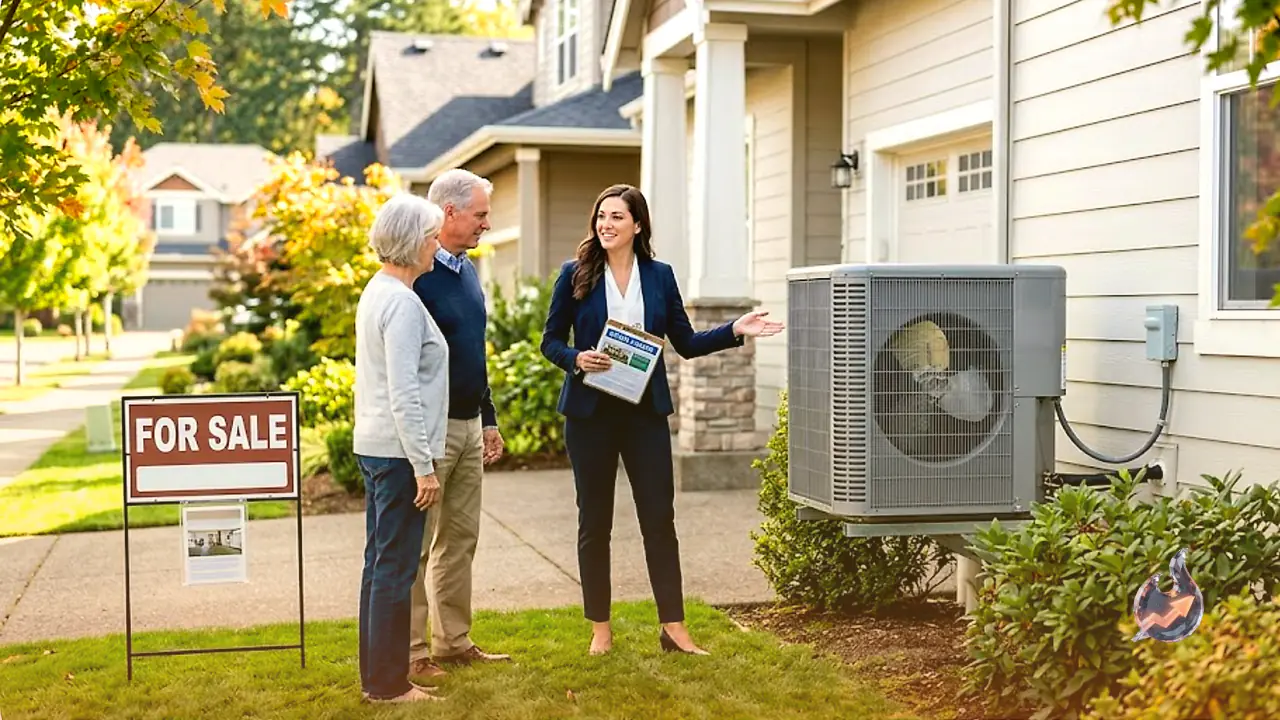

Selling a home involves countless decisions about what to highlight and what to leave out. A major new analysis suggests that one fact deserves prominent placement in every listing: whether the home has a heat pump. Sellers who mention it are walking away with thousands more at closing, while those who skip it are almost certainly leaving money behind.
What the Study Found
The findings come from a joint report by three organizations: the nonprofit Smart Energy Consumer Collaborative, which researches consumer attitudes and behaviors during the energy transition; 257, a customer-intelligence platform that profiles US residential property characteristics for contractors, utilities, and others; and the trade group the National Association of Realtors. Together, they analyzed more than half a million sales of US homes with ducted heat pumps between 2024 and 2025.
The pattern was clear: homes whose listings mentioned the heat pump sold for 0.6 percent to 1 percent more than comparable homes where the listing made no mention of the appliance. At a median sale price of $399,000, that gap works out to between $2,300 and $3,900 per home.
Scott Rosenberg, a cofounder and chief executive officer of 257, put the number in perspective. "Just shy of $4K doesn't sound like a lot of money on a home sale," he said. "But it's actually a meaningful piece of the investment that you made to get the heat pump in the first place."
The Cost of a Heat Pump and What Sellers Can Recover
In 2026, a ducted heat-pump system costs on average about $15,400, according to energy marketplace EnergySage, though prices can vary considerably depending on region, the size of the home, its electrical service, and the local contractor doing the work. For context, a comparable gas furnace plus central AC system can run about half that amount, according to home services platform Angi. With the listing-price bump factored in, sellers who mention their heat pump can effectively recover about 15 percent to 25 percent of what they originally spent on it.
The financial argument for heat pumps goes beyond what they add to a sale price. These systems handle both heating and cooling from a single unit and are typically two to four times more energy-efficient than conventional furnaces. Because they operate without combustion, they produce no toxic byproducts, carry no carbon monoxide risk, and avoid the climate impact associated with gas or oil systems. Over time, that efficiency also translates to lower monthly utility bills.
For most homeowners, economics is the deciding factor. "A homeowner who puts a garage on, redoes their bathroom, improves their kitchen, always thinks, 'Am I going to get this value back?'" Rosenberg said. The data now suggests the answer for heat pumps is yes.
How the Analysis Was Conducted
The methodology behind the findings was designed to account for the enormous complexity of real estate pricing. Every home is different, and buyers routinely pay more for particular floor plans, neighborhood character, or scenic views. Isolating the effect of a heat pump listing mention requires comparing homes that are nearly identical in every other way.
To accomplish this, 257 applied a machine learning technique that grouped homes into clusters based on hundreds of shared attributes. Within each cluster, the team then compared sale prices for homes where the heat pump was mentioned in the listing against those where it was not. Rosenberg is confident in the results because of both the rigor of this approach and the sheer scale of the data involved.
An Earlier Study Found an Even Bigger Premium
Yueming "Lucy" Qiu, an economics professor at the University of Maryland, described the new report as "very valuable" for quantifying what buyers are willing to pay for heat pumps. "I'm actually very happy that this came out," she said. Qiu had explored similar territory years earlier, though at a smaller geographic scale.
In 2020, Qiu and her colleagues published a peer-reviewed paper in Nature Energy examining home sales across 23 states between 2000 and 2018. Their focus was on homes that had sold both before and after a heat pump was installed. By comparing the change in those sale prices, adjusted for inflation, against the trajectories of homes that never received a heat pump, they could isolate the contribution of the appliance itself.
Their results pointed to a significantly larger premium: homes with heat pumps sold for 4 percent to 7 percent more, a gain of $10,400 to $17,000 based on an average home price of $240,000 at the time.
That figure is considerably higher than what the 257 report identified, but the discrepancy reflects the different questions each study asked. Qiu's team wanted to know the total value a heat pump adds to a home. Rosenberg's team was asking a narrower question: for homes that already have a heat pump, what does it matter whether the listing says so?
"We weren't trying to make the case for energy efficiency but rather to study whether it's valued once it's there," Rosenberg said. Qiu said she would welcome a follow-up study in which 257 applies her original methodology to a portion of their dataset. "Just as a robust check to see if, using similar methods, they find a similar magnitude [to what] we do," she said.
Real Estate Agents Often Fail to Highlight Heat Pumps
One of the starkest numbers in the report is this: in homes that already have a ducted heat pump, the appliance is mentioned in the real estate listing just 8 percent of the time. That means nine out of ten sellers with a heat pump are missing out on thousands of dollars simply because no one wrote it into the listing.
Part of the reason may lie with the agents doing the writing. Matt Christopherson, director of business and consumer research at the National Association of Realtors, noted that homebuyers are increasingly asking about energy-efficient features, motivated not just by environmental concerns but by the practical desire to keep utility bills manageable. Yet despite that growing buyer interest, agents often struggle to translate the benefits of these systems into effective listing language.
The survey found that more than half of Realtors said they were "not too confident" or "not confident at all" in their ability to explain the advantages of heat pumps to clients. That confidence gap appears to be showing up directly in how homes get described when they go on the market.
A Virtuous Cycle Could Change the Picture
Rosenberg sees a path toward improvement. If agents come to understand that buyers are actively willing to pay a premium for homes with heat pumps and begin promoting these systems more consistently in their listings, he believes the effect will compound. "That'll have a virtuous-cycle effect of reinforcing and signaling to buyers that this is something they should pay attention to," he said.
The logic is straightforward: the more listings that feature heat pumps, the more buyers come to expect and seek them out, which drives up demand and prices further. For homeowners weighing whether to invest in a heat pump, this data offers a clearer picture than ever. The environmental and safety benefits have long been understood. Now there is concrete evidence that the financial case holds up at resale too, as long as someone remembers to put it in the listing.