




















Household and commercial consumers across India face a new set of cooking gas guidelines and potential tariff adjustments starting August 1, 2026. State-owned oil marketing companies (OMCs) will revise LPG cylinder prices on the first day of the month. Indian Oil, HPCL, and BPCL routinely assess rates for 5 kg, 10 kg, 14.2 kg, and 19 kg cylinders, taking into account prevailing international energy market conditions to increase, decrease, or freeze prices.
Surging Crude Oil Prices and August Tariff Expectations
Industry analysts point to a high probability of an LPG price hike for August 2026 driven by climbing global crude oil costs. Data from Trading Economics indicates that crude oil prices surged by 40% over the course of July due to escalating supply bottlenecks. Disruptions that initially centered around the Strait of Hormuz extended into the Red Sea, a vital maritime corridor handling millions of barrels of Saudi Arabian crude exports every day.
This upward pressure follows a brief period of relief in July 2026, when 19 kg commercial LPG cylinder prices were slashed by Rs 173 to Rs 183.50 across major cities. That rate revision represented the first price reduction for commercial gas cylinders in 2026. Consequently, July commercial rates stood at Rs 2,930 per cylinder in Delhi, Rs 2,885.50 in Mumbai, Rs 3,106 in Chennai, and Rs 3,081.50 in Kolkata. Domestic 14.2 kg LPG cylinder prices remained unchanged during July, selling at Rs 942 in Delhi, Rs 968 in Kolkata, Rs 941.50 in Mumbai, and Rs 957.50 in Chennai.
Aadhaar eKYC Mandates and Subsidy Cap Clarifications
Petroleum authorities and OMCs continue to drive completion of Aadhaar-based eKYC authentication to streamline subsidy disburse under the Pradhan Mantri Ujjwala Yojana (PMUY). Official clarifications specify that biometric eKYC authentication applies strictly to LPG consumers who have not yet completed the verification process. Non-PMUY customers who previously finalized their Aadhaar authentication are not required to repeat the process.
Furthermore, subsidy caps remain capped at 4 cylinder refills per year for Ujjwala beneficiaries during August 2026. The government previously reduced the subsidized quota from 9 cylinders per year down to 4 refills. Under this structure, Ujjwala households receive a subsidy of Rs 300 per cylinder on their first four refills of the year, translating to a maximum annual financial aid of Rs 1,200 per family.
Single Household Gas Policy and Mandatory PNG Surrender
Government policy mandates that any residential property located in an area with established piped natural gas (PNG) infrastructure must transition to PNG. Regulations enforce a strict 'one household, one cooking gas connection' rule, prohibiting consumers from maintaining active LPG and PNG supplies simultaneously.
Beyond standard relocation surrender protocols, customers who fully switch to PNG must formally terminate their Indane Gas, HP Gas, or Bharat Gas connections within a 30-day window. However, citizens who relocate in the future to non-PNG localities retain the right to obtain a transfer voucher, enabling them to restore standard LPG service.
Quick-Commerce Delivery and Lightweight Composite Cylinders
July introduced instant delivery models for lightweight gas cylinders via quick-commerce platforms. Urban consumers can now order 5 kg and 10 kg LPG units through on-demand delivery applications like Instamart.
A partnership between Swiggy and HPCL led to the launch of the HP Navya 10 kg composite cylinder. Both the HP Navya and the 5 kg HP Appu Gas metal cylinder are listed on Swiggy Instamart for residents in Bengaluru. Customers place orders via the mobile application, selecting either composite or metal mini-cylinders with choices for online payment or cash on delivery.
Simultaneously, BPCL unveiled 'Bharatgas Lite ZIP', a premium Free Trade LPG (FTL) service emphasizing rapid new connection setup and express delivery. On July 25, Indian Oil introduced 'Indane XTRALITE NOW', a 10 kg composite LPG cylinder featuring a rust-free, translucent casing that allows users to monitor gas levels directly. The service includes express delivery within 4 hours of booking, customizable delivery time slots, and streamlined documentation.
Digital Booking, OTP Verification, and Refill Lock-in Periods
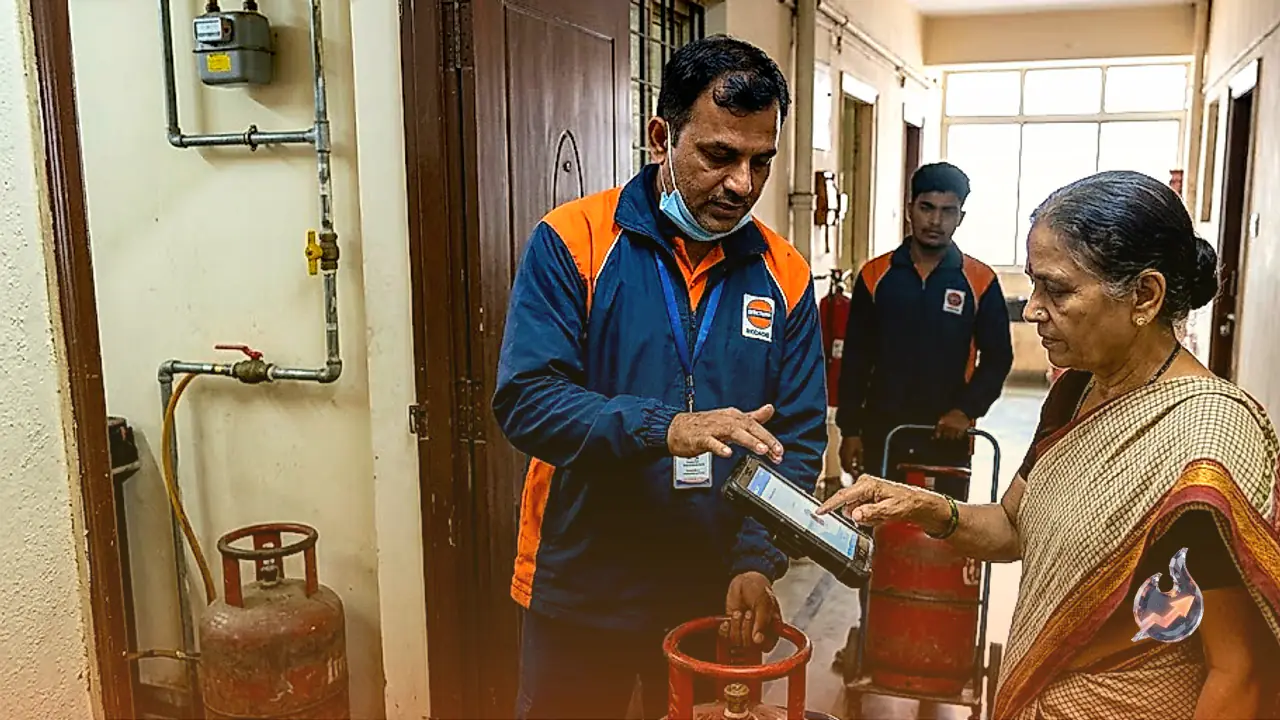
Standard booking and security protocols remain operational across all distributors. Consumers are instructed to book refills using digital channels rather than visiting physical distribution centers, after which delivery personnel deliver cylinders directly to households.
To prevent unauthorized deliveries, a Delivery Authentication Code (DAC) or OTP is generated and sent to the customer's registered mobile number upon dispatch. Delivery drivers must collect and verify this OTP prior to handing over the cylinder; failure to provide the code results in the return of the shipment. Lastly, minimum refill lock-in intervals remain fixed at 25 days for urban consumers and 45 days for rural households between successive bookings.