



















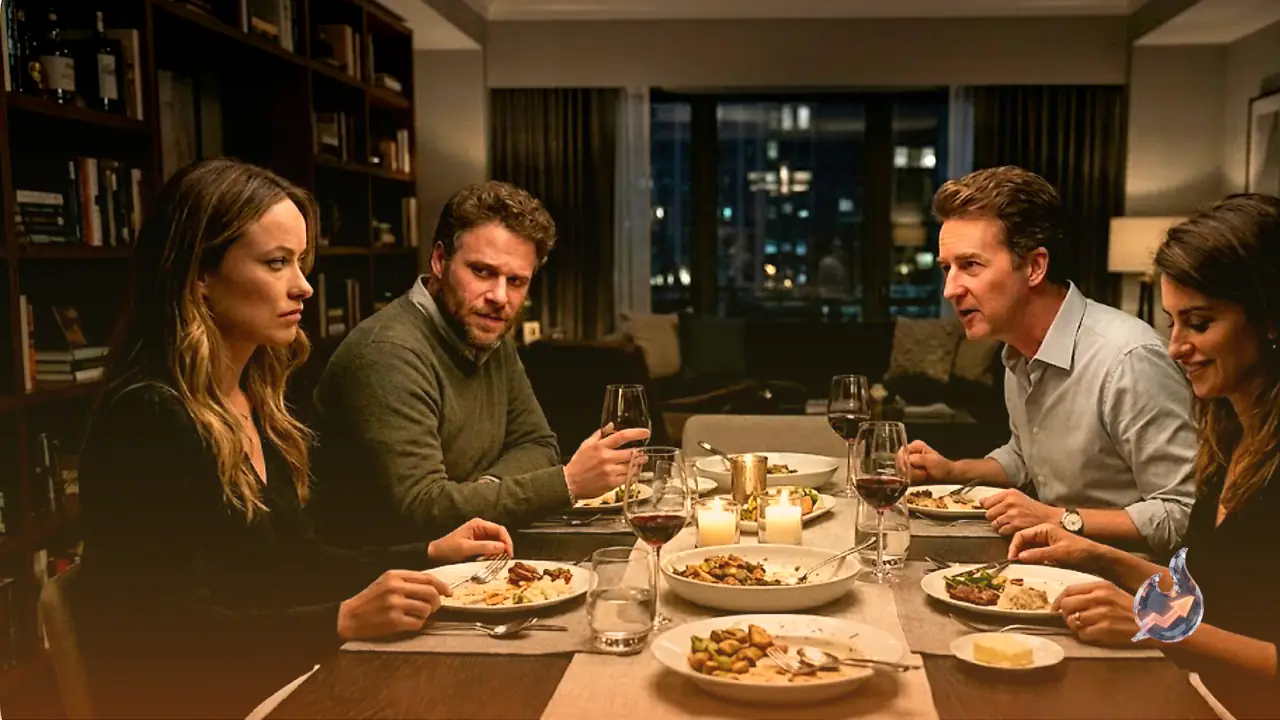

Most films about deteriorating relationships spend their time tracing how two people stopped understanding each other. The Invite has no interest in that question. It already knows the damage is done. What Olivia Wilde's film wants to do is observe what happens when two people stuck deep in that damage are placed in a confined space with two strangers, given wine and marijuana, and simply watched. The result is a comedy that is frequently funny and frequently difficult to sit with, often at exactly the same time.
The Script and Where It Came From
The screenplay is the work of writing partners Rashida Jones and Will McCormack, who made their names together on the 2012 divorce romcom Celeste And Jesse Forever. For The Invite, they have adapted Spanish filmmaker Cesc Gay's 2020 film Sentimental, which centers on a relentlessly quarrelsome married couple who invite their upstairs neighbours over for an evening of meat and cheese. The premise transfers faithfully, as does the film's key pivot: around halfway through the night, wine and weed have loosened everyone up considerably, and the conversation arrives at territory no one had planned to visit, pegging among the topics that come up.
Four Performances Worth Watching
Seth Rogen plays Joe in what might fairly be called peak disillusionment mode. Joe has quietly withdrawn from everything in his life: his job, his marriage, his own sense of purpose. He moves through each day with a sulky, petulant inertia, snapping and sulking in roughly equal measure. The performance works because Joe has absolutely no idea how far gone he is. Wilde plays Angela, his quite literally buttoned-up wife, a woman holding herself together through sheer determination, desperate for someone to notice and appreciate the decor she has so carefully put together. At their best, the two bicker. At their worst, they are at each other's throats, their accumulated small grievances amounting to something genuinely depressing.
When the neighbours arrive, they bring a different kind of problem. Edward Norton plays Hawk with a specific, effortless smugness: a man who appears to have arrived at some higher level of self-awareness and quietly wants everyone in the room to register that fact. Norton makes this quality feel entirely natural, which is where the skill lies. Penélope Cruz, blonde and gloriously unguarded as Pína, brings an unmistakably European bluntness to the evening that functions as its own kind of provocation. All four of these characters are fantastically annoying in their own particular ways. The film seems to suggest that this is not really a character flaw so much as a shared human condition.
Tonal Tightrope in a Closed Space
Wilde keeps all four of them inside the apartment and lets the pressure build. The evening becomes a kind of psychological trial, with resentments, frustrations, fears and barely suppressed desires surfacing one by one until everything is in the open and being thrown in faces. Sustaining this kind of tone is genuinely difficult work: The Invite has to stay funny while also being genuinely upsetting, and it manages that balance more consistently than not. The overlapping dialogue, much of it feeling spontaneously improvised, gives the film a naturalism that makes the cruelty land harder. There is also something warmer underneath all of it, a real sense that Wilde and her writers actually want good outcomes for all four of these people despite everything they do to each other. As vicious as it gets, the light finds its way in.
There are stretches where the script works a little too hard, the dialogue becoming slightly too constructed, slightly too theatrical, and some moments tip into broader comedy than the situation actually needs. These are passing problems rather than sustained ones and do not define the experience of watching the film.
Earning Its Place in Good Company
The stagnation of long relationships has generated some of cinema's most affecting and honest work. Eternal Sunshine Of The Spotless Mind, Before Midnight and Marriage Story each found their own distinct way into the particular grief of love that has quietly curdled. The Invite earns a place alongside them, not by matching their scale or ambition, but by bringing the same commitment to honesty and the same refusal to look away from what long-term unhappiness actually looks like from the inside. It gets there with all its heart and soul.