



















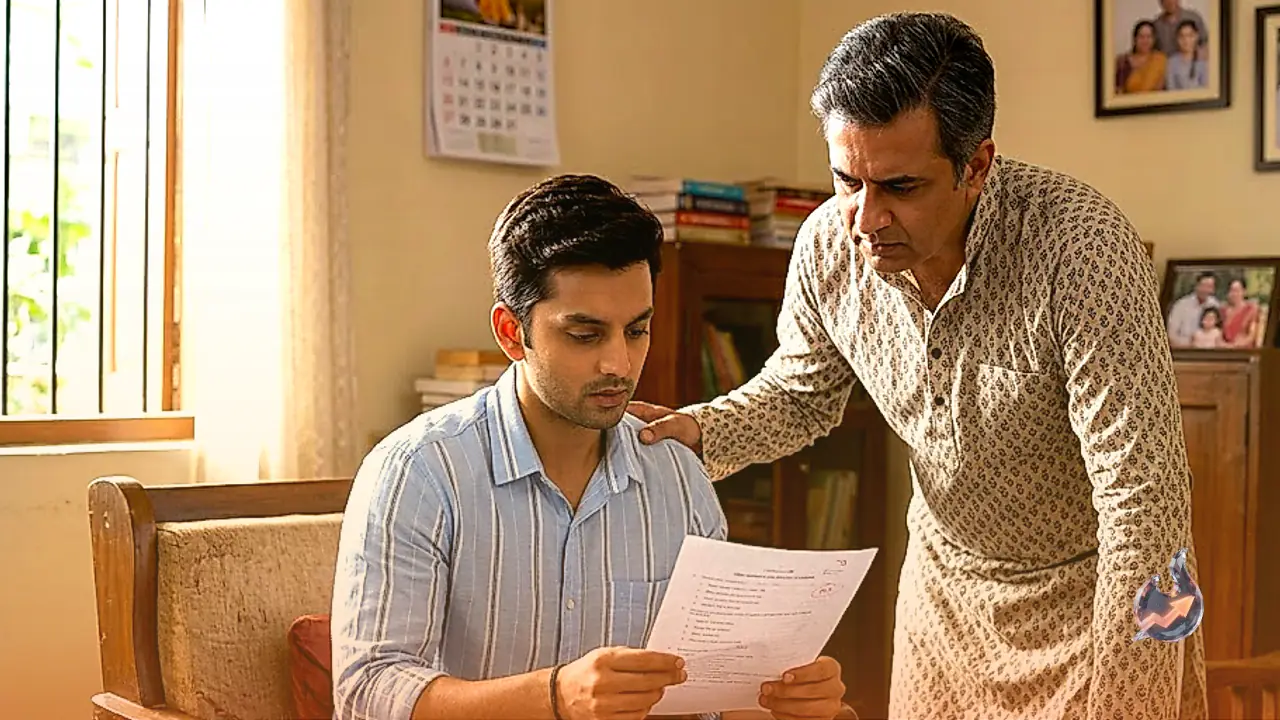

Whenever Indian cinema tackles the quiet desperation of ordinary citizens, the harsh mechanics of competitive examinations, and the crushing weight of societal judgment, audiences tend to respond with deep empathy. Recent benchmarks like '12th Fail' proved that straightforward, heart-felt storytelling centered on youth struggles resonates far more than glossy spectacle. Arriving in theaters on August 7, 2026, 'Aryabhatt Ka Zero' enters this narrative domain with a fresh perspective. Directed thoughtfully by Kamal Chandra, the film addresses a universal modern vulnerability: the fear of failure and the artificial benchmarks society uses to measure human worth. Over a tightly edited runtime of 1 hour and 54 minutes, the screenplay explores a young graduate's sense of inadequacy, a delicate father-son dynamic, and a journey toward self-realization. In this Aryabhatt Ka Zero review, we closely evaluate the film's structural strengths, performance nuance, and thematic resonance.
A Gritty Beginning in the Hub of Competitive Exams
The story opens with an intriguing flashback set across the bustling avenues of Mukherjee Nagar in Delhi, a renowned preparation hub for nationwide civil service exams. Amidst screaming police sirens and a distressed young man sprinting for safety, a commanding background voiceover sets the philosophical framework: asserting that some individuals are born heroes, some become villains, and the rest are dismissed as completely useless. This opening directly introduces the central protagonist, Brahmagupta Srivastava, affectionately known as Baggu, brought to life by Himansh Kohli. Hailing from a modest lower-middle-class family in Uttarakhand, Baggu is an unemployed university graduate caught in a downward spiral of uncertainty. His father, Aryabhatt Srivastava, portrayed by Neeraj Sood, works diligently as a Class IV government employee. While the father quietly harbors immense hopes for his son's future advancement, Baggu's continuous missteps seem to derail every opportunity.
Heartbreak, Societal Pressure, and the Pursuit of Redemption
The primary narrative catalyst occurs when Baggu's attractive girlfriend Rinku, played by Sonal Sehgal, makes a pragmatic life choice, leaving him behind to marry an established SDM officer. Devastated by the breakup, Baggu vows to outshine her new husband by cracking the rigorous UPSC examinations. Relocating to Delhi, he throws himself into intensive study, yet personal shortcomings and anxiety repeatedly drag him down into failure. As rejection notices pile up, local relatives and neighbors turn hostile, mocking his father by labeling Baggu as 'Aryabhatt Ka Zero'. The psychological impact of his father's diminishing faith, combined with relentless public humiliation, shatters Baggu's self-esteem, convincing him that he is indeed a complete failure. The second half of the movie traces his struggle to break free from these toxic labels and discover intrinsic strength beyond exam scores.
Realism in Direction and Screenplay Nuance
Director Kamal Chandra opts for a grounded, realistic aesthetic rather than relying on loud melodramatic tropes or heavy visual effects. He captures the subtle indignities and quiet resilience of middle-class households with genuine sincerity. The narrative structure is divided effectively: the first half balances Baggu's missteps, romantic rejection, and urban survival struggles with gentle observational humor, while the second half transitions into an introspective emotional drama. Screenwriter Tariq Mohammad crafts authentic dialogue, paying special attention to the uncomfortable silences and unspoken tension between father and son. The interactions feel natural and linger in the memory long after the credits roll. The film accurately portrays small-town social dynamics, bureaucracy, and domestic expectations.
Performance Breakdown and Supporting Cast
This project marks a significant career milestone for Himansh Kohli, who delivers a mature portrayal of an insecure young man grappling with inadequacy, helplessness, and sudden bursts of frustration. His facial expressions during emotional scenes convey palpable vulnerability. Neeraj Sood offers an equally compelling performance as the long-suffering father who absorbs public ridicule while remaining deeply concerned for his son's well-being. The shared screen time between Kohli and Sood serves as the emotional anchor of the movie. Meanwhile, Ravi Kishan brings vibrant energy and humor to his supporting role, lifting the momentum whenever he appears. Sonal Sehgal plays Rinku with sharp pragmatism, while Darshana Banik leaves a favorable impression in a brief appearance. The ensemble cast, including Shilpa Shinde, Rajesh Sharma, Alka Amin, Ishlin Prasad, and Naresh Vohra, adds texture and credibility to the story world.
Critical Flaws and Final Verdict
Despite its emotional core, the movie suffers from a few technical flaws. The pacing in the initial half feels sluggish, taking considerable time to establish its central conflict. Additionally, the romantic breakup subplot follows a somewhat conventional and predictable trajectory. The musical score is largely unmemorable, serving its background function without elevating key moments. During the climax, the narrative slightly compromises its realistic tone to amplify dramatic impact. Nevertheless, 'Aryabhatt Ka Zero' functions as a compassionate commentary for anyone who has ever felt diminished by competitive standards, offering a gentle reminder that human value extends far beyond numbers on a mark sheet.