



















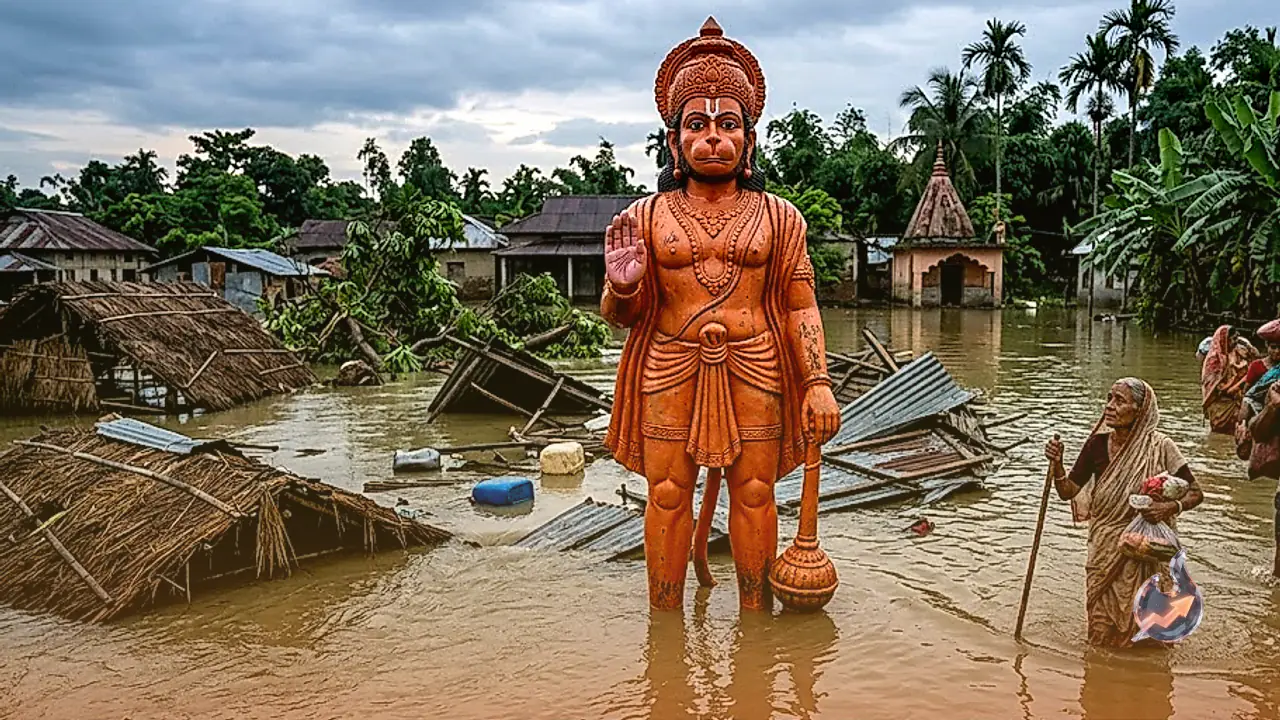

Rising floodwaters across several regions of Assam have caused widespread devastation, disrupting ordinary civilian life and submerging vast areas of land. Amidst the terrifying scenes of surging rivers, destroyed residential structures, and damaged infrastructure, a poignant visual from Sivasagar district has gripped public attention. In the Bamunpukhuri locality, the entire structure of a local temple complex was washed away by the furious current, yet the idol of Lord Hanuman remained firmly standing on its original base. Following the emergence of this scene, local residents and devotees have been wading through deep water to bow before the statue and offer prayers, drawing emotional strength during a period of immense adversity.
A Symbol of Unwavering Faith Amid Raging Waters
In the Bamunpukhuri area of Sivasagar district, the sudden inundation led to highly precarious conditions. Torrents of water carrying mud and debris battered local buildings and public pathways. Although surrounding walls and sections of the temple succumbed to the force of the deluge, the statue of Bajrangbali remained upright and undamaged. Observing this sight, many individuals expressed that the visual serves as a powerful reminder of hope when surrounding realities appear overwhelming. Messages invoking faith and endurance have been circulating widely alongside the imagery as affected communities rally to support each other.
For many local villagers, the preservation of the idol amidst total destruction represents a pillar of resilience. While interpreting such occurrences as miraculous is a matter of personal spiritual belief alongside the necessity for factual ground assessment, the image has undoubtedly offered vital psychological comfort to families suffering severe losses. Amid depressing reports of displacement and damage, the visual of an unshaken statue has emerged as a beacon of emotional fortitude.
Official Data from Disaster Management Authority Across 13 Districts
The stark reality behind this disaster is reflected in the official figures released by the Assam State Disaster Management Authority. According to official data updated on Friday, a total of 1,55,849 people across 13 districts in the state are currently suffering from the impact of the floods. Swollen rivers and unceasing inundation have affected 464 villages and 33 revenue circles, severely disrupting agricultural activities and daily economic operations.
Furthermore, the cumulative death toll linked to flood incidents in Assam this year has climbed to 98. These metrics highlight the severe challenges confronting emergency rescue crews and administrative agencies on the ground. Waterlogging in residential quarters has rendered thousands homeless, compelling administration teams to execute large-scale relief operations and establish emergency shelters.
Ground Reality of Disaster in Sivasagar, Golaghat, and Jorhat
The upper districts of the state have borne a major brunt of the monsoon fury. In Sivasagar district, official reports state that 48,286 residents have been directly impacted by the floodwaters. Meanwhile, in neighboring Golaghat district, the situation is even more critical, with the affected population reaching 58,750. Jorhat district has similarly experienced widespread displacement, counting 25,259 affected inhabitants.
In these districts, vital road links have been submerged or washed away, isolating numerous interior villages. Substantial agricultural land remains submerged under feet of water, damaging standing crops and jeopardizing agricultural livelihoods. Disaster response forces, operating alongside local governance bodies, are deploying motorized boats to evacuate stranded families, deliver food packets, and supply drinking water.
Emotional Support During Tragedy and Upcoming Rehabilitation Challenges
During catastrophic natural events, communities endure not only material losses but also profound emotional distress. In such testing moments, symbols of faith provide psychological anchoring to help survivors cope with loss and uncertainty. The steadfast standing of the Hanuman statue in Sivasagar communicates a sense of endurance, reminding people of the strength required to navigate crises.
Nevertheless, long-term recovery for Assam will demand extensive effort once the floodwaters recede. Cleaning operations, disease control, restoration of damaged power grids, rebuilding destroyed homes, and repairing agricultural infrastructure will pose major administrative hurdles. In the midst of these ongoing hardships, the image of an unshaken idol amidst the flood continues to offer hope and unity to thousands fighting to rebuild their lives.