
















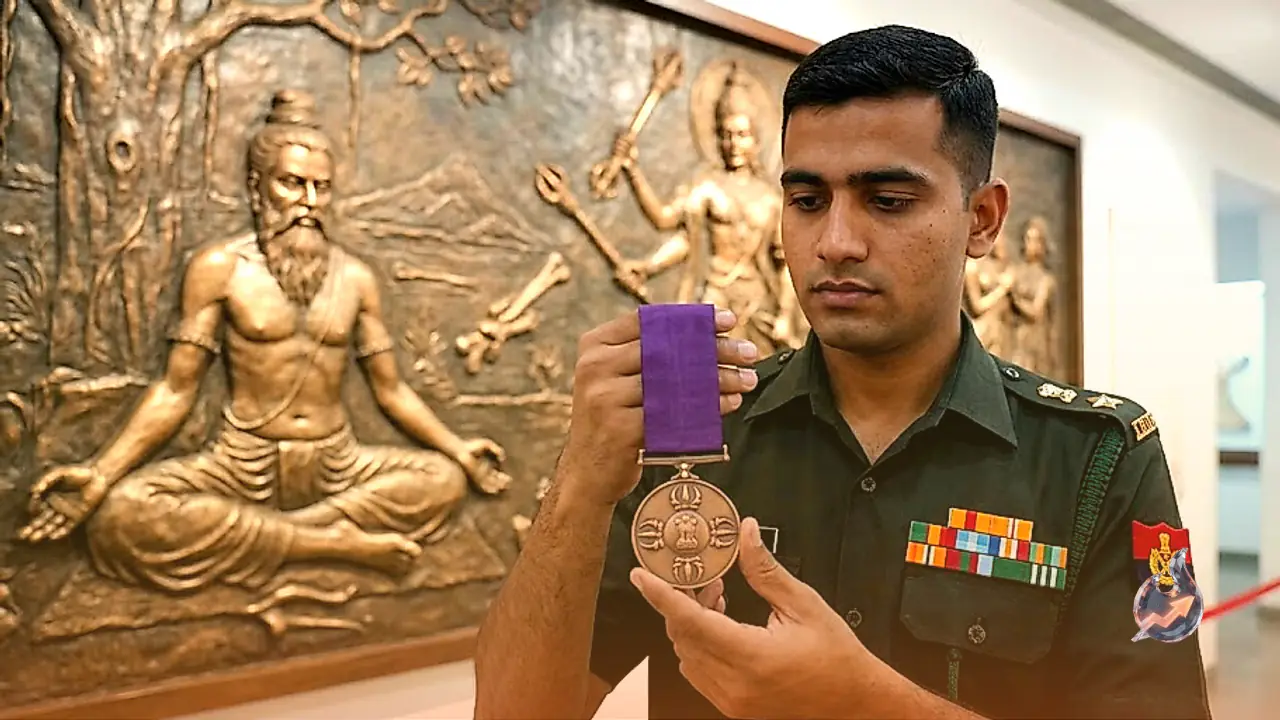

India's highest military decoration for wartime bravery, the Param Vir Chakra, is far more than a metallic medal bestowed upon heroes. It embodies the timeless ideals of courage, selflessness, and ultimate devotion to the nation. Upon examining the physical structure of this esteemed award, one notices the national emblem surrounded by four replicas of the legendary weapon, the Vajra, pointing in the four cardinal directions. This motif is directly rooted in ancient Vedic tradition, representing the divine thunderbolt forged from the bones of Maharishi Dadhichi by the celestial architect Vishwakarma. Far beyond a mythological narrative, this story reflects a deep philosophical truth about sacrifice and duty that laid the conceptual foundation for independent India's supreme honor for battlefield valor.
India's Highest Military Honor: The History of the Param Vir Chakra
The Param Vir Chakra is India's preeminent wartime gallantry award, conferred upon military personnel for displaying the most conspicuous bravery, daring acts of valor, or self-sacrifice in the presence of the enemy. Officially instituted on 26 January 1950, when India transitioned into a sovereign republic, the award was given retroactive effect from 15 August 1947, the day of national independence. Soldiers across the army, navy, and air force who demonstrate extraordinary dedication under extreme danger are recognized with this medal. Cast in bronze as a circular emblem, the award hangs gracefully from a plain purple ribbon on the uniform of the brave recipient.
Visual Architecture of the Medal: Ashoka Pillar Surrounded by Indra's Vajra
A closer look at the aesthetic composition of the Param Vir Chakra reveals the Ashoka Pillar, India's national emblem, enshrined at its center. Positioned around this central core are four replicas of Lord Indra's formidable thunderbolt, the Vajra. This visual arrangement was not chosen merely for artistic elegance; it conveys a profound universal message: true power is born out of selflessness and supreme sacrifice rather than raw physical destruction. By integrating the Vajra, the award visually communicates that a soldier's ultimate strength lies within their devotion to duty and willingness to give up everything for the nation.
Mythological Foundations: The Menace of Vritrasur and the Celestial Crisis
Ancient scriptures including the Rigveda, Bhagavata Purana, and Mahabharata describe Maharishi Dadhichi as one of ancient India's most venerated sages, renowned for his intense austerities, profound wisdom, and altruism. According to scriptural lore, a powerful demon king named Vritrasur acquired immense cosmic powers through arduous penance, defeating the Devas and overthrowing heaven. His reign created chaos across the universe. Unable to counter Vritrasur's strength, Lord Indra and the celestial deities approached Lord Vishnu seeking a way to restore balance and order.
Lord Vishnu's Counsel and Maharishi Dadhichi's Supreme Sacrifice
Lord Vishnu revealed to the Devas that Vritrasur was impervious to conventional weapons, divine boons, and metals. The demon could only be slain by a unique weapon forged from the sanctified bones of a sage whose body had been refined by long centuries of spiritual discipline and self-restraint—Maharishi Dadhichi. When the celestial beings approached the sage at his hermitage to request the donation of his physical remains, Maharishi Dadhichi did not hesitate for a moment. Understanding that his physical form was temporary and meant for the greater good of existence, he willingly relinquished his life through yogic power (Yogabala). This act remains celebrated in Indian heritage as the ultimate example of self-sacrifice.
Forging the Vajra by Vishwakarma and the Defeat of Vritrasur
Following the sage's departure from his mortal body, the Devas gathered his holy bones and presented them to Vishwakarma, the divine architect and craftsman of the gods. Utilizing his divine skills, Vishwakarma crafted the invincible Vajra from Dadhichi's bones and handed it to Lord Indra. Armed with this divine weapon, Lord Indra engaged Vritrasur in battle and ultimately vanquished the demon, restoring peace and righteousness. Consequently, the Vajra became an enduring symbol of indestructible righteousness, defense of truth, and power derived from selflessness.
Savitribai Khanolkar: From Switzerland to India and the Medal Design
When independent India sought a design for its premier gallantry medal, military authorities wanted a symbol that represented sacrifice and moral strength rather than simple military force. The task of creating this emblem was entrusted to Savitribai Khanolkar. Born Eve Yvonne Maday de Maros in Switzerland, she married Captain Vikram Ramji Khanolkar of the Indian Army and deeply embraced Indian culture. She mastered Hindi, Marathi, and Sanskrit, immersing herself in ancient Indian mythology, art, and philosophy. Drawing upon her deep understanding of ancient scriptures, she proposed incorporating Indra's Vajra into the Param Vir Chakra, a design that continues to define India's highest military honor today.
The Philosophical Legacy of Dadhichi's Sacrifice for Modern Soldiers
The Param Vir Chakra is not merely a recognition of tactical victory on the battlefield; it serves as a reminder to every soldier and citizen that duty transcends personal welfare. Genuine strength emerges not from armaments alone, but from unwavering commitment and selflessness. True valor involves placing the safety and honor of the country above one's own life. Whenever a soldier is decorated with the Param Vir Chakra, the honor celebrates both their individual heroism and the timeless ideal of supreme sacrifice established by Maharishi Dadhichi thousands of years ago.