
















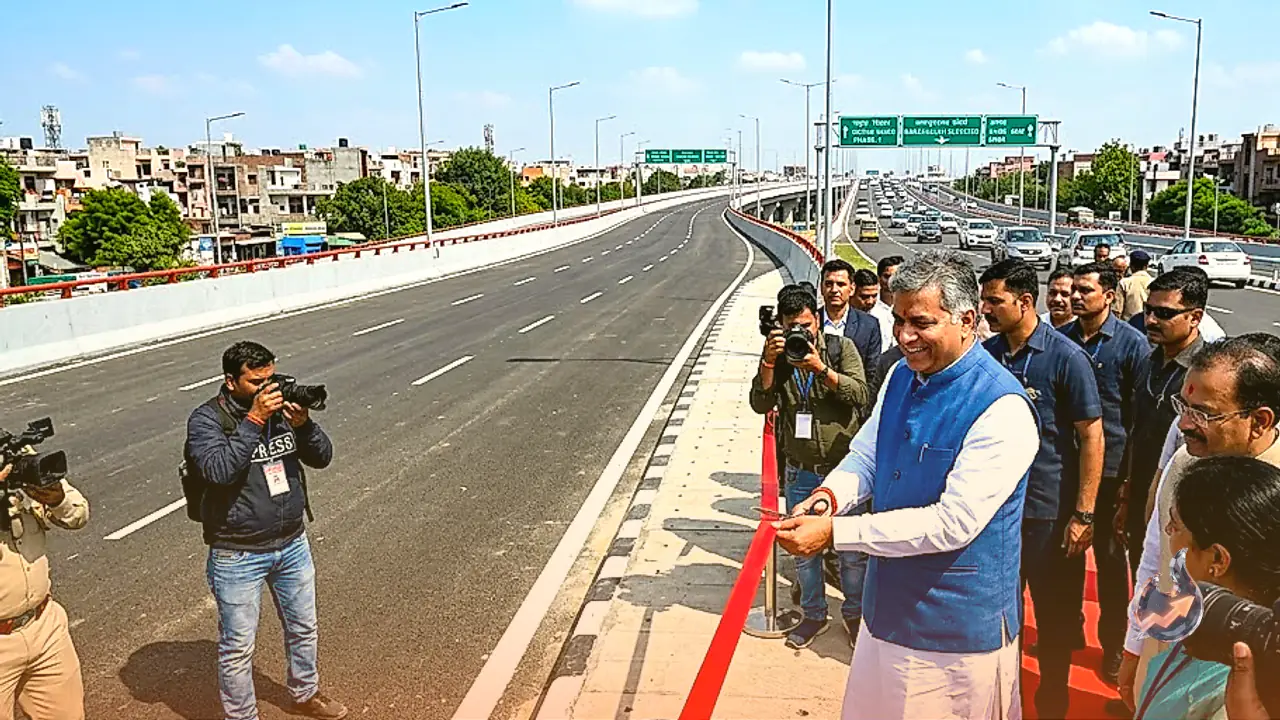

Daily travel across Delhi and the National Capital Region is poised for a significant transformation with the completion of the Barapullah Elevated Corridor Phase-3. Connecting Sarai Kale Khan to Mayur Vihar Phase-1, this newly completed 3.5-kilometer elevated section is now fully prepared for public use. Public Works Department Minister Parvesh Sahib Singh Verma conducted an on-site inspection on Saturday alongside senior department officials to review the final construction work and operational preparedness. Once operational, the link will offer a fast and seamless alternative route for motorists traveling toward central and south Delhi from eastern parts of the capital, Noida, and Ghaziabad, substantially easing congestion around the congested Sarai Kale Khan intersection.
A 9-Kilometer Signal-Free Link from Mayur Vihar to AIIMS
With the integration of the third phase, the full Barapullah elevated stretch running from Mayur Vihar through Sarai Kale Khan to AIIMS will span roughly 9 kilometers as an uninterrupted, signal-free expressway. Commuters will be able to complete the journey between Mayur Vihar and AIIMS in just 15 minutes, bypassing numerous intersections that previously caused prolonged travel times. Union Home Minister Amit Shah is scheduled to formally inaugurate the Phase-3 elevated corridor and dedicate it to the public on September 29, 2026, marking its immediate opening for regular vehicular traffic. The facility creates a continuous elevated bypass for traffic moving between East Delhi, neighbouring satellite towns, and southern districts.
Congestion Relief for DND, Akshardham, and Key Arteries
The operationalization of this infrastructure is expected to redistribute vehicular movement across several high-volume corridors. Minister Parvesh Verma noted that opening the elevated structure will relieve critical choke points, particularly around the DND Flyway and the Akshardham corridor. Daily commuters traveling between Delhi and NCR hubs including Noida, Ghaziabad, and Sahibabad stand to gain major time savings during peak hours. Furthermore, reducing traffic bottlenecks and cutting down vehicle idling times at signals is expected to lower vehicular emissions and contribute to lowering air pollution levels across the transit route.
Navigating Clearances and a Revised Outlay of ₹1,635.03 Crore
The completion of Barapullah Phase-3 follows an extended journey marked by bureaucratic hurdles, land ownership issues, and statutory requirements. The infrastructure undertaking was initially sanctioned with an estimated budget of approximately ₹1,260.63 crore, which later escalated to a revised total of ₹1,635.03 crore due to project delays and modifications. Progress was repeatedly interrupted by complex land acquisition issues, forest clearances, environmental permissions, and prolonged arbitration procedures. Verma confirmed that all inter-departmental hurdles, including environmental approvals and dispute resolution matters, have now been successfully settled, paving the way for the timely public opening.
Dedicated Infrastructure for Cyclists and Pedestrians
A notable design feature distinguishing Barapullah Phase-3 is its integration of dedicated non-motorized transport infrastructure alongside traditional vehicular lanes. Beyond facilitating swift transit for cars and four-wheelers, the corridor incorporates a dedicated 2-meter-wide cycle track designed to support clean urban mobility. Additionally, planners have included a 1.5-meter-wide sidewalk to ensure secure, separated space for pedestrians. This inclusion makes the structure one of Delhi's few elevated urban corridors to actively accommodate non-motorized transport alongside rapid vehicle traffic.