
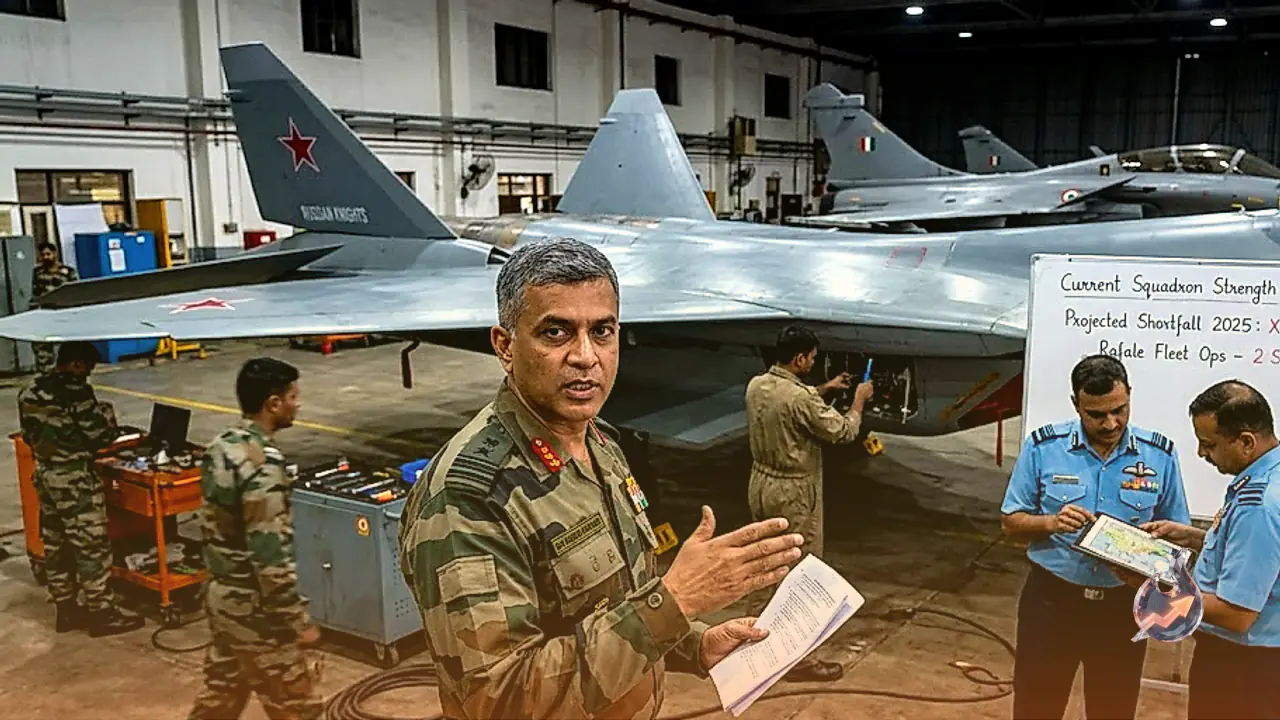























The geopolitical alignment between Moscow and New Delhi has taken center stage once again as Russian President Vladimir Putin arrives in New Delhi for the high-profile BRICS summit. Seizing the diplomatic momentum, Russia has actively renewed its pitch to supply India with its advanced Su-57 fifth-generation stealth fighter jet. Sources familiar with the developments indicate that Moscow's initial proposal involves a package of approximately two squadrons, which translates to a fleet of 36 to 40 aircraft. While the acquisition of such a cutting-edge platform represents an attractive technological leap, the Indian Air Force (IAF) is grappling with a structural challenge that goes far deeper than simply purchasing new military hardware. The ultimate dilemma for Indian defense planners is how to rapidly reverse the steady decline in the IAF's active fighter squadron numbers, a crisis that threatens the nation's air defense preparedness.
The Critical Gap in Air Defense Capabilities
Currently, the IAF operates with an estimated strength of only 29 to 31 fighter squadrons. This is a concerningly low number when contrasted with the government's sanctioned target of 42 active squadrons. This target of 42 is not an arbitrary figure; it represents the minimum force required to effectively defend Indian airspace in a hypothetical, simultaneous dual-front conflict involving neighboring adversaries. The persistent gap between the actual squadron strength and the mandated requirement leaves Indian planners in a tight spot, forcing them to distribute limited assets thinly across vast and hostile borders.
Looming Retirements and the Threat of Further Depletion
The security challenges are poised to intensify as the decade progresses. By 2030, a significant portion of the IAF's legacy fleet is scheduled to be phased out of active service. Iconic but aging warplanes such as the Anglo-French Jaguar, the Russian-origin MiG-29, and the French Mirage-2000 are all approaching the end of their operational lifetimes. If these retirements proceed without a swift and proportionate influx of new fighter platforms, the domestic squadron deficit will deteriorate to even more critical levels. Consequently, any potential agreement to acquire the Su-57 cannot be evaluated solely on the basis of its stealth features or radar capabilities; it must be judged by how many units India can induct and how rapidly they can be integrated into active service.
Analyzing the Rafale Acquisition Strategy
India's previous major defense acquisition serves as a highly instructive case study in this regard. The purchase of 36 Rafale fighter jets from France undoubtedly provided a massive qualitative boost to the IAF. Equipped with highly advanced sensors, superior electronic warfare suites, and long-range Meteor air-to-air missiles, the Rafale is a formidable weapon system. However, because the purchase was limited to just 36 aircraft, which translates to only two operational squadrons, the acquisition did not resolve the quantitative deficit plaguing the IAF's overall fleet size. The French fighters successfully created a highly potent tactical spearhead, but they could not fill the broader strategic void left by decommissioned aircraft. A similar pitfall is highly possible if India agrees to buy only a small batch of Su-57 jets.
Operational Constraints of a Limited Su-57 Fleet
Writing for the defense portal Defence.in, analyst Jaideep Gupta highlights the tactical limitations of a minor acquisition. If India goes ahead with buying only 36 to 40 of these fifth-generation aircraft, it will indeed gain a highly sophisticated capability. These stealth jets excel at suppressing enemy air defenses, executing deep-penetration strikes against well-defended high-value assets, and leading complex operations. Yet, a small fleet of two squadrons is incredibly difficult to deploy across multiple geographically separated zones. Spreading such a limited number of advanced jets across both the western and northern frontiers while also keeping aside aircraft for pilot training, routine maintenance cycles, and operational reserves would leave the operational commanders with very little flexibility.
Why a Larger Order of 72 to 90 Jets Makes Strategic Sense
This logistical and strategic constraint underscores the need for a much larger Su-57 fleet if India decides to commit to the Russian platform. Acquiring four to five squadrons, which would equate to roughly 72 to 90 aircraft, would provide the IAF with a truly transformative fifth-generation capability. With a fleet of this scale, the air force could confidently deploy these advanced stealth fighters across multiple theaters of operation simultaneously. This volume would also ensure that the daily operational readiness of the fleet remains high, as there would be enough aircraft to rotate through intensive maintenance schedules and continuous pilot training programs without degrading the active frontline defense posture.
Economic and Industrial Benefits of a Scale-Based Deal
Beyond the immediate tactical advantages, a larger procurement contract of 72 to 90 aircraft would also yield substantial economic and industrial benefits for India's domestic defense sector. A multi-billion-dollar deal of this scale gives New Delhi immense leverage to negotiate for extensive technology transfer and the establishment of local assembly lines. By producing these sophisticated fighter jets within India, the government could significantly reduce the unit cost of each aircraft through economies of scale. Furthermore, it would facilitate the creation of a comprehensive domestic Maintenance, Repair, and Overhaul (MRO) ecosystem, which would reduce India's long-term dependence on Moscow for spare parts and engineering support.
Serving as a Technological Bridge to the AMCA
Perhaps the most critical consideration for India's strategic planners is how a potential Su-57 deal fits with the nation's indigenous stealth fighter initiative, the Advanced Medium Combat Aircraft (AMCA). The AMCA is India's flagship program to design and manufacture a home-grown fifth-generation stealth fighter. However, developing such an advanced aerospace platform is a notoriously complex process that faces persistent challenges related to engine integration, cutting-edge materials, and production timelines. It will likely take a significant amount of time before the AMCA is ready for mass production and deployment. In this context, a locally manufactured fleet of Su-57 jets could serve as a valuable capability bridge. It would allow the IAF to induct and operate fifth-generation stealth aircraft immediately, gaining crucial operational experience with low-observable platforms while the AMCA program is being refined. If the development of the AMCA experiences unforeseen delays, the presence of an active Su-57 fleet would prevent a dangerous technological gap from opening up in India's air defense strategy. Ultimately, the decision comes down to a choice between a limited, stop-gap purchase of two squadrons or a comprehensive, large-scale strategic acquisition that addresses both the immediate technological and quantitative needs of the nation's air defense.


