























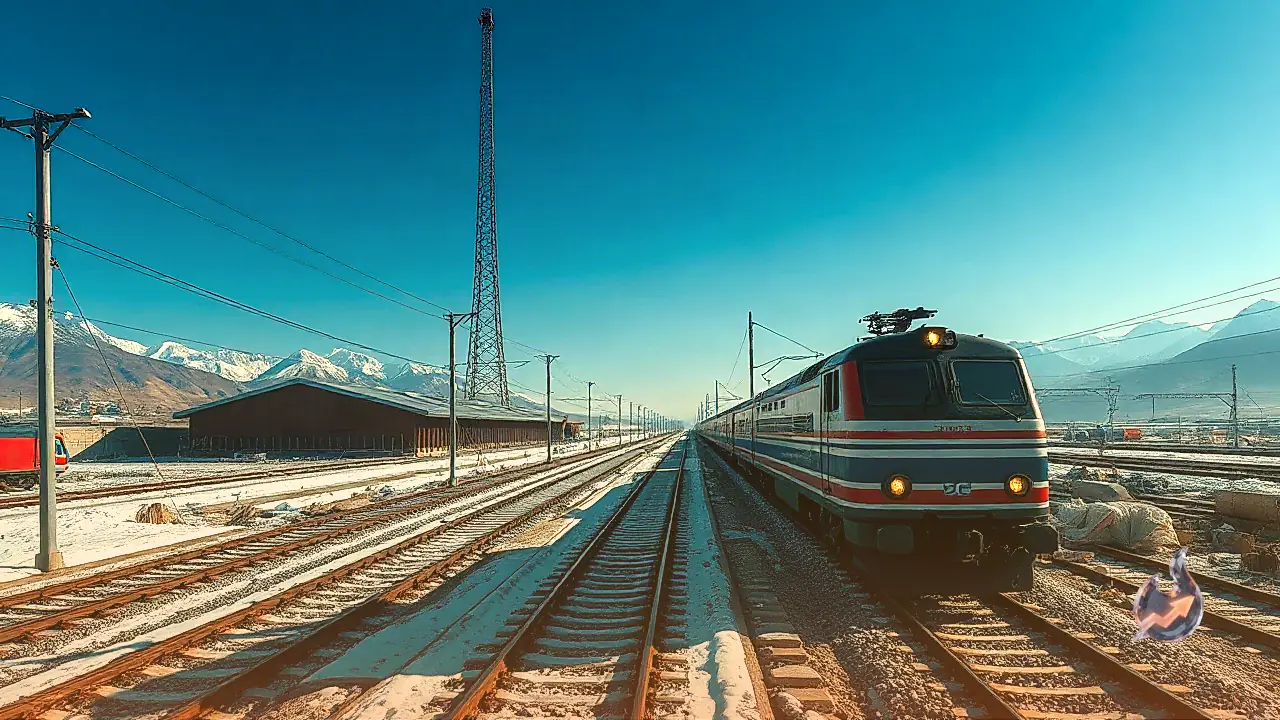

China has begun construction on a new rail corridor designed to reach Europe without passing through Russian territory, a project that is emerging as a serious economic and strategic challenge for India. The push follows a visit by Chinese President Xi Jinping to Kyrgyzstan, where talks focused on accelerating this ambitious rail link. While Xi's stated goal was to expand Chinese trade, the corridor carries significant implications for India's strategic and commercial standing in the region.
Mapping the China-Kyrgyzstan-Uzbekistan rail line
Built under China's Belt and Road framework, the project is known as the China-Kyrgyzstan-Uzbekistan, or CKU, railway. Once the roughly 500-kilometre line is complete, China will be able to send goods straight to Europe while bypassing Russia entirely, making it the shortest rail route linking the two regions. The largest stretch of the corridor, about 305 kilometres, runs through Kyrgyzstan's mountainous terrain and will rely heavily on tunnels. As part of this work, China has already started building a 210-metre tunnel inside Kyrgyzstan. Once finished, the project will give China direct rail connectivity to Europe for the first time.
27 tunnels, 43 bridges and 20 stations planned
Across the 500-kilometre route, China has proposed building 27 tunnels, 43 bridges and 88 roadbed sections, along with 20 railway stations along the way. The scale of construction reflects China's aim of running fast, all-weather supply routes that keep moving even through snow and harsh conditions. Completion of the project will give China direct access to Europe and the Middle East, and the route could eventually extend by land to Pakistan and the Indian Ocean, further expanding Chinese trade across the Middle East, South Asia and Europe.
China could overtake India in Central Asia
Once operational, the rail line is expected to strengthen China's grip on Central Asian markets, potentially pushing it ahead of India in the region. The new route will cut the distance between China and Europe to around 900 kilometres, saving 7 to 8 days of travel time. With Chinese supply chains moving that much faster, India could find it harder to compete across the region. The line's annual capacity is put at around 1.5 crore tonnes, a volume large enough to directly affect India's trade prospects. India, by contrast, currently has to rely on a sea route to reach Central Asia, one that depends on Iran's Chabahar port.
A blow for India if the line reaches Afghanistan and Pakistan
If China's rail network is eventually extended to link up with railway lines in Afghanistan and Pakistan, it would mark one of the biggest setbacks for India. Such a connection would let China route its trade through Kyrgyzstan and Uzbekistan all the way to Afghanistan, Pakistan and the Arabian Sea. Uzbekistan itself is working toward linking this corridor to the Indian Ocean. That would hand China another pathway to Pakistan's ports and the Arabian Sea, a development widely seen as India's biggest geopolitical risk from the project.
Pressure building on Indian exporters
China's new rail line will also have a direct bearing on India's position in the Central Asian market. If China begins delivering low-cost goods into the region faster, Indian exporters of machinery, electronics, consumer goods and industrial equipment are likely to face fresh competition. That could put pressure on Indian businesses on both price and delivery speed.
Chabahar could be India's answer
The project also opens up a potential opportunity for India. It is likely to raise the strategic importance of the Chabahar project, through which India can ship goods to Iran and Central Asia. India also has the option of expanding trade with Europe and Russia through the International North-South Transport Corridor, or INSTC. Seen this way, Chabahar could evolve in the coming years from being just a port into Central Asia's logistics gateway for India.