






















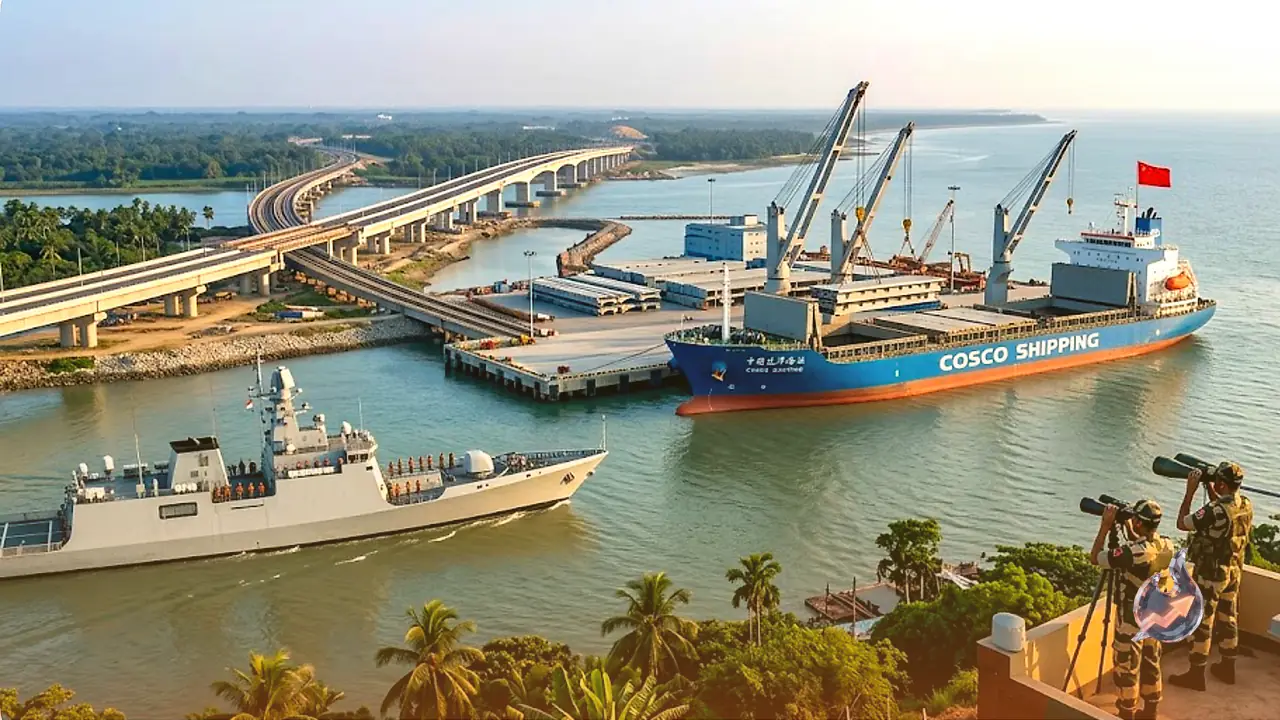

Having already secured a route to the Arabian Sea through the China-Pakistan Economic Corridor (CPEC) in Pakistan, China is now turning its attention to the Bay of Bengal. Beijing has begun taking steps to build a new economic corridor together with Bangladesh and Myanmar. If the project goes through, China would gain a road, rail and maritime network stretching right up to India's eastern border, a development being viewed as strategically significant. Once this network is in place, China would reportedly be able to move tanks and troops by road all the way to India's entire eastern frontier whenever needed.
Linking Kunming to Mongla Port
According to a Times of India report, the project was discussed in detail during a recent visit to China by Bangladesh Prime Minister Tariq Rahman. The proposal envisions connecting China's Kunming city to Bangladesh's major ports, particularly Mongla Port, via Myanmar. This would not only ease the movement of goods but also strengthen China's strategic footprint all the way to the Bay of Bengal.
A Gwadar-style blueprint for the Bay of Bengal
The new corridor could largely be modelled on CPEC. Just as CPEC gave China access to the Arabian Sea through Pakistan's Gwadar port, this new corridor could open up a fresh route for China to the Bay of Bengal.
Trade infrastructure with military potential
Defence experts point out that modern road, rail and port networks are normally used for trade during peacetime, but the same infrastructure can double up for military logistics, troop movement and the swift transport of heavy military equipment during a crisis or war. That is precisely why this Chinese project could become a growing headache for India.
Reviving the 1999 BCIM plan
Chinese Ambassador to Dhaka Yao Wen was quoted as saying that the idea itself is not new. He noted that the concept of a Bangladesh-China-India-Myanmar (BCIM) economic corridor first emerged back in 1999, aimed at linking the four countries through road, rail, waterway and air connectivity. That plan, however, never moved forward.
Yao Wen also said that the cooperation now beginning between China and Bangladesh is not the final stop, and that China would welcome other countries if they wished to join the initiative later. Whether to join now or wait, he said, would be entirely up to the countries concerned. The ambassador further said Beijing and Dhaka have agreed to go beyond economic cooperation, setting up a 2+2 dialogue mechanism covering foreign policy and defence matters, through which the two sides hope to give fresh direction to their strategic and security cooperation.
Ties warmed after Sheikh Hasina's ouster
Relations between Beijing and Dhaka have strengthened rapidly since Sheikh Hasina was ousted in Bangladesh in 2024. Several agreements have been signed in this period that India is watching closely. These include the Teesta river project, Chinese involvement in developing the Lalmonirhat airbase near India's eastern border, plans to set up a drone manufacturing and technology transfer unit in Dhaka, and a contract awarded to China to develop an economic zone near Mongla Port. Notably, the Mongla project was originally proposed to be built with India, but Bangladesh later cancelled that arrangement and handed the contract to China instead.
New challenge on India's eastern flank
If this new economic corridor becomes a reality, China's strategic grip over South Asia would grow considerably stronger, while India could face fresh challenges along its eastern borders, with Beijing potentially gaining an alternative strategic corridor beyond Pakistan, this time through Bangladesh and Myanmar.