























Heavy rain and strong winds have prompted a fresh yellow alert for the national capital and the wider NCR region, with the warning covering both July 29 and July 30. Even before that window began, Tuesday's rainfall was enough to overwhelm the city's drainage, leaving several stretches waterlogged and traffic crawling to a halt while commuters and schoolgoers struggled to reach their destinations on time.
Storms and stifling humidity set to double up on July 30
Forecasters say thunderstorms accompanied by lightning are more likely on July 30, with daytime temperatures across both alert days expected to hover around 32 degrees Celsius. What will make conditions harder to bear is humidity climbing as high as 100 percent, producing the kind of sticky, oppressive heat that often follows a spell of rain. Given how unpredictable conditions have turned, residents have been urged to avoid stepping out unless absolutely necessary. There is some relief on the horizon though, with weather expected to turn somewhat more settled from July 31 onward.
Deep depression tracks through Chhattisgarh on its way to Madhya Pradesh
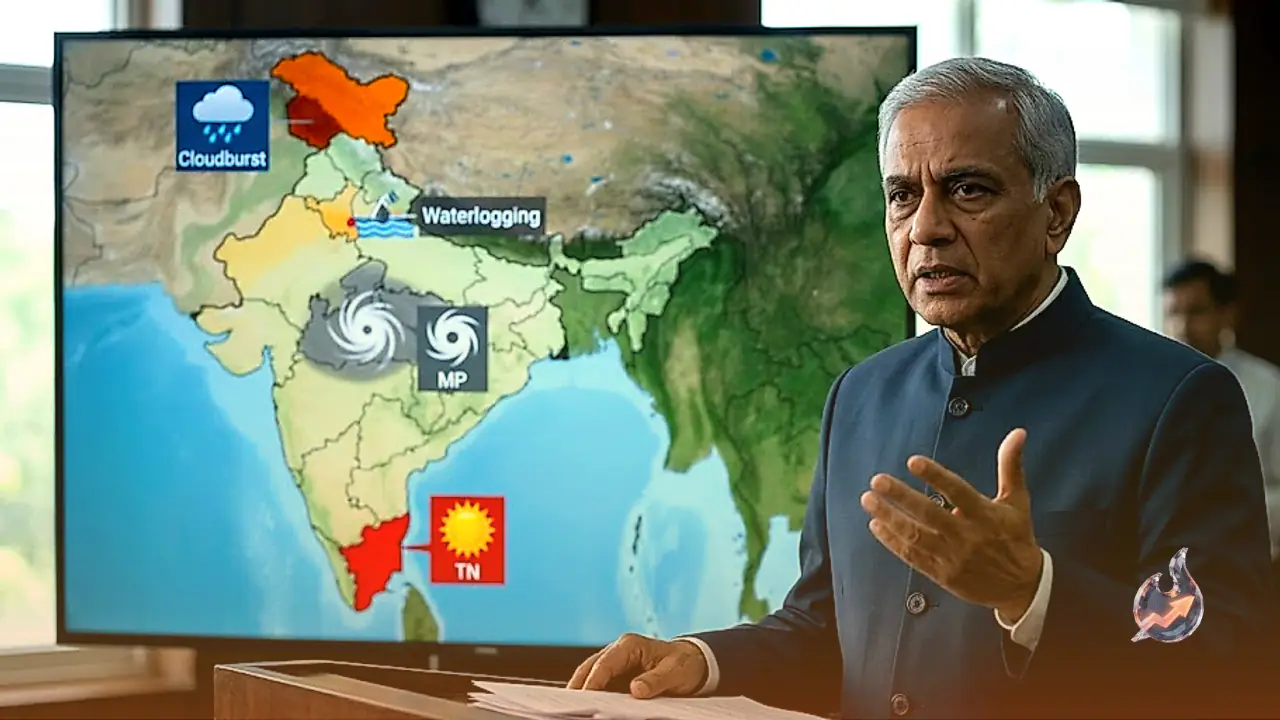
A deep depression that formed over north interior Odisha and south Jharkhand is now drifting westward at a speed of roughly 15 kilometres per hour. The system is currently centred over the middle parts of Chhattisgarh, passing very close to Raigarh, Champa, Sambalpur and Bilaspur, and sits about 180 kilometres from the state capital, Raipur. Meteorologists expect the depression to move into the eastern parts of Madhya Pradesh within the next 24 hours, bringing a strong likelihood of torrential rain to that stretch. Authorities in the affected districts have already issued alerts and asked residents to move to safer locations as a precaution.
Cloudburst fears shut schools in Jammu and Kashmir's Doda and Kishtwar
Conditions are arguably most alarming in the hill state of Jammu and Kashmir. Both government and private schools in Doda and Kishtwar districts have been shut because of the deteriorating weather, though authorities have directed that online classes continue so students don't lose out on learning. Kishtwar is additionally on edge over the risk of heavy rain triggering rockfall onto roadways, while several parts of the Chenab valley have been receiving continuous rainfall since the morning. A major alert has been issued for the Jammu division covering the next three days, with the weather department warning specifically of cloudbursts, flash floods and landslides. People have been advised to stay well away from rivers, streams and any area with fast-moving water. The Jammu-Srinagar highway remains open for now, but travelling on it carries real risk.
South India tells a different story: rain in the hills, scorching heat on the plains
While the north grapples with rain-driven chaos, southern India is experiencing an almost opposite pattern. Tamil Nadu's Western Ghats districts are forecast to see moderate rainfall over the next seven days, and a heavy rain alert has been sounded for the Nilgiris, Coimbatore and Theni districts. That rain is welcome news for the hill regions, but it comes paired with severe heat building up across the plains and coastal belt. In and around Chennai, maximum temperatures could run as much as 4 degrees above normal, potentially pushing the mercury past 39 degrees Celsius. The weather department attributes this unusual split to a trough line that has formed at the lower level of the atmosphere. Residents in the affected areas have been advised to guard against heat stress and drink plenty of water.
Precautions to take as rain and heat both stay unpredictable
Staying alert is the best safeguard while the weather keeps shifting this sharply. Those in Delhi-NCR should step outside only when truly necessary and steer clear entirely of waterlogged roads and underpasses. Anyone in hilly regions such as Jammu and Kashmir or Tamil Nadu's Western Ghats should stay well away from rivers and fast-flowing water and check the latest weather updates before setting out on any journey. Meanwhile, residents of Tamil Nadu's plains should keep themselves hydrated, carry an umbrella when heading out in the sun, rely only on helpline numbers issued by local authorities during emergencies, and never dismiss the weather department's warnings as unimportant.


