







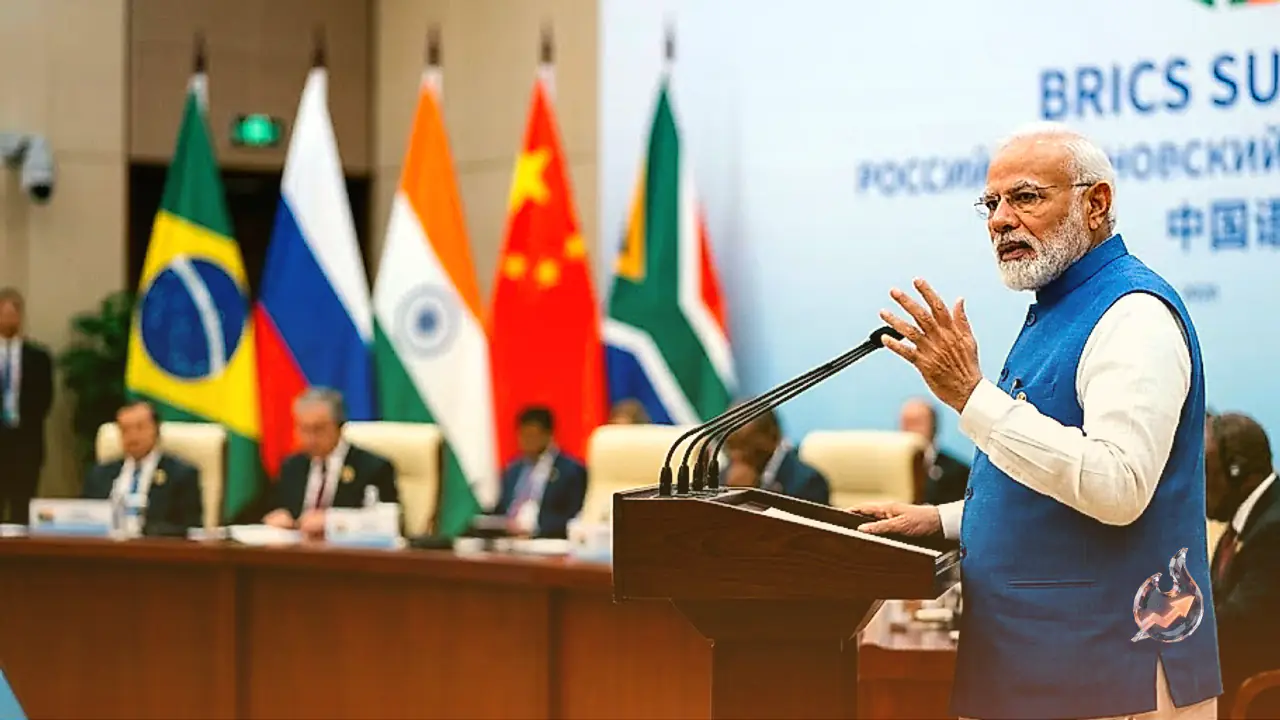


















A recurring topic of intense debate at the recent BRICS summit centered on whether the global economy can successfully reduce its heavy reliance on the US dollar. On the surface, the proposition appears straightforward: distance yourself from the greenback and conduct all cross-border commerce in respective local currencies. However, the underlying economic mathematics is far from simple. Professor Srikanth Kondapalli, a Chinese Studies expert at Jawaharlal Nehru University (JNU), has broken down these intricate complexities, warning that developing nations rushing into an abrupt departure from the dollar could inadvertently invite severe financial turmoil. The vulnerability stems not merely from the currency itself, but from how deeply these developing economies remain integrated with Western consumer markets, global financial stability, critical maritime trade routes, and international banking frameworks. Altering this established architecture overnight could impose unbearable costs.
The energy sector represents one of the most compelling pieces of this puzzle. According to Professor Srikanth Kondapalli, the US dollar continues to play an overwhelmingly dominant role in global petroleum commerce to this day. The historical roots of this arrangement trace back to the early 1970s. The emergence of the petrodollar architecture, cemented following the visit of then US Secretary of State Henry Kissinger to Saudi Arabia in 1972, forms a crucial chapter of this ongoing narrative. In the present climate, marked by the ongoing Russia-Ukraine conflict and mounting tensions involving Iran, renewed upward pressure on oil prices has placed an immense burden on developing nations. Consequently, while BRICS nations frequently deliberate on moving away from the dollar, they remain acutely hesitant to assume the extreme risk of breaking free entirely without a safety net.
Professor Srikanth Kondapalli outlined this multifaceted financial reality across five key points.
Increased Vulnerability for Developing Nations: According to Professor Srikanth Kondapalli, emerging economies such as Brazil, South Africa, and India do not operate in total isolation from Western markets in the manner that China does. The economies of these nations remain significantly intertwined with the consumer markets of the United States and Europe. They require reliable access to global financial stability, while international maritime trade routes and established banking networks remain equally vital for their day-to-day operations. Had the BRICS bloc suddenly announced an immediate disengagement from the dollar, numerous developing countries could have faced catastrophic shocks across their financial markets and trade sectors, threatening everything from domestic stock exchanges to foreign commerce. This exact apprehension explains why the official BRICS joint declarations omitted any direct commitment to abandoning the dollar.
Sustained Dominance in Global Trade: Professor Srikanth Kondapalli highlighted telling international transaction statistics, noting that approximately 54 percent of all global financial settlements continue to be conducted in US dollars. Alternative currencies such as the euro, the British pound, and the Japanese yen trail far behind in overall market share. This empirical reality demonstrates that the dollar's grip on the international financial machinery remains remarkably robust. Consequently, nations belonging to the Global South cannot afford a reckless decision to sever ties in a single stroke. The respective national currencies of these developing countries have simply not attained the maturity required to handle massive volumes of international trade smoothly.
The 1972 Kissinger Visit and the Petrodollar Dynamic: Delving into the historical mechanics highlighted by the professor, the connection between crude oil and the US dollar remains paramount. He pointed to Henry Kissinger's 1972 diplomatic journey to Saudi Arabia as a defining moment that cemented the relationship between energy commodities and the American currency. The resulting petrodollar framework established a powerful mechanism that perpetually reinforced the dollar's supremacy in global petroleum transactions. To this day, many developing countries rely heavily on massive energy imports. Because oil is globally priced in US dollars, these nations are continuously forced to secure dollar reserves. Even if a nation desires to bypass the dollar for ideological reasons, the harsh reality of energy procurement forces it straight back into the traditional system. Professor Kondapalli noted that geopolitical friction, including the Russia-Ukraine conflict and Iranian tensions, pushed oil prices near the threshold of 100 dollars per barrel, exerting intense downward pressure on developing economies.
Rising Influence of the Chinese Yuan Within BRICS: Amidst ongoing discussions regarding de-dollarisation, an internal monetary dynamic within the BRICS alliance itself warrants close examination. According to Professor Srikanth Kondapalli, out of the approximately 1.7 trillion dollars in total intra-BRICS trade turnover, nearly 47 percent is settled directly in Chinese yuan. This heavy concentration raises valid concerns for participant nations like India, Brazil, and South Africa. If a transition away from the dollar merely substitutes it with an overwhelming dependence on another single currency, new systemic risks will inevitably emerge. Therefore, the core dilemma facing the BRICS coalition extends far beyond merely escaping the dollar; the fundamental question remains which alternative framework can be trusted and whose hands will ultimately control that replacement system.
Digital Currencies as an Interim Bridge: According to the professor, internal deliberations among BRICS members have explored the increased adoption of local currency settlements alongside central bank digital currencies. The primary objective behind these explorations is to enable central or state banks of member nations to execute direct bilateral transactions and safeguard their domestic economies against major external financial shocks. However, he stopped short of endorsing this as a permanent or definitive solution. In his assessment, central bank digital currencies can function primarily as an interim stepping stone. While they may successfully facilitate incremental growth in local currency commerce, the monumental challenge of completely replacing the global hegemony of the US dollar persists. This fundamental limitation explains why, despite extensive high-level discussions on digital and local currencies during the BRICS summit, no definitive proclamation regarding the abandonment of the dollar was issued.


