



















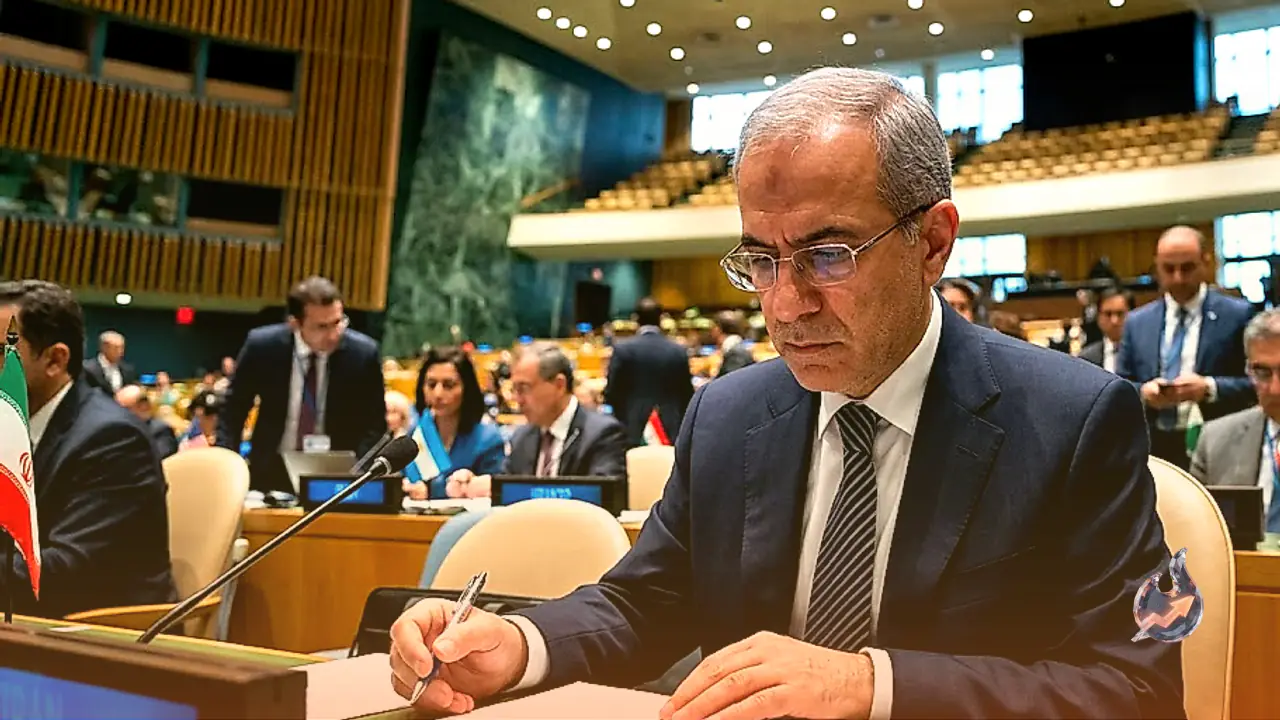

Tensions across West Asia took center stage at the United Nations General Assembly as US President Donald Trump delivered an uncompromising message directly targeting Iran. Speaking from the global podium, Donald Trump warned that Iran must either embrace a path of peace or brace itself for widespread destruction. The reaction from Tehran was immediate and sharp. The Iranian military responded by stating that the threats from Donald Trump merely demonstrate that American strategic calculations have entered an absolute dead end, warning that their forces remain fully prepared to retaliate with even more ferocious military strikes.
Yet, right alongside this combative posture, diplomatic engagements were quietly unfolding behind closed doors. Following his address, Donald Trump informed journalists that senior American officials had conducted a detailed, three-hour discussion with Iranian delegates within the United Nations General Assembly. He further indicated that an additional round of high-level meetings is scheduled to take place shortly. Meanwhile, Iranian President Masoud Pezeshkian arrived in New York, preparing to present Tehran's perspective on the international stage regarding the extensive damage inflicted by the United States and Israel since February 28. In his address, Donald Trump expressed confidence that a comprehensive diplomatic pact could be concluded with Iran following the American elections in November, though he maintained that he was by no means retreating from potential warfare.
Persian Gulf Fragility and the Security of Energy Routes
Diplomatic observers have pointed to the noticeable contrast between the sharp rhetoric and the parallel diplomatic overtures. While the official address sought to convey an impression that the United States held complete mastery over the geopolitical landscape and was dictating the tempo against Iran, the simultaneous invitation extended to Iranian representatives for direct negotiations presented an entirely different reality. Over past years, multiple rounds of dialogue between Washington and Tehran have commenced only to collapse abruptly, leaving global markets uncertain about whether genuine peace can be engineered. If meaningful discussions take place between Donald Trump and Masoud Pezeshkian in New York, it could unlock vital progress for international commerce. The broader global economy urgently requires stability across the Gulf, the uninterrupted reopening of the Strait of Hormuz, and the unhindered movement of commercial oil tankers to mend severed maritime trade and supply chains.
Outrage in Jamui Over Harassment Case and Questions for Law Enforcement
On the domestic front, significant public concern has erupted in Bihar following a brazen criminal act in Jamui, where a minor girl was publicly assaulted and harassed. Law enforcement authorities engaged the prime suspects in an encounter, resulting in one accused suffering a bullet injury to his leg while the second suspect sustained fractures. The two individuals have been identified as Nandan Yadav and Hareram Yadav. The initial assault occurred on September 19, during which the perpetrators recorded the illicit act on camera and later circulated the footage across various social media platforms. It was only after this digital recording gained traction online that law enforcement agencies formally identified those involved.
Prior to tracking down the main suspects, police officers had apprehended three juveniles. Interrogations conducted with these detained minors directed law enforcement personnel toward the Mandwa hills, where an armed confrontation ensued with Nandan Yadav and Hareram Yadav. A major point of public anger stems from the realization that had the perpetrator not uploaded the visual evidence to the internet himself, the entire incident might have remained completely undetected. Young women residing in Jamui have voiced urgent demands that exemplary legal punishment be handed down to Nandan Yadav and his associates to deter future offenses.
Subsequent background inquiries revealed that the injured suspect is a habitual offender with an extensive record. Despite the active liquor prohibition laws across Bihar, he was deeply involved in the illicit sale and consumption of alcohol, alongside publishing compromising videos online. Past records show that he had previously abducted young women and subjected victims to extortion and blackmail through illicit video recordings. This pattern has prompted sharp scrutiny regarding why local policing mechanisms failed to track his activities earlier. Preventing illicit behavior before it escalates remains a foundational duty of law enforcement, an area where local administrative oversight proved critically deficient.
Appointment of 3,567 Teachers in Uttar Pradesh and Strict Anti-Corruption Directives
In Uttar Pradesh, Chief Minister Yogi Adityanath presided over a substantial employment distribution ceremony in Lucknow, handing over official appointment letters to 3,567 candidates. These newly selected educators will take up posts as principals, headmasters, lecturers, and assistant teachers across government-aided secondary educational institutions. During the ceremony, the Chief Minister remarked that these candidates secured their positions solely through their academic perseverance and dedication rather than administrative benevolence, noting that a transparent and resilient selection mechanism had been put in place.
A primary administrative priority remains ensuring that the actual joining process remains unmarred by corrupt practices. Because these appointments are assigned to privately managed, government-aided schools where the local school management oversees final administrative induction, concerns regarding extortion often arise. Addressing the successful candidates, the Chief Minister issued an explicit warning to institutional managers and educational bureaucrats. He instructed candidates to report directly to his office if any administrator demanded monetary kickbacks or created impediments during joining, affirming that individuals involved in extortion would face severe consequences and immediate imprisonment.
Prayagraj Candidate Agitation Over Teacher Eligibility Norms
Beyond the appointment ceremony, administrative attention was directed toward resolving ongoing student demonstrations in Prayagraj. Candidates preparing for trained graduate teacher and post-graduate teacher selections have been staging a continuous sit-in protest since September 5, marking 16 straight days of agitation. The demonstrators have been demanding the application of previous recruitment guidelines for an upcoming notification encompassing 20,000 vacant teaching positions. Under previous regulatory frameworks, holding a Bachelor of Education degree was not mandatory for specific examination categories, a condition that has now been introduced as an obligatory requirement. Aspiring teachers argue that completing the mandatory teacher-training degree requires a two-year investment, meaning that an immediate enforcement of the revised criteria would abruptly disqualify hundreds of thousands of applicants. In response to these concerns, the Chief Minister confirmed that state authorities have been instructed to communicate with the National Council for Teacher Education to seek regulatory adjustments reflecting candidate representations.
The event also featured sharp political exchanges concerning recruitment integrity under previous state administrations. Allegations were revived regarding historical practices where employment opportunities reportedly hinged upon political patronage and financial bribes. The Chief Minister directed pointed criticism toward Akhilesh Yadav and the Samajwadi Party leadership, while broader remarks referenced former minister Shivpal Singh Yadav alongside past observations by Om Prakash Rajbhar regarding cash handling during historic recruitment exercises.