






















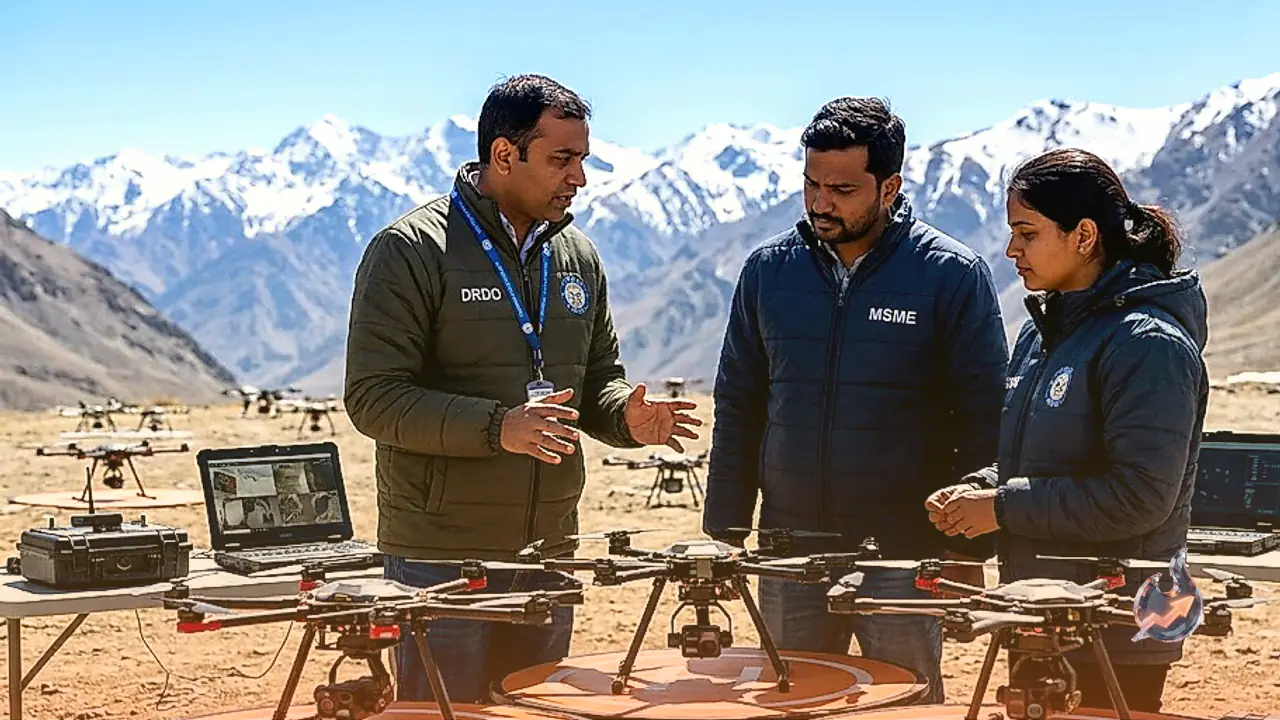

India is advancing its defense technology capabilities by developing a specialized autonomous drone swarm system. Instead of relying solely on conventional fighter jets or heavy missile platforms, the current focus emphasizes expanding tactical unmanned aerial capabilities. The Defence Research and Development Organisation (DRDO) has initiated a major project to build an advanced drone swarm designed to remain fully operational even under intense electronic jamming. Officially designated as the 'Development of Close Formation Flying of Multiple Drones' project, this program aims to strengthen front-line military operations.
DRDO TDF Initiative and Opportunities for Indian Startups
To realize this advanced technology, DRDO has invited proposals from domestic startups and Micro, Small, and Medium Enterprises (MSMEs). The project is being executed under the Technology Development Fund (TDF) scheme, which provides financial and technical backing to boost indigenous defense innovation. Notably, large public sector undertakings have been excluded from this specific tender to encourage grassroots research and directly empower private defense startups. This initiative aligns with the growing demand within the Indian Armed Forces for autonomous systems on modern battlefields.
Lessons From Operation Sindoor and the Shift Toward Autonomous Warfare
Defense analysts highlight that during 'Operation Sindoor' in May 2025, Unmanned Aerial Systems (UAS) demonstrated critical utility in reconnaissance, surveillance, and precision targeting. That operational experience reinforced the necessity for self-reliant, highly secure, and closely coordinated drone networks in modern conflict scenarios. The newly planned 50-drone swarm system directly addresses these combat lessons by offering resilient tactical support.
Master-Slave Drone Architecture and Tight Formation Precision
According to DRDO technical specifications, the swarm will consist of 1 'Master Drone' managing and directing 49 'Slave Drones'. The Master Drone will receive operational commands directly from a Ground Control Station and maintain the target grid structure. The primary engineering challenge involves maintaining an extraordinarily tight distance of just 500 millimeters (half a meter) between individual drones during flight. To avoid collisions, each drone must maintain positional accuracy within 5 centimeters across all axes.
Extreme Weather Capabilities and Secure Communication Systems
The drone swarm is engineered to perform reliably under severe environmental and geographic conditions. The drones must be capable of taking off, hovering, executing missions, and returning safely at altitudes up to 5,000 meters in mountainous regions. Furthermore, the system must retain flight stability in wind speeds reaching 20 meters per second. Given the threat of hostile communication interference, integrating a robust, electronic jamming-resistant communication architecture is a mandatory requirement.
Rapid Deployment, Battery Performance, and Indigenous Sourcing Mandate
Each drone within the network must support a payload capacity of up to 2 kilograms, allowing for cameras, specialized sensors, or electronic warfare equipment. Operational requirements dictate that the entire system must transition from unpacked storage to flight readiness within 5 minutes. Battery specifications mandate a minimum operational flight time of 30 minutes, backed by a fast-charging capability that restores full power in just 15 minutes.
Two-Year Project Timeline, Prototype Testing, and Final Deliverables
To adhere to 'Make in India' guidelines, DRDO mandates that at least 70 percent of the system components must be sourced indigenously, while commercial components originating from adversary nations are strictly prohibited. DRDO will provide up to 90 percent of the total development cost as grant funding. The selected enterprise must construct a working prototype within 12 months, followed by another 12 months of evaluation at DRDO testing facilities. Upon completing the 24-month project cycle, the developer will hand over 50 complete drones, reserve battery packs, and full software source code to DRDO.