




















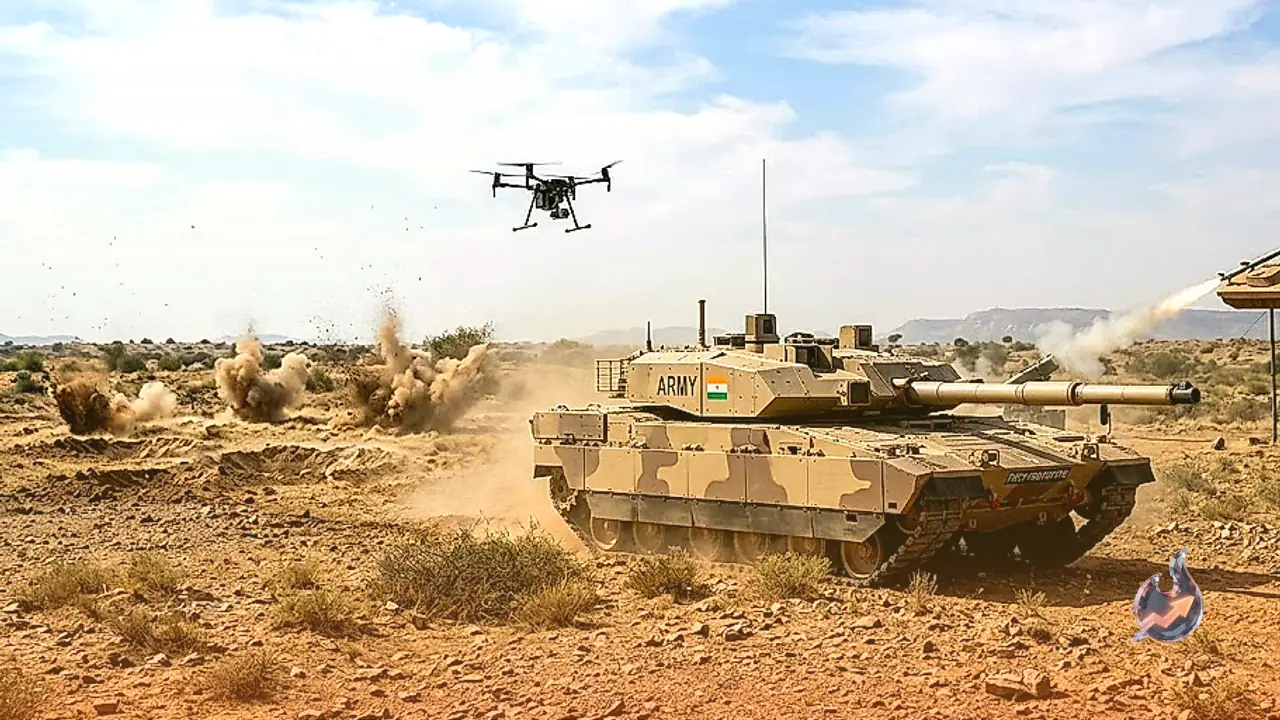

When discussions arise regarding the Indian Army's future Main Battle Tank, known as the Future Ready Combat Vehicle or FRCV, attention frequently centers on its main gun, heavy armor, engine power, and artificial intelligence capabilities. However, the true trial for this armored combat vehicle will extend far beyond these conventional attributes. The complex combat environment for which the FRCV is currently being developed does not guarantee that an adversary will simply position a competing tank directly across the field. Instead, opposing forces can deploy aerial drones, launch anti-tanks missiles from a distance, bombard positions with artillery, scatter landmines across the terrain, and utilize electronic warfare tactics to disrupt the vehicle's crucial communication systems and sensors.
Ministry of Defense Approval and Core Requirements
In September 2024, the Ministry of Defense granted formal approval for the Acceptance of Necessity or AoN concerning the FRCV project. The government outlined this upcoming MBT as a future platform equipped with enhanced mobility, all-terrain capability, multilayered protection, precision fire, and real-time battlefield awareness. Nevertheless, the pressing question remains regarding the exact spectrum of hazards the FRCV will need to navigate on the battlefield of tomorrow.
The Evolving Nature of Tank Warfare
An era existed when another tank was widely considered the primary and sole adversary of a main battle tank. Armored vehicles would confront each other directly, and their relative strength was determined primarily by their main armament, protective plating, and operational mobility. Today, that visual landscape has transformed completely. In modern military engagements, deploying a rival tank directly in front is no longer necessary to neutralize an armored vehicle. A compact drone can pinpoint its exact coordinates, a secondary drone can execute a strike, a distant missile operator can receive targeting data, and artillery batteries can saturate the designated sector within moments. Consequently, the FRCV cannot function merely as a vehicle designed exclusively to combat other tanks; it must operate within a theater where lethal strikes can materialize well before any visual contact is established.
The Drone Threat: Inexpensive and Pervasive Hazards
Drones will constitute among the most formidable challenges facing the FRCV. The significance of unmanned aerial systems extends well beyond their capacity to carry munitions; their primary strength lies in providing the adversary with enhanced reconnaissance capabilities. A small UAV can locate an FRCV, monitor its movements continuously, and relay those coordinates to alternative weapon platforms capable of delivering the final blow. This dynamic explains why visual signature and visibility have gained immense importance in contemporary warfare. Reports indicate that over two-thirds of Russian tanks in recent conflicts have been targeted utilizing first-person-view drones. When an adversary maintains constant surveillance over a position, the window for defensive reaction before an impact shrinks drastically. Furthermore, FPV drones have compounded the difficulty because they represent relatively inexpensive and compact systems that can be deployed en masse. Thus, the FRCV will confront a fundamental dilemma extending far beyond blocking heavy missile strikes; it must determine whether it can maintain its structural integrity amid dozens or hundreds of small aerial drones.
Top-Attack Vulnerabilities: Threats From Above
For extensive periods, tank protection philosophies relied on the premise that the thickest armor plating should be concentrated across the front and lateral flanks. Modern weaponry, however, has fundamentally altered the trajectory and angle of incoming attacks. Top-attack munitions are engineered to strike the vulnerable upper surfaces of a tank, an area traditionally possessing comparatively lighter defensive shielding. This reality dictates that thick armor alone will prove inadequate for the FRCV. The platform must possess the capability to detect incoming threats well in advance and instantly determine the appropriate countermeasure. This exact operational requirement underscores why the Ministry of Defense specified multilayered protection as a primary prerequisite for the FRCV program.
Anti-Tank Guided Missiles: Long-Range Precision Strikes
Anti-Tank Guided Missiles, commonly referred to as ATGM systems, will present another severe hazard to the FRCV. The principal advantage of these advanced weapons lies in the detachment of the operator from the immediate vicinity of the target, allowing soldiers to initiate strikes from secure, extended distances. Consequently, the defensive architecture of the FRCV must operate simultaneously across multiple tiers encompassing threat detection, early warning issuance, electronic decoy deployment, and the physical interception of incoming projectiles. This operational necessity elevates the importance of the Active Protection System or APS. The explicit objective of an APS is to intercept incoming rockets or missiles before they make contact with the vehicle's hull. However, merely installing an APS is insufficient, as the system must demonstrate speed, precision, and absolute reliability under actual combat duress.
Artillery Barrages: Invisible Shelling Beyond Direct Sight
Artillery represents another critical danger where a tank can endure heavy bombardment without ever sighting an opposing combatant directly. Modern battlefield sensors and reconnaissance drones now feed real-time targeting telemetry directly to artillery batteries. This operational reality dictates that maintaining outward visibility within the immediate vicinity of the FRCV is entirely insufficient. The vehicle must comprehend which surveillance assets are tracking its position and determine where that telemetry is being transmitted. Enhanced battlefield awareness and rapid mobility thus become integral components of its survivability. If the FRCV ascertains that its coordinates have been compromised, it requires the capacity to relocate swiftly.
Landmines and Immobilization: Neutralizing Movement Without Destruction
Destroying an armored vehicle is not the sole method to neutralize its effectiveness on the battlefield. If a tank is successfully immobilized and stripped of its operational mobility, it instantly transforms into a vulnerable target. Landmines and improvised explosive devices represent severe threats for precisely this reason. Once the tracks or suspension system of a tank sustain critical damage, its most valuable tactical attribute—its continuous movement—is permanently compromised.