






















Renowned poet Ramdhari Singh Dinkar wrote that forgiveness suits a venomous serpent, but holds no meaning for a toothless, harmless creature. This philosophy underlines the fundamental reality of national defence: true peace and sovereignty can only be safeguarded through formidable strength. Across 79 years of independent history, the Indian Air Force (IAF) has exemplified this exact synergy of deterrence and valor. Inherited in 1947 from the Royal Indian Air Force under severe resource constraints and territorial division, the force has evolved into one of the world's most capable and technologically advanced air arms. The journey from propeller-driven vintage aircraft to modern supersonic jet fighters represents not merely a equipment upgrade, but an extraordinary narrative of national resolve, engineering adaptability, and pilot mastery.
Partition Disruptions and the Historical 1947 Kashmir Air Bridge
The inception of independent India's air arm was marked by acute structural challenges. Originally established on October 8, 1932, at Drigh Road in Karachi, the Royal Indian Air Force saw roughly one-third of its squadrons, trained personnel, and key infrastructure allocated to Pakistan during Partition. The remaining assets were far from fully configured for high-altitude operations across the Western frontiers or the rugged Himalayan terrain. When tribal raiders backed by regular forces invaded Jammu and Kashmir shortly after independence, India faced a critical emergency with low operational readiness and British commanders occupying senior posts on both sides of the border, creating an atmosphere of ambiguity.
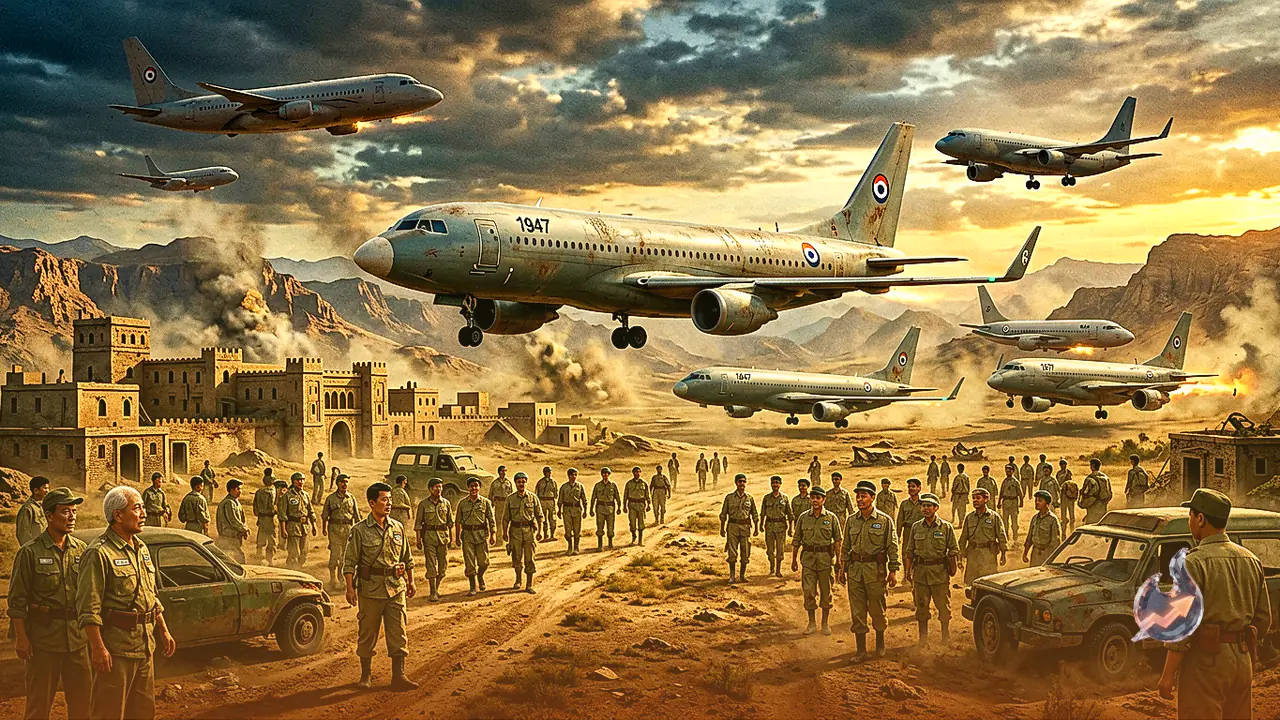
According to retired Group Captain Rajeev Kumar Narang, Senior Fellow at the Manohar Parrikar Institute for Defence Studies and Analyses and recipient of the Vayu Sena Medal, Indian pilots demonstrated remarkable ingenuity under extreme pressure. Operating without designated airfields, proper landing infrastructure, or navigational aids, IAF pilots flew transport aircraft directly into Srinagar and Poonch. By establishing a historic air bridge, the IAF airlifted troops, ammunition, food, and essential medical supplies right to the battleline while evacuating civilians. This decisive air intervention effectively halted the raiders and secured critical territories of Jammu and Kashmir. Remarkably, during World War II, British Professor Wells had assessed India's technology ecosystem as virtually non-existent, keeping advanced data restricted exclusively to European officers. Overcoming this zero baseline, Indian airmen established a tradition of operational excellence right at the dawn of independence.
Building Self-Reliance from 1951 and Mastering Fleet Diversity
While the IAF aims for complete self-reliance by 2047, its indigenous manufacturing initiative traces back to the immediate aftermath of independence. In 1951, just four years after emerging from two centuries of colonial rule, India successfully manufactured its first indigenous trainer aircraft, the Hindustan Trainer-2 (HT-2). Developing a homegrown trainer so rapidly established a foundational defense industrial vision that continues to guide the service today.
Subsequent decades required IAF aircrew and technical personnel to operate an exceptionally diverse fleet procured from both Eastern (Soviet Union/Russia) and Western (United States, United Kingdom, France, and Poland) blocs. Soviet platforms featured metric MKS flight dials and instrumentation, whereas Western aircraft relied on entirely different cockpit layouts and operational standards. Despite these stark systemic contrasts, the IAF seamlessly integrated fighters such as the Vampire, Mystere, MiG-21, MiG-23, MiG-27, MiG-29, Sukhoi-30 MKI, Jaguar, and Mirage-2000. The transport wing simultaneously maintained platforms including the Avro, Dornier, IL-76, and AN-32. Transitioning from Soviet Mi-series and French Alouette helicopters to indigenous platforms like the Advanced Light Helicopter (ALH), Light Utility Helicopter (LUH), and Light Combat Helicopter (LCH), the service has successfully bridged technological divides while expanding indigenous capabilities.
1965 and 1971 Conflicts: Decimating Armour and Securing Complete Air Supremacy
Following the 1962 border conflict, Pakistani military planners miscalculated Indian defense readiness, initiating hostilities in 1965. Although India maintained a defensive, peace-oriented stance initially, the military response was swift and devastating once attacked. In the plains of Punjab, IAF close-air-support sorties systematically neutralized enemy Patton tanks. Indian forces also secured the tactically critical Haji Pir Pass, demonstrating supreme battlefield advantage before restoring territories under goodwill agreements.
During the 1971 Liberation War, the IAF achieved absolute air superiority over Eastern Pakistan (now Bangladesh) within the opening days of the conflict. A defining moment occurred when IAF MiG-21 fighters executed a precision rocket strike against the Governor's House in Dhaka. Unguided rockets were generally not regarded as surgical precision weapons during that era, yet Indian pilots delivered them directly through the conference room windows where high-level enemy command discussions were underway. The strike decimated the adversary's command leadership morale, accelerating immediate capitulation.
The 1971 campaign showcased flawless joint service coordination. Faced with intricate river networks in East Pakistan that threatened to slow ground advances, IAF helicopters created a massive vertical air bridge, ferrying army units over water obstacles directly behind enemy lines. Surrounded by land, air, and a naval blockade, the adversary's command structure collapsed, resulting in the historic public surrender of 93,000 armed troops, an event unparalleled in modern military history.
1999 Kargil War: Operation Safed Sagar and Mid-Battle Technical Innovation
The 1999 Kargil conflict presented unprecedented operational demands when enemy forces covertly occupied mountain outposts exceeding 15,000 feet. Mountain warfare traditionally demands a seven-to-one attacker ratio to displace entrenched defenders on high peaks. To overcome these formidable odds, the IAF launched Operation Safed Sagar, marking the first time in military aviation history that precision air strikes were executed at such extreme altitudes and low air densities.
When conventional iron bombs proved ineffective against fortified high-altitude bunkers, the IAF executed real-time battlefield innovations. Technical teams and pilots modified unguided iron bombs with laser-guided kits, adapting them for precision delivery from Mirage-2000 fighters. Flying over 500 strike sorties, the IAF destroyed enemy supply depots and fortified command positions with surgical accuracy. This adaptive air strategy shattered the adversary's logistics and high-altitude defensive posture. From the improvised air bridges of 1947 to precision strikes over Kargil, the Indian Air Force has consistently demonstrated that tactical adaptability and operational resolve remain the decisive factors in national defense.