



















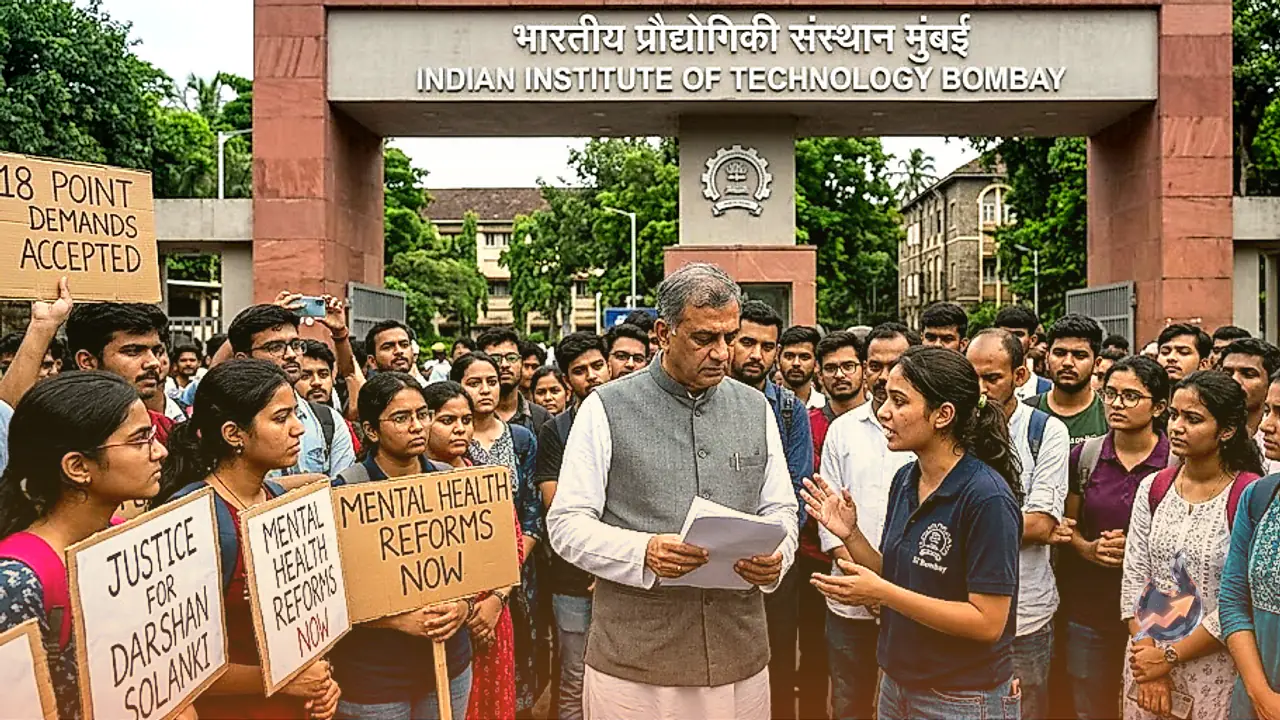

A wave of student agitation at IIT Bombay culminated in administrative concessions after three days of relentless demonstrations at the institute's gates. Following intense pressure from the student body in the wake of a second-year undergraduate's death, Director Kedare formally signed and agreed to an 18-point charter of demands. The development brought an end to the immediate blockade at the entrance, though tensions across the campus remain palpable as multiple inquiries commence.
Three Days of Demonstrations at the Campus Gate
The unrest began after the 22-year-old student was found dead in his hostel room on a Friday evening, merely hours after being accused of academic misconduct during a mid-semester examination. Shocked by the loss, students gathered in large numbers at the main gate, mounting a sustained sit-in protest. The demonstrators demanded immediate punitive measures against the faculty involved, an impartial inquiry into the surrounding circumstances, and comprehensive policy reforms. As the standoff entered its third day without signs of weakening, the administration engaged the student representatives and conceded to the entire charter.
The 18-Point Charter: Demands for Accountability and Suspension
At the heart of the 18-point charter is an uncompromising call for institutional accountability and disciplinary action. The students demanded that Professor Suryanarayana Dulla be suspended immediately pending the completion of the probe, with a further stipulation that anyone found culpable upon conclusion of the inquiry be removed from their post. In addition, the charter called for an unreserved public apology from IIT Bombay, asserting that the institute defamed the deceased student by publishing partial and selective details in a LinkedIn post.
Time-Bound Inquiries and Administrative Deadlines
To prevent procedural delays, the student charter established rigid timelines and direct administrative oversight. The resolution mandates the establishment of an independent inquiry committee comprising professors, student representatives, outside members, and individuals recommended by the student body. This committee will investigate the precise circumstances surrounding the fatality, including the nature and speed of the emergency and hospital response. The panel must deliver an interim report by September 30, followed by a final report by October 15.
Direct engagement has also been formalized. The administration agreed to conduct an open house before September 22 featuring the Director, Dean of Student Affairs (SA), Dean of Academic Programmes (AP), and the Head of Department, providing students an open floor to raise concerns. Furthermore, the charter introduced an unprecedented accountability clause: if the agreed measures are not executed within one month, the Director, Dean AP, and Dean SA are expected to resign. The administration must also furnish weekly written progress updates on the implementation of each demand.
Welfare Reforms and Support for Bereaved Families
The charter extends well beyond the immediate incident, demanding systemic transformations in student welfare, faculty conduct, and healthcare support. The document stipulated that adequate and prompt financial assistance be extended to the families of four individuals who died at IIT Bombay in recent months, alongside continuous administrative support. Demonstrators highlighted an urgent need to sensitize faculty members to mental health struggles and to revamp internal counseling infrastructure.
The agreed framework also requires establishing an autonomous mechanism to evaluate student distress. Comprising students, faculty, professional mental health practitioners, and external specialists, this body will be tasked with identifying structural pressures, refining disciplinary procedures, and ensuring effective distress-mitigation measures across all departments.
Crime Branch Takes Over Criminal Investigation
While the internal resolution unfolded on campus, the statutory legal proceedings advanced significantly. The Powai police registered an FIR based on a complaint lodged by the deceased student's parents, invoking Section 108 of the Bharatiya Nyaya Sanhita (abetment of suicide) along with relevant provisions of the Scheduled Castes and Scheduled Tribes (Prevention of Atrocities) Act. The family alleged that the youth endured severe institutional harassment and caste-based discrimination, matters that now form a central part of the police inquiry.
Recognizing the gravity of the case, the Mumbai Crime Branch took over the investigation into the 22-year-old student's alleged suicide. Investigators have named Professor Dulla as an accused in the matter and are preparing to summon him and other institute personnel for interrogation as forensic and witness examinations continue.
Examination Hall Episode and Faculty Defense
The tragic chain of events traces back to a mid-semester examination hall. The student, who was discovered dead later that evening, had allegedly been caught using a smartphone and accessing ChatGPT during the test. IIT Bombay stated that the student had reportedly uploaded the examination question paper to ChatGPT to generate answers, but maintained that no punitive disciplinary process had been formally launched against him. The institute asserted that the invigilator and department head present on site counseled the student, offering reassurances that the incident would not jeopardize his broader academic standing.
However, the IIT Bombay Faculty Forum took a firm stand in defense of Professor Dulla. Issuing a statement of solidarity, the forum maintained that the professor was discharging his official duty as an invigilator when he identified unauthorized smartphone usage and reported the suspected academic misconduct through designated institutional channels. While conveying profound grief and condolences to the student's family, the faculty body expressed serious distress over what it characterized as attempts to tarnish Professor Dulla's reputation for merely upholding academic integrity. With the internal pact signed, attention now shifts to the pending September 30 interim investigative report.