























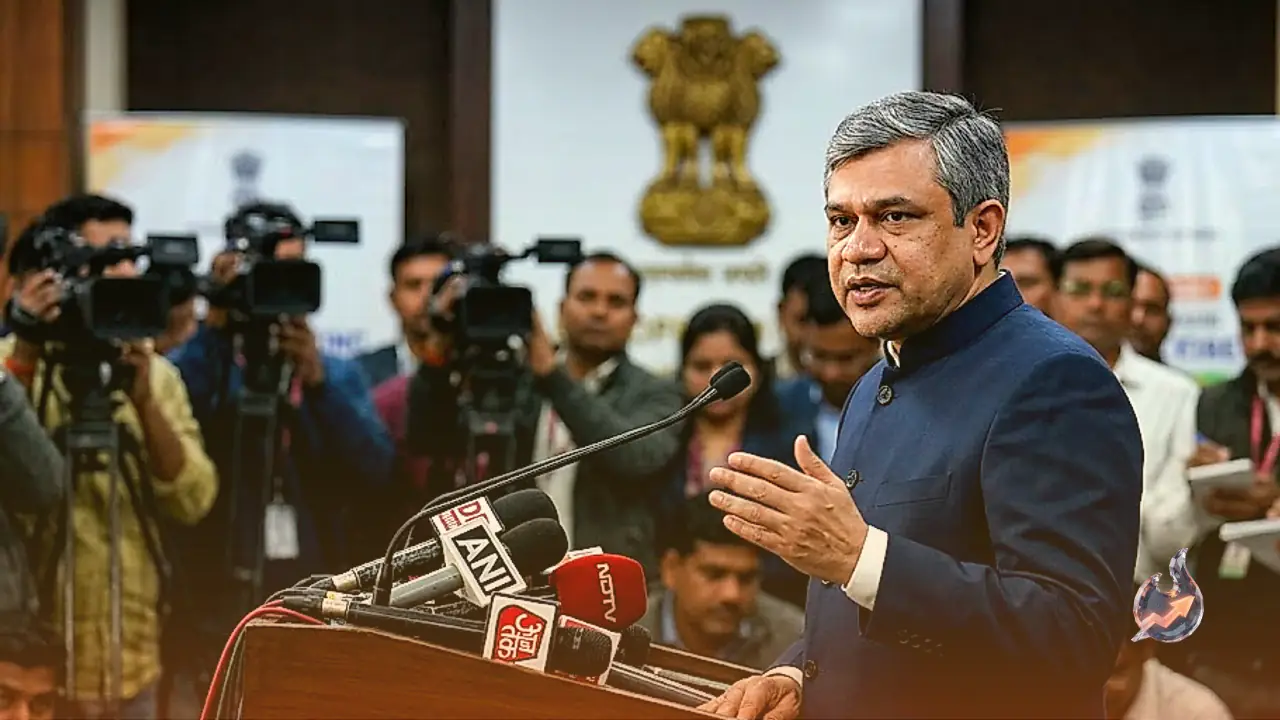

The Central Government of India has initiated stringent measures to enhance safety standards for women and children across online platforms. Moving to curb non-compliance by social media entities, updated directives have been issued to fortify the nation's digital security framework. Union Minister for Electronics and Information Technology Ashwini Vaishnaw provided key details regarding these policy decisions in the Lok Sabha. He affirmed that technology platforms must maintain strict surveillance over content that poses harm to minors. Furthermore, whenever a court or government authority issues an order regarding objectionable material, platforms are legally mandated to remove the flagged content within a strict 3-hour deadline. The government has simultaneously tightened regulatory oversight on deepfakes and fraudulent content generated through artificial intelligence.
Technical Mandates on AI Content and Enforcing Safe Harbor Liability
Addressing the Parliament, Minister of State for Information and Broadcasting Dr L Murugan outlined the government's long-term digital vision, stating,
"India's internet will be made safe and trusted."He emphasized that social media corporations are required to deploy robust technical mechanisms within their architecture to detect and block deceptive AI-generated content.
Under the updated IT rules brought into force on 10 February 2026, severe punitive provisions have been framed against the dissemination of deepfakes and fake synthetic media. Social media companies must recalibrate their internal content moderation systems accordingly. Any platform failing to comply with these statutory requirements will forfeit its legal immunity (safe harbor protection) under IT law, exposing the entity to direct legal prosecution and regulatory sanctions.
Child Privacy Safeguards Under DPDP Act 2023 and Mandatory Reporting
To shield children from digital risks, strict statutory regulations have been enacted under the Digital Personal Data Protection (DPDP) Act 2023. Under these provisions, any entity processing a child's personal data must first obtain verifiable parental or legal guardian consent.
The regulations impose a complete prohibition on tracking children's online behavior, profiling their activity, or serving targeted advertisements directed at minors. Additionally, social media intermediaries are now legally obligated to report offenses involving children under the POCSO Act and the Bharatiya Nyaya Sanhita to relevant law enforcement agencies without delay.
NCRP Portal Enhancements and Anonymous Cyber Crime Reporting
To assist victims of cyber crime, new user-centric tools have been integrated into the National Cyber Crime Reporting Portal (NCRP). Women and children can now submit complaints on the portal while remaining completely anonymous, ensuring privacy and protection during reporting.
The portal has also introduced a feature titled 'Report and Check Suspect', allowing citizens to verify the authenticity of suspicious websites and WhatsApp numbers. Users can also directly report Telegram handles and social media links containing deepfake content for swift investigation.
Nationwide Awareness Drives, School Curriculum and Forensic Infrastructure
To foster digital literacy, the Ministry of Electronics and Information Technology (MeitY) has conducted thousands of workshops under its Information Security Education and Awareness (ISEA) program, reaching over 1.1 million participants across India. Concurrently, the government and CERT-In are regularly publishing awareness handbooks and educational videos. To embed safety habits early, the Ministry of Education and CBSE have incorporated cyber security topics directly into school curricula.
Capacity building initiatives driven by the Indian Cyber Crime Coordination Centre (I4C) have provided cyber safety training to more than 200,000 students affiliated with the NCC and NSS. To combat cyber offenses against women, the Union Government has released over 132 crore rupees in funds to state governments. Furthermore, 33 specialized cyber forensic laboratories have been operationalized across India, and more than 24,000 police personnel have undergone comprehensive training in forensic analysis and digital crime investigation.