






















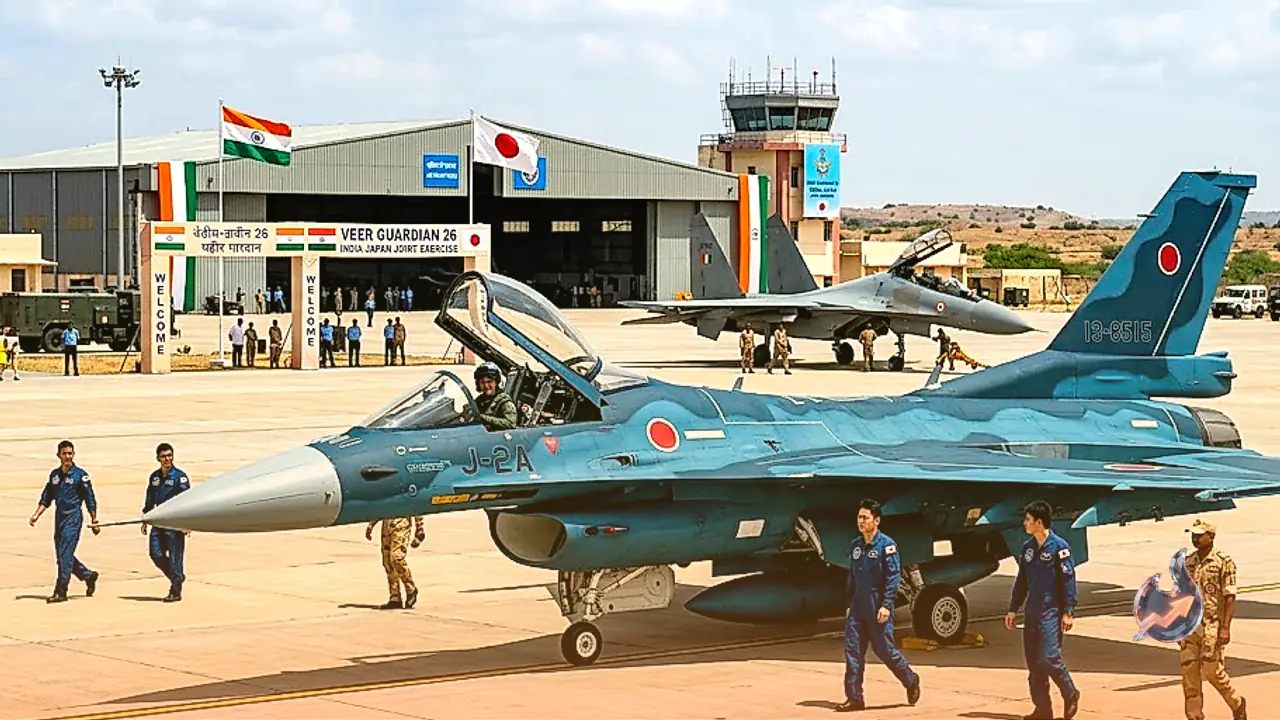

Defense and strategic cooperation between India and Japan are reaching a significant new milestone. In September, Japan is scheduled to send its F-2 fighter jets to India for the very first time. Three F-2 fighter jets and approximately 110 military personnel from Japan will participate in the upcoming Veer Guardian 26 military exercise, which is set to take place in Rajasthan. Running from September 9 to September 21, this joint drill will go beyond a standard bilateral air force training exercise, highlighting the deepening strategic alignment between New Delhi and Tokyo in the evolving Indo-Pacific region. Notably, this marks the first time Japan is deploying its combat aircraft onto Indian soil, a development widely viewed as a direct message to China amid its expanding regional influence.
Japanese F-2 Jets To Touch Down In India
According to the Japan Air Self-Defense Force, the Veer Guardian 26 exercise will be hosted in Rajasthan. The deployment will include three advanced F-2 fighter jets from Japan. In addition, around 110 personnel from the 8th Air Wing based at the Tsuiki Air Base in southwestern Japan will travel to India to take part in the drills. In a statement reported by media outlets, Japan Air Self-Defense Force Chief of Staff Takehiro Morita emphasized that the exercise will serve as a crucial opportunity to enhance mutual understanding and operational trust between the two air forces.
Previously, the air forces of both nations have engaged in cross-country training under the Veer Guardian framework. The inaugural edition of the exercise took place in Japan in January 2023. At that time, India deployed its Su-30MKI aircraft, while Japan participated with its F-2 and F-15 fighter jets. Now, by sending its combat aircraft to Indian territory for the first time, Tokyo is elevating bilateral defense engagement to a new tier.
Strategic Significance Amid Growing Regional Tensions
Security concerns for both India and Japan over recent years have been largely intertwined with China's expanding military activities. While India faces territorial disputes with China along its Himalayan frontiers, Japan remains increasingly concerned about Beijing's assertive military maneuvers in the East China Sea and the Western Pacific. According to Jagannath Panda, an expert on Indo-Pacific affairs, this exercise should not be viewed merely as a routine military drill. He noted that while India confronts China along the Himalayan sector, Japan monitors Chinese military operations in the East China Sea and the Western Pacific, meaning the security challenges faced by both countries are steadily converging.
Japan's air force currently operates a formidable fleet of over 300 frontline combat aircraft. This inventory includes approximately 200 F-15J and F-15DJ jets, roughly 85 to 90 Mitsubishi F-2A and F-2B fighters, and around 50 F-35A and F-35B aircraft, with the fleet size continuously expanding. Tokyo is actively pursuing plans to acquire a total of 147 F-35 fighters, comprising 105 F-35A and 42 F-35B models. Furthermore, Japan is collaborating with the United Kingdom and Italy to develop a next-generation fighter jet under the Global Combat Air Programme, which is expected to enter service around 2035.