



















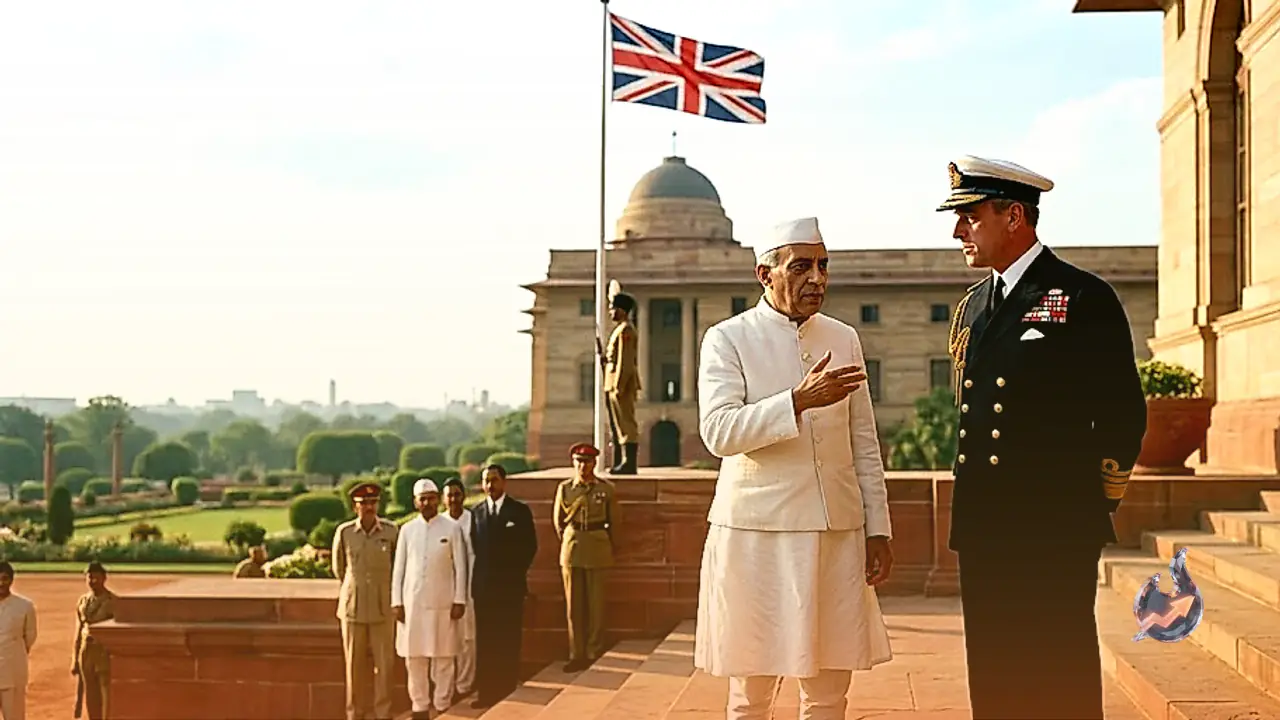

With only five days remaining before India gained independence, preparations were in full swing across the nation. However, behind closed doors in Delhi, an important diplomatic question had emerged regarding government protocol. The issue centered on how and when the British flag, the Union Jack, should be displayed on official government buildings in independent India. This matter sparked an exchange of official letters between Jawaharlal Nehru and Viceroy Lord Mountbatten from August 5 to August 10, 1947.
Mountbatten Proposal and the 10 Observance Days
Archival records show that Lord Mountbatten sent a letter to Jawaharlal Nehru on August 5, 1947. In this letter, Mountbatten proposed a list of 10 specific dates throughout the year on which he desired the Union Jack to be flown alongside the Indian national flag on public buildings.
The dates suggested by Mountbatten included the following
- January 1: Army Day
- April 1: Air Force Day
- April 25: Anzac Day
- May 24: Commonwealth Day
- June 12: King's Official Birthday
- June 14: United Nations Flag Day
- August 4: Queen's Birthday
- August 15: Indian Independence Day
- November 7: Navy Day
- November 11: Remembrance Day
6 August 1947: Nehru Firm Stand on Independence Day
Jawaharlal Nehru responded to Lord Mountbatten on August 6, 1947. In his letter, Nehru acknowledged the general concept of flying dual flags on public structures on designated days, but he drew a strict line regarding August 15.
Nehru clearly stated that August 15 carried unique national significance for India, and therefore the Indian national flag must fly alone on that day. He also suggested that this rule should remain in place for future anniversaries of Independence Day.
Instructions Regarding India House in London
While maintaining a firm stance on Indian soil, Nehru showed diplomatic flexibility regarding international protocol. In his letter, he mentioned an inquiry made concerning India House in London. Nehru noted that while the tricolor would fly alone across India, displaying both the Indian flag and the Union Jack at India House in London on August 15 would be an appropriate diplomatic gesture. Instructions to this effect were forwarded to the Indian High Commissioner in London.
9 and 10 August: Revised Letters and Agreement on Future Consultations
Responding to Nehru, Lord Mountbatten wrote back on August 9, 1947. In this revised letter, Mountbatten removed August 15, 1947 from the list of dual-flag days. However, he suggested that in future years, the High Commissioners of both new Dominions, India and Pakistan, could jointly consult on whether to fly the Union Jack on August 15.
On August 10, 1947, Nehru sent a brief reply thanking Mountbatten for his letter of August 9. Nehru agreed to the proposal that the governments of India and Pakistan could jointly consider the question regarding August 15 in the following year, leaving the final decision to future discussions.
10 August in Karachi: Role of Jogendra Nath Mandal
While flag protocol discussions were taking place in Delhi on August 10, 1947, significant political developments were unfolding in Karachi. The newly formed Constituent Assembly of Pakistan was commencing its initial proceedings, appointing Jogendra Nath Mandal as its temporary chairman.
Mandal, a prominent Dalit leader from Bengal, believed that political cooperation with the Muslim League was necessary to safeguard the rights of scheduled castes. During the violent communal clashes of Direct Action Day in Calcutta in 1946, Mandal had urged the Dalit community to stay away from the riots. His political alignment had brought him close to Muhammad Ali Jinnah.
On August 10, Mandal assumed his temporary role in the assembly. The following day, on August 11, 1947, he formally declared Muhammad Ali Jinnah as the permanent President of the Pakistan Constituent Assembly, after which Jinnah delivered his address on civic equality. Thus, August 10, 1947 remained a crucial date in the constitutional history of both emerging nations.