
























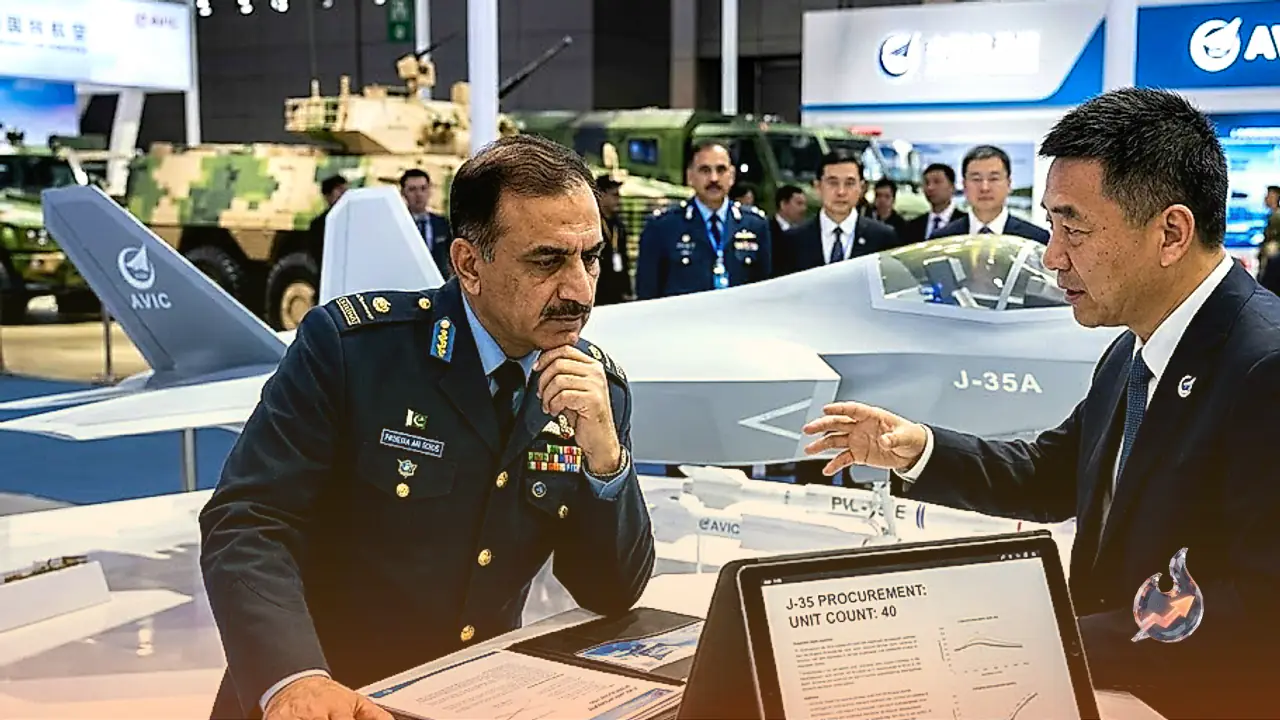

The strategic air landscape of South Asia is rapidly moving toward a crucial juncture as competition over fifth-generation stealth combat aircraft intensifies. Talks regarding Pakistan's potential acquisition of 40 J-35 stealth fighter jets from China have sparked rigorous debate among global defense analysts. Should this procurement go through, its ramifications will extend far beyond bilateral military rivalry between India and Pakistan, fundamentally altering the broader geopolitical alignment across the Indo-Pacific region. In response to these developments, Washington based defense policy experts and prominent research institutions are reassessing the feasibility of offering the American F-35 stealth fighter to India.
While the United States has previously expressed willingness to supply F-35 fighters to New Delhi, the Indian defense leadership has hitherto refrained from committing to either the American F-35 or Russia's Su-57 platform. With Pakistan advancing toward securing Chinese fifth-generation capability, military strategists are actively questioning whether India must swiftly adopt an interim solution to safeguard its technological edge in regional airspace.
Pakistan's Pursuit of 40 J-35 Stealth Jets and Regional Air Balance
Defense evaluations built upon open source intelligence indicate that Pakistan is actively negotiating to purchase approximately 40 J-35 stealth fighters from Beijing. If finalized, Pakistan will become the inaugural foreign customer to operate China's indigenous fifth-generation stealth platform. The J-35 made its inaugural public flight demonstration during the 2024 Zhuhai Air Show. Military analysts emphasize that integrating these fighters into the Pakistan Air Force will significantly enhance its offensive range and radar evasion capabilities, while concurrently solidifying China's operational footprint in South Asia.
The Chinese J-35 incorporates advanced low-observable geometry and radar absorbing materials designed to penetrate sophisticated air defense networks. Deploying a fleet of 40 such stealth platforms would present fresh tactical hurdles for Indian air defense radars and interception systems. Consequently, international defense observers view this prospective deal as a major structural shift in the South Asian military equilibrium.
Heightened Focus from US Think Tanks and the F-35 Option
Prominent Washington think tanks, including the Stimson Center, the Carnegie Endowment for International Peace, and the Center for Strategic and International Studies (CSIS), have closely analyzed the strategic fallout of this potential transaction. Research fellows at these institutions contend that Pakistan's induction of J-35 jets signifies much more than a routine hardware upgrade; it reflects a deepening military alliance between Beijing and Islamabad. This growing defense synergy poses novel security challenges for Western strategic interests and partner nations in the region.
Manufactured by Lockheed Martin, the F-35 Lightning II is widely regarded as the world's most capable fifth-generation multirole stealth platform. American defense scholars argue that a substantial Pakistani stealth inventory will inevitably exert strategic pressure on Washington to bolster India's aerial combat power. Given that the United States considers India a pivotal partner in counterbalancing China's expanding influence, accelerating combat aviation assistance to New Delhi is gaining renewed traction among policymakers.
India's Operational Capability Gap and Indigenous AMCA Timeline
The central strategic dilemma facing New Delhi revolves around an operational timeline disparity. India's home-grown fifth-generation fighter program, known as the Advanced Medium Combat Aircraft (AMCA), remains under active development. Defense engineers and military planners estimate that full-scale production and operational deployment of the AMCA are still several years away.
Aerospace analysts identify this temporal capability gap as a matter of strategic vulnerability. If Pakistan receives operational J-35 units while India's AMCA remains in the development cycle, regional air superiority could temporarily tilt. Although the Indian Air Force currently operates advanced 4.5-generation multirole fighters such as the Rafale and upgraded Su-30MKI, fifth-generation stealth platforms operate in a fundamentally distinct combat paradigm defined by low radar cross-sections, advanced sensor fusion, and networked warfare capabilities.
F-35 Integration Barriers and the Russian Defense Ecosystem
A section of American defense experts suggests that procuring the F-35 could serve as an effective stopgap measure for India, affording immediate stealth deterrence until the indigenous AMCA reaches operational maturity. However, navigating this path involves formidable technical and geopolitical hurdles. The primary obstacle resides in the Indian Armed Forces' deep integration with Russian military hardware.
India's combat inventory features significant numbers of Russian-built Su-30MKI fighters alongside the state-of-the-art S-400 Triumf surface-to-air missile system. US military planners have long voiced concern that operating the F-35 in close proximity to Russian defense hardware risks exposing sensitive stealth characteristics and electronic signatures. Furthermore, the F-35 functions as a highly network-centric weapon platform tied to the secure Operational Data Integrated Network (ODIN) managed by the United States. Participating in ODIN demands strict adherence to US cybersecurity protocols and operational controls, requirements that conflict with India's foundational doctrine of strategic autonomy.
Domestic Defense Manufacturing versus Immediate Import Dilemma
Strategic debate within India's defense community remains divided between two primary approaches to fifth-generation fighter procurement. Proponents of foreign acquisition argue that purchasing American F-35s or Russian Su-57s would immediately neutralize any tactical advantage sought by Pakistan and China, ensuring uninterrupted air deterrence.
On the other hand, advocates of self-reliance contend that committing vast financial reserves to expensive foreign fighter procurements could undermine the nation's ambitious AMCA program. Large-scale imports risk diverting capital, engineering focus, and industrial momentum away from domestic defense manufacturing initiatives like Atmanirbhar Bharat. Although Pakistan's J-35 contract has not been formally executed and Washington has made no official commitment regarding F-35 transfers to India, these dynamics underline the rapidly intensifying stealth arms race in South Asia. India's ultimate decision will require balancing immediate tactical imperatives against long-term indigenous defense autonomy.


