





















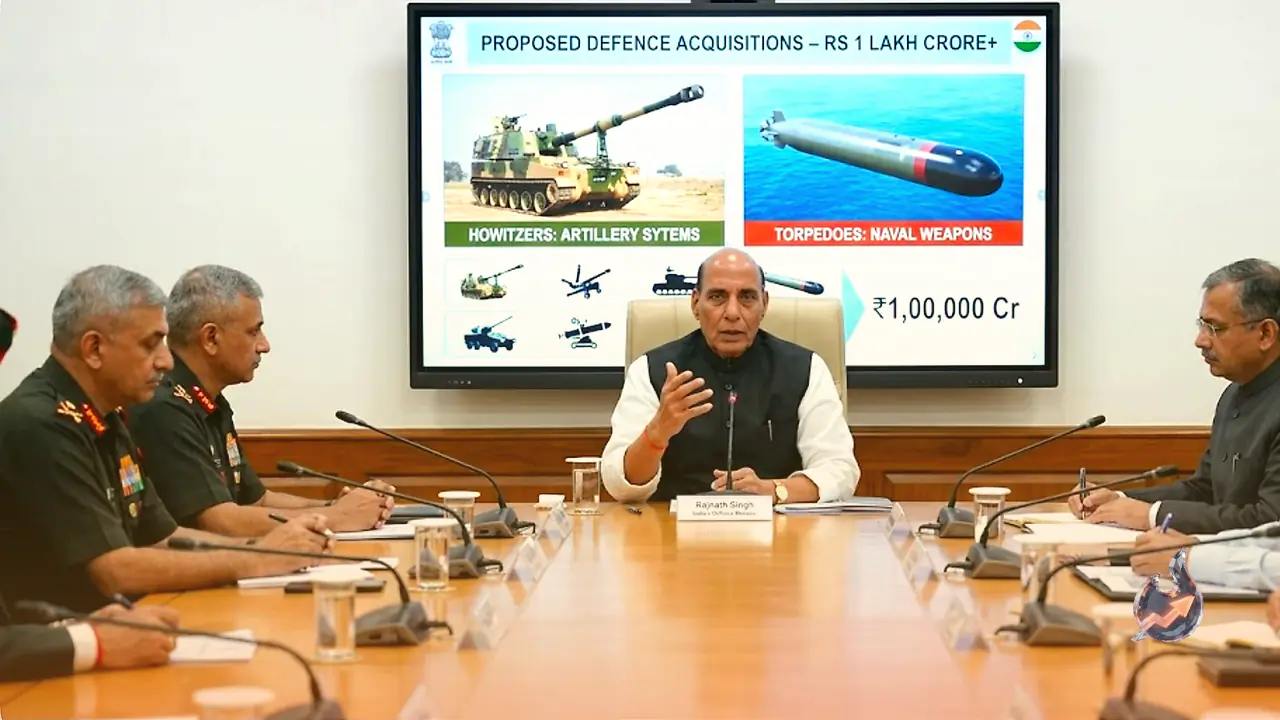

India's top defence procurement body, the Defence Acquisition Council (DAC), is set to hold a crucial meeting on Friday to consider arms and equipment purchase proposals worth more than Rs 1 lakh crore. The meeting will be chaired by Defence Minister Rajnath Singh, with the core objective of strengthening the operational readiness of the Indian armed forces. Several major modernisation projects are expected to get the go ahead, and all these proposals have been drawn up keeping India's evolving security challenges in mind, whether along the northern border or the western front.
The First Step: Acceptance of Necessity
The most important item on the agenda is clearing the Acceptance of Necessity, or AoN, for these proposals. It is considered the first and most basic stage of any defence procurement process. An AoN does not amount to an actual purchase order, but it gives the entire process formal approval and opens the path from floating a tender to eventually signing a contract.
Army to Get a Fresh Batch of K-9 Vajra Howitzers
The largest chunk of this round of proposals belongs to the Indian Army, which has been steadily working to build up its firepower. Among the proposals is an additional purchase of K-9 Vajra self-propelled 155 mm howitzers. These guns are already part of the Army's arsenal and have proven themselves everywhere from high-altitude terrain like Ladakh to desert regions. Rapid mobility, long-range accuracy and strong firing capability make them especially valuable.
Preparing for a Silent Strike From the Sky
The meeting will also take up proposals for loitering munitions, commonly known as kamikaze drones. These are weapons that can hover in the air for extended periods and strike a target precisely the moment an opportunity arises. Their role in modern warfare has grown rapidly in recent years.
Also under consideration is the purchase of Verba MANPADS, or man-portable air defence systems, which are capable of bringing down low-flying aircraft, helicopters and drones. The proposals additionally include extra air defence guns and Active Protection Systems (APS) for tanks, which are designed to destroy incoming missiles and rockets in mid-air before they can hit their target.
Big-Ticket Items for the Navy and Air Force Too
It isn't just the Army in focus. The Navy's wishlist on the agenda includes next-generation heavyweight torpedoes, unmanned surface vessels (USVs), unmanned underwater vehicles (UUVs), drones, electronic warfare systems and sonar systems. For the Air Force, discussions are expected to cover long-range stand-off precision missiles, air-to-air refuelling tankers and new air defence radar systems.
A Major Push for Indigenous Defence Manufacturing
If all these proposals are cleared, the biggest beneficiary is likely to be India's domestic defence manufacturing base. Bharat Electronics Limited (BEL) and Bharat Dynamics Limited (BDL) in particular are expected to see the largest gains from fresh orders. Taken together, this marks a significant step forward in India's defence modernisation journey. It will not only boost the strike capability of the armed forces but also multiply their ability to respond to any threat along the borders. The scale of these preparations makes clear that India's military strategy is set to become far more technology driven, faster and more lethal in the times ahead.