
















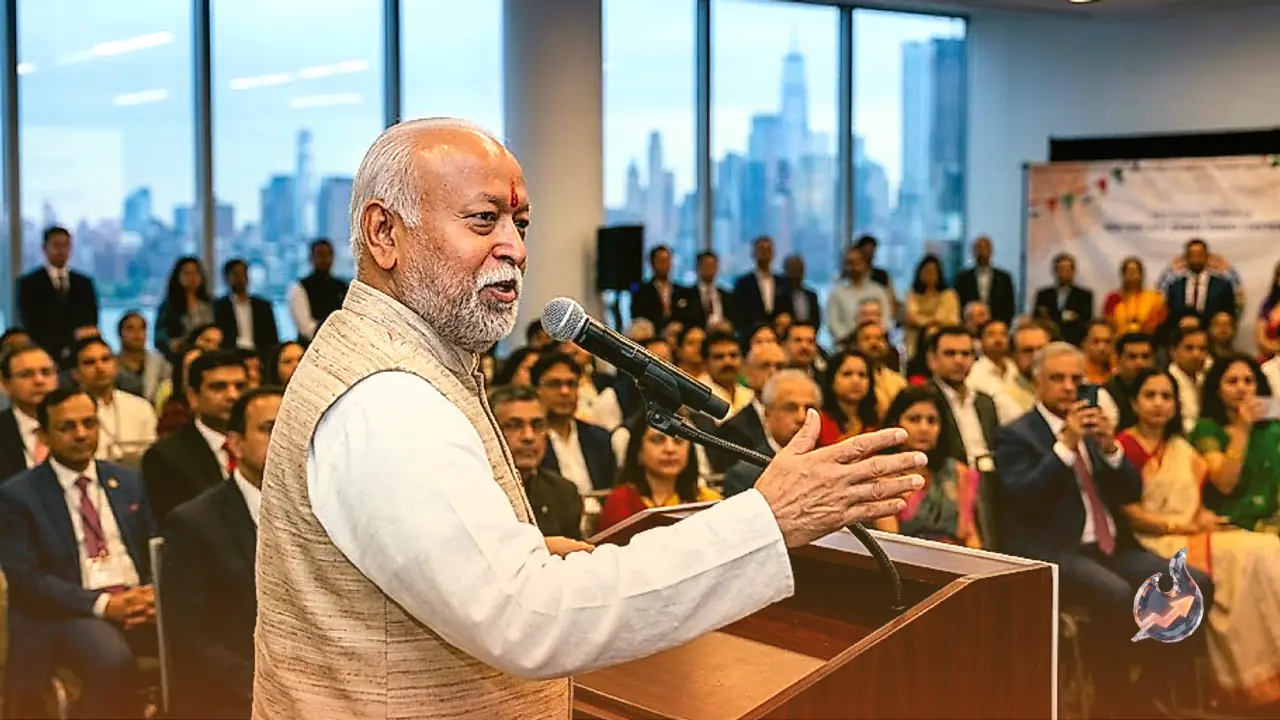

During a major international gathering of spiritual leaders in New York titled the One World: One Humanity faith leaders conference, Rashtriya Swayamsevak Sangh chief Mohan Bhagwat delivered a comprehensive address on religious diversity, shared humanity, and social cohesion. Before an audience comprising leaders from various religious traditions, Bhagwat underscored that while forms of worship and ritualistic disciplines may vary greatly, the ultimate truth and the essence of humanity remain singular and universal.
The Core Tradition of Shared Humanity
Elaborating on traditional Indian philosophy, Bhagwat noted that the land's heritage has long embraced the view that paths and faiths can be multiple, yet human dignity is indivisible. He explained that truth is one and humanity is a direct manifestation of that absolute truth. In his view, the mission of the organization involves traveling across different parts of the globe to remind people that beneath surface-level differences, the entire human race constitutes a single family.
Clarifying Hindutva and Muslim Integration
Addressing the broader interpretation of Hindutva, the RSS leader recounted a specific interaction from 2018 when certain Muslim individuals questioned him regarding the organization's concept of a Hindu nation. Directly addressing that inquiry, Bhagwat stated that if any Hindu believes that Muslims should not exist in India, that person completely fails to understand the foundational spirit of Hindutva. He explained that the Hindu worldview recognizes diverse routes toward the ultimate truth, all converging toward a unified goal.
Preserving Human Dignity Amid Diversity
He maintained that no fundamental inequality exists among human beings and every individual holds an inherent right to live with dignity and self-respect. According to him, embracing diversity while concurrently preserving an underlying sense of unity remains the defining hallmark of Indian tradition. Discussing religious practices, the RSS chief noted that while ritualistic disciplines might serve as practical tools along an individual spiritual journey, the ultimate objective of true religion is the realization of truth itself.
Overcoming Historical Adversity Through Dialogue
Reflecting on historical experiences, Bhagwat pointed out that the nation has withstood numerous foreign invasions and severe historical challenges over centuries, yet its civilization consistently offered a universal message of oneness to the world. He also highlighted ongoing organizational dialogues with Muslim and Christian communities within India. He stressed that while dialogue represents a crucial initial step, humanitarian service must proceed hand in hand with communication rather than being treated as a secondary afterthought.
Dispelling Misconceptions Surrounding Service Work
Asserting the non-discriminatory nature of organizational outreach, Bhagwat claimed that relief and service initiatives undertaken by members are executed without any bias whatsoever. He acknowledged that misunderstandings and erroneous narratives regarding the organization often circulate widely, though such misconceptions quickly dissipate when critics experience the grassroot work firsthand. Furthermore, he remarked that the organization historically prioritizes ground-level service over media publicity.
The Role of Politics and Public Opinion
Concluding his address, Bhagwat touched upon the influence of modern politics and public opinion, noting that political parties and leaders in a democracy invariably respond to prevailing public sentiments. He observed that bringing about meaningful global change and averting conflicts requires engaging with the political sphere, provided the underlying motivation remains constructive rather than self-serving. He criticized the prevailing political mindset dominated by narrow self-interest and urged a shift toward collective well-being and social harmony.