























Military strategists in New Delhi and defense corridors are closely watching developments as India prepares to secure what can only be described as a silent underwater leviathan. In contemporary geopolitics, true supremacy is not merely measured by might on land or in the air, but by the ability to dominate the depths of the ocean and outmaneuver adversaries beneath the waves. The Indian Navy has steadily bolstered its fleet over recent months with vessels capable of deterring hostile intentions from the sea. Now, the nation is on the verge of securing a groundbreaking submarine deal that will drastically elevate its underwater warfare capabilities. The defining trait of this upcoming submarine class is its extraordinary endurance, allowing it to lurk undetected beneath the ocean surface for weeks on end without exposing itself to enemy surveillance, much like a patient predator waiting motionless before striking its target. This pivotal transition centers around the proposed high-profile defense agreement between India and Germany.
Project-75I and the Core Value of the Deal
The true significance of this impending defense acquisition lies far beyond its hefty price tag of approximately ₹90,000 crore or the procurement of six new vessels. The primary strength of this entire procurement initiative is the advanced capability it grants, enabling these submarines to sustain prolonged military operations deep beneath the ocean for multiple days without ever surfacing or risking detection. In modern naval warfare, this specific underwater endurance transforms a conventional submarine into a deeply formidable strategic asset.
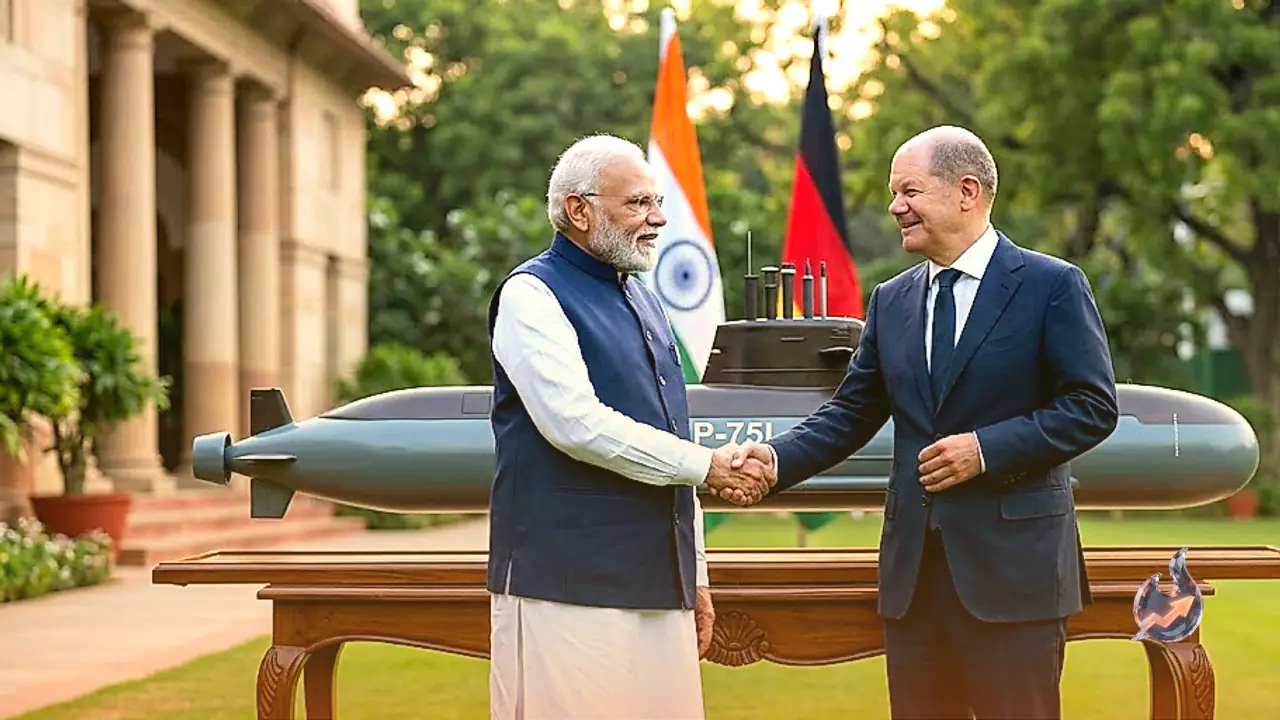
On July 30, German Ambassador to India Philipp Ackermann expressed strong confidence that the long-delayed Project-75I agreement could potentially be signed as early as August. Valued at roughly 8 billion euros, amounting to nearly ₹90,000 crore, the project involves a strategic partnership between India’s Mazagon Dock Shipbuilders Limited and Germany’s ThyssenKrupp Marine Systems.
Domestic Construction and Technological Framework
Under the finalized framework of the plan, all six submarines will be constructed entirely within India. Industry expectations suggest the design will draw heavily from ThyssenKrupp Marine Systems’ advanced Type-214 class diesel-electric submarines, which are widely recognized globally as among the quietest and longest-residing conventional underwater vessels. However, formal signatures have not yet been placed on the contract. The precise financial cost, the final configuration of the boats, and the exact scope of technology transfer bound for India will only become fully transparent once the official contract is officially sealed and executed.
In reality, the timeline for this ambitious defense project has faced multiple extensions in the past. Back in March, the German ambassador anticipated a formal agreement within six to eight weeks, while German Defence Minister Boris Pistorius suggested in April that the deal could wrap up within three months. The newly cited August timeframe certainly indicates that discussions have entered their decisive final phase, but experts caution that until the paperwork is formally signed, the arrangement cannot be treated as completely finalized.
Understanding Snorkel Vulnerabilities
A typical diesel-electric submarine operating solely on battery power can remain remarkably quiet and difficult to detect. Its primary tactical vulnerability emerges when those energy reserves require recharging. To replenish batteries, the submarine must navigate upward to shallow or periscope depth, extend a snorkel above the waterline, and draw atmospheric oxygen to power its internal diesel engines. While the vessel does not need to surface fully, operating near the water line and exposing masts significantly increases the probability of acoustic, thermal, radar, or visual signatures being intercepted by adversaries.
The Strategic Value of Air-Independent Propulsion
Air-Independent Propulsion, commonly known as AIP, is specifically engineered to bridge these risky battery-charging gaps. The AIP system generates electrical power internally without drawing oxygen from the surrounding atmosphere. In the case of ThyssenKrupp Marine Systems, fuel cells utilize stored reactants electrochemically to generate power, allowing the submarine to recharge or preserve its batteries while remaining fully submerged. ThyssenKrupp Marine Systems notes that its latest Type 214 design pairs a fuel-cell AIP with a remarkably low acoustic signature, supporting submerged operations for weeks without detection. The exact endurance of an Indian vessel will ultimately depend on its final physical size, configuration, speed, and specific mission profiles.
It is important to note that AIP does not convert a conventional submarine into a nuclear-powered vessel. The technology remains most effective for slow, quiet patrol missions. High-speed movement quickly exhausts energy reserves, whereas nuclear submarines can maintain high speeds and prolonged deployments indefinitely. Nevertheless, in operational waters where a submarine must quietly wait for a target or safeguard vital maritime choke points, extending underwater endurance can prove tactically decisive.
Parallel Domestic Efforts and Ongoing Developments
The Indian Ministry of Defence originally issued the Request for Proposal for six conventional submarines equipped with a proven fuel-cell AIP system under Project-75I in July 2021. The undertaking was structured under a strategic partnership model requiring an Indian shipyard to collaborate with an overseas technology partner. When industry assessments reviewed the competitive landscape in January 2025, none of India's seventeen operational conventional submarines featured AIP technology. Since that time, India has commissioned INS Vagshir, the sixth and final Kalvari-class submarine constructed by Mazagon Dock Shipbuilders Limited under the preceding Project-75 program.
While those Kalvari-class vessels were delivered without integrated AIP, India has actively pursued a separate domestic solution for them. The Defence Research and Development Organisation is currently developing an indigenous fuel-cell AIP system intended for integration into existing submarines via an extra hull section during scheduled refits. Recent project updates from the organization indicate ongoing progress in realizing this domestic technological capability.