





















The Historic Banyan Tree Planted by Fakhruddin Ali Ahmed in Sultanpur Nears Its 50th AnniversaryIndia
23 Aug 2026, 12:21 pm (58 min ago)· 2

The Historic Banyan Tree Planted by Fakhruddin Ali Ahmed in Sultanpur Nears Its 50th Anniversary

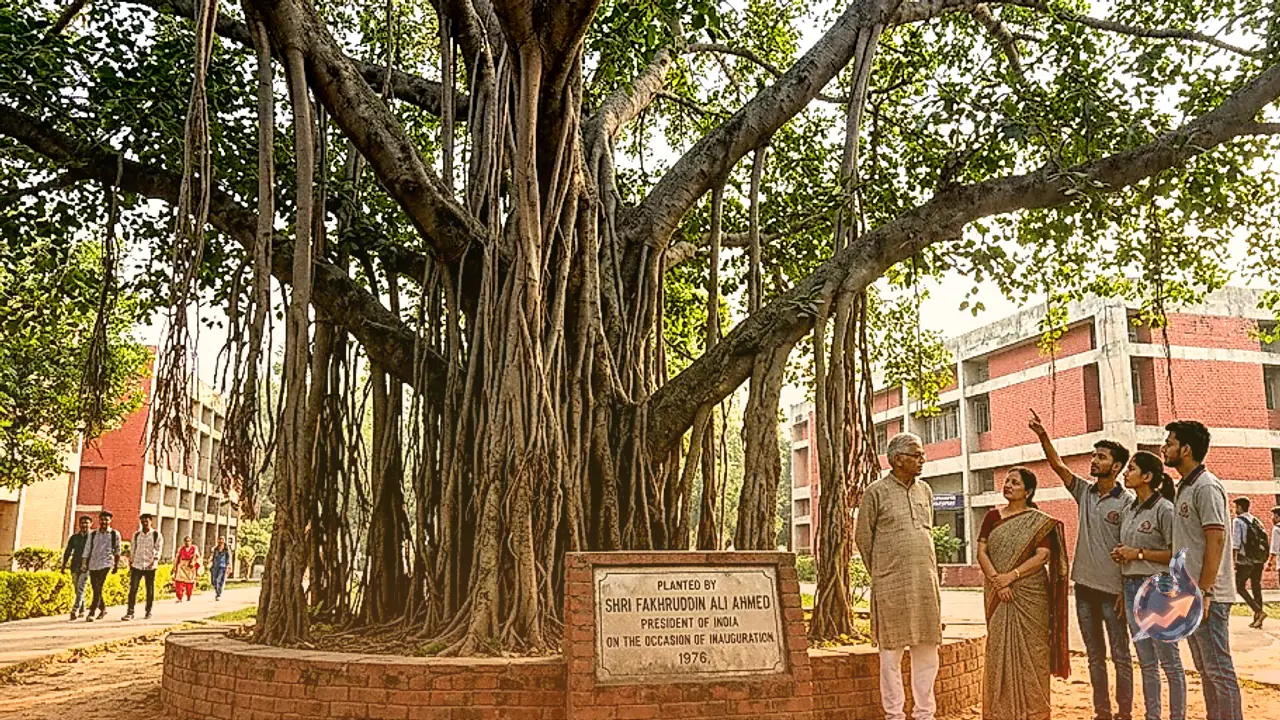
A massive banyan tree inside the Kamla Nehru Institute of Technology campus in Sultanpur stands as a living testament to history. It was personally planted by the then President of India, Fakhruddin Ali Ahmed, in 1976.

Sultanpur is home to numerous historical trees and sites that carry unique local significance and beliefs, though concrete documentation is often hard to find. However, there is one remarkable tree on record that was planted not by an ordinary citizen, but by the President of India. The story dates back to 1976, during the inauguration of the Kamla Nehru Institute of Technology. Back then, Union Minister Babu Kedarnath Singh invited President Fakhruddin Ali Ahmed to grace the inauguration ceremony, during which the tree was planted. Today, this banyan tree is nearly 50 years old and has grown into a massive structure.

Planted by the Hands of the President

Dr. Saurabh Mani Tripathi, a professor working at the Kamla Nehru Institute of Technology, explains that Sultanpur harbors many trees and historical landmarks that are not merely parts of nature, but containers of rich local history. One such banyan tree stands proudly within the institute campus, distinguished by the fact that it was planted by the country's president with his own hands.

Also read

Specifically, July 28, 1976, marked a momentous day in Sultanpur's history. It was the day designated for the inauguration of the Kamla Nehru Institute of Technology. Upon the invitation of prominent Sultanpur leader and Union Minister Babu Kedarnath Singh, the then President of India, Fakhruddin Ali Ahmed, traveled to Sultanpur. During the inauguration festivities, President Fakhruddin Ali Ahmed and Babu K.N. Singh planted this banyan sapling on the campus grounds. At the time, few could have imagined that this small sapling would eventually evolve into a living monument of the region's past.

A Living Monument to History

Today, the banyan tree has expanded into a grand canopy, serving as a reminder of the era when the country's first citizen visited the soil of Sultanpur. Its roots reach deep not just into the earth, but into the historical fabric of the city. In Indian tradition, the banyan tree symbolizes longevity, stability, and enduring heritage. Consequently, this tree is far more than just flora for Sultanpur; it remains a living memory of that historic event on July 28, 1976.


Questions & Answers

Who planted the banyan tree on the KNIT campus?
The banyan tree was planted by the then President of India, Fakhruddin Ali Ahmed, on July 28, 1976.
How old is the banyan tree now?
Today, the banyan tree is approximately 50 years old and has grown into a massive form.
For what event did President Fakhruddin Ali Ahmed visit Sultanpur?
He visited Sultanpur to attend the inauguration ceremony of the Kamla Nehru Institute of Technology.
Who invited the President to Sultanpur?
The President was invited by the prominent Sultanpur leader and Union Minister Babu Kedarnath Singh.

Comments 2

Karan Malhotra@karan-malhotra·43m ago

This report is vital from the perspective of environmental history and the preservation of public heritage. Such historical sites and natural landmarks linked to the nation's highest constitutional office require proper legal and administrative documentation to ensure their protection against future encroachment or vandalism.

Ravikash Gupta@ravikash·43m ago

While this report highlights a unique intersection of environment and history, it also invites an economic and tourism-driven perspective. Developing such historic trees as 'heritage assets' or green capital can boost localized educational tourism. If premier institutions like KNIT allocate institutional budgets or leverage Corporate Social Responsibility (CSR) for the upkeep of these natural landmarks, it would strongly align with sustainable development and campus greening goals. In the future, geo-tagging and digital mapping of such heritage sites could significantly enhance awareness among researchers and the younger generation.

Citizen journalism

Become a TrendKia journalist

Voice of the people

Share news, photos and videos from your area with TrendKia and let your voice reach the nation. Every citizen a journalist.

Join now
CH 01 LIVE
TrendKia TV ON AIR