





















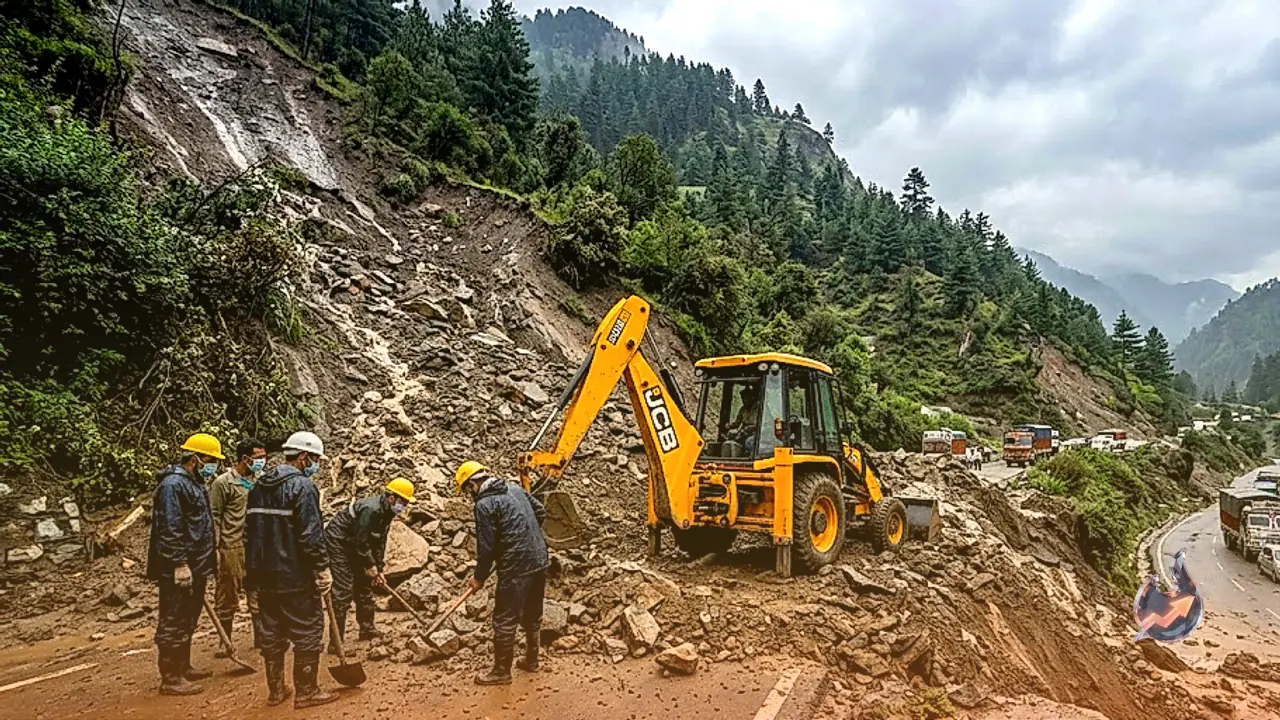

Continuous heavy torrential rains across Himachal Pradesh have severely disrupted normal life, with the Meteorological Centre in Shimla issuing a yellow alert for heavy rainfall at isolated places until August 11. On Thursday, shooting stones and falling boulders caused a massive landslide at Nigulsari in Kinnaur district, forcing the complete closure of the National Highway. This stretch near Nigulsari has posed a persistent structural challenge and headache for both local residents and state authorities over the past three years.
Landslide Incidents and Traffic Delays in Shimla and Manali
In the state capital Shimla, a landslide hit the Chamiyana Hospital Road, dumping heavy mud and stones onto the thoroughfare. Disaster management teams deployed heavy machinery to clear the debris and restore vehicle movement. Meanwhile, in the tourist town of Manali, an overflowing stream near Vashishth Chowk deposited massive quantities of sludge onto the primary highway, stranding hundreds of vehicles in a long traffic congestion. Response crews from the Border Roads Organisation (BRO) have been working continuously to clear the roadway and resume smooth traffic.
Statewide Disruption to Roads, Power Supply, and Water Infrastructure
According to official data released by the State Emergency Operation Centre (SEOC), a total of 112 roads remained completely closed to traffic by Wednesday evening. In addition, 61 drinking water supply schemes experienced disruptions, while 189 electricity transformers were knocked out of service across the state. The geographical breakdown of closed roads across districts includes
- Mandi District: 37 roads closed (highest in the state).
- Kullu District: 34 roads closed.
- Sirmaur District: 29 roads closed.
- Kangra District: 8 roads closed.
- Shimla District: 4 roads closed.
- Una District: 2 roads closed.
- Chamba District: 1 road closed.
Infrastructure Losses and Water Restoration Progress
Providing details on regional utility damage, Chief Engineer Deepak Garg of the Dharamshala zone stated that out of 1,643 drinking water schemes in the Kangra-Chamba region, approximately 820 schemes suffered disruptions at various times during the monsoon. The department has successfully restored operational capacity to all affected units, with roughly 90 percent repaired permanently and the remaining 10 percent functioning temporarily through alternative arrangements.
Engineering assessments indicate that monsoon rains have inflicted total financial losses amounting to approximately 67 crore rupees in the Kangra-Chamba zone. Within this region, Chamba district incurred damage worth around 27 crore rupees, while Kangra district suffered losses estimated at 40 crore rupees. The worst-affected locations in Chamba included Sultanpur, Udaipur, and Obri Bag. Other impacted installations included the Gaj water supply scheme in Dharamshala, Beas-based water projects in Jaisinghpur and Thural, and around 10 schemes in Bharmour, all of which have now been fully restored.
Detailed 24-Hour Rainfall Statistics and Temperature Readings
Heavy rainfall lashed multiple regions of Himachal Pradesh over the 24-hour period ending Wednesday evening. Data from weather monitoring stations revealed that Jattan Barrage recorded the highest precipitation at 135.4 mm. Rainfall measurements across other key locations included
- Raipur Maidan: 124.2 mm
- Naina Devi: 110.6 mm
- Nahan: 101.2 mm (with a separate station recording 64.8 mm)
- Dehra Gopipur: 97.2 mm
- Nadaun: 90 mm
- Kangra and Ghamroor: 76.2 mm each
- Murari Devi: 66.6 mm
- Dharamshala: 60.1 mm
- Neri: 58.5 mm
- Una: 52 mm
- Paonta Sahib: 50.2 mm
Kangra district experienced heavy rainfall accompanied by intense thunderstorms. In terms of temperature extremes, Kukumseri recorded the lowest minimum temperature at 13.2 degrees Celsius, whereas Una recorded the highest maximum temperature at 34.2 degrees Celsius.