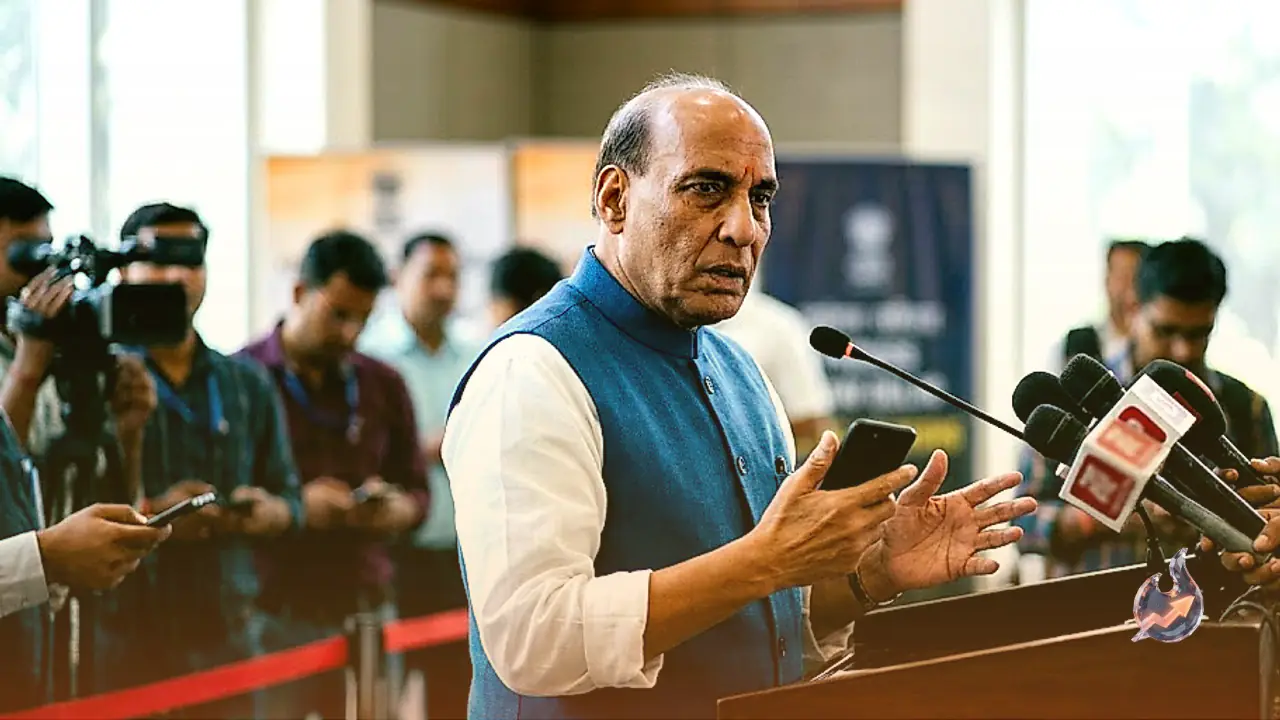






















Amid an escalating political debate over the national song Vande Mataram, Union Minister Rajnath Singh has launched a sharp criticism against the opposition party. Sharing his views on a social media platform, he asserted that any law passed by Parliament, the country's supreme institution, is binding on every citizen. He emphasized that refusing to accord formal respect to the national song and directly opposing it represents a serious constitutional issue.
Parliamentary Authority and Rajnath Singh's Statement
Defense Minister Rajnath Singh clarified that adhering to rules framed by Parliament remains a constitutional obligation for all. He stated, "Congress formally refusing to respect Vande Mataram and directly opposing it is extremely unfortunate and constitutionally a very serious matter." His comments came as political friction grew following recent updates to official protocol surrounding the 150 year old song composed by Bankim Chandra Chattopadhyay.
Background of the Vande Mataram Protocol Dispute
The controversy deepened after the central government accorded national anthem status to Vande Mataram and mandated the rendition of all six stanzas during official ceremonies. Updated guidelines also introduced stringent penalties for disrespecting or interrupting the song. In response, the Congress party decided to sing only the first two stanzas during its events, prompting sharp objections from government leaders who advocate for complete adherence to the new framework.
Opposition Arguments and Differing Perspectives
Several opposition lawmakers have raised objections to the mandatory singing of all six stanzas. Member of Parliament Shashi Tharoor described the compulsory full rendition at official events as burdensome and unnecessary. Similarly, lawmaker Imran Masood cited personal religious beliefs and constitutional freedoms, indicating he would stand in respect but refrain from singing the stanzas. Meanwhile, legal complaints filed against senior leaders like Sonia Gandhi have further intensified the public exchange between opposing political camps.
About Indian National Congress
The Indian National Congress is a major political party in India, founded on December 28, 1885. It emerged as the first modern nationalist movement across the British Empire in Asia and Africa. Under the leadership of Mahatma Gandhi after 1920, the party became the central participant in the Indian independence movement, playing a decisive role in achieving freedom from British colonial rule.