
















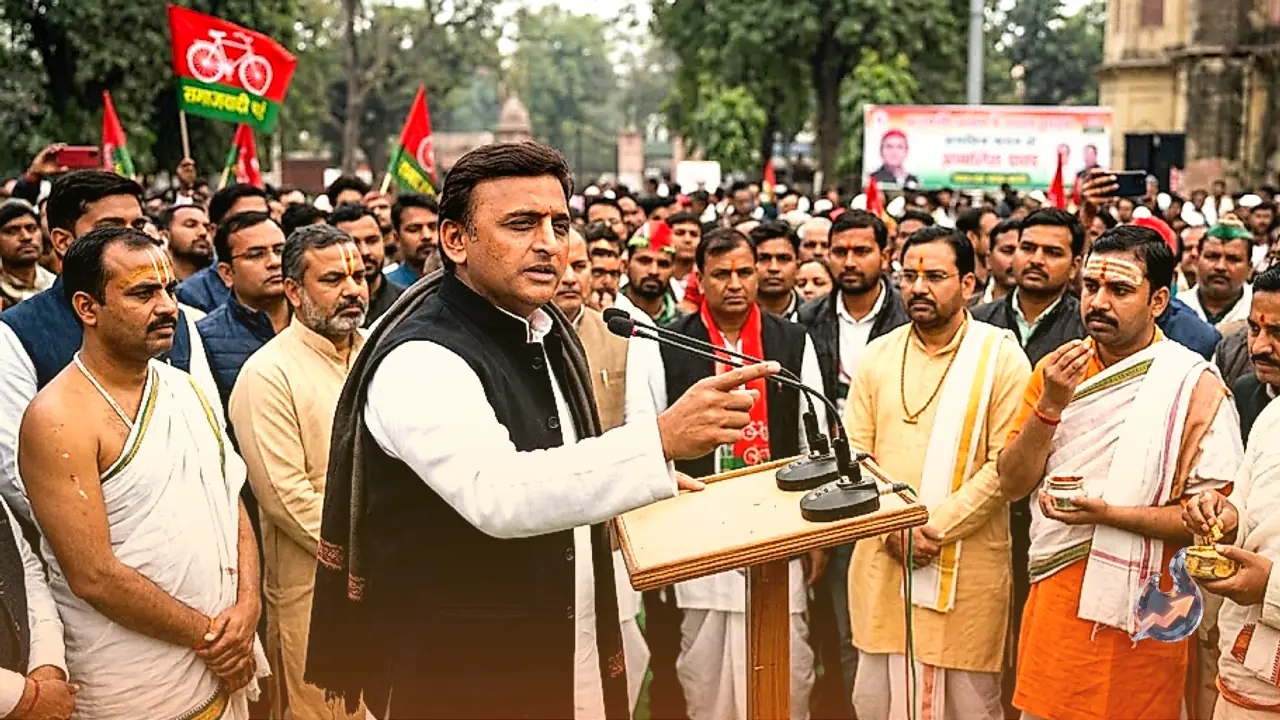

Political activity across Uttar Pradesh is intensifying rapidly as the state draws closer to its upcoming assembly elections. With the electoral battle looming large, political parties have stepped up their outreach to secure the support of the influential Brahmin community. Various factions are actively working to pull this crucial voter base into their respective folds. In a significant political move on August 5, Samajwadi Party national president Akhilesh Yadav introduced a fresh interpretation of the PDA concept, declaring that the letter 'P' now stands for 'Pandit'. Back during the 2022 assembly elections, the very same acronym used the term 'Pichhra' for that letter, making this transition from backward to Pandit a notable political message within the state's electoral landscape.
While addressing a dedicated Brahmin convention organized in Lucknow, Akhilesh Yadav launched a sharp attack on the ruling Bharatiya Janata Party led by Yogi Adityanath. He accused the ruling establishment of systematically targeting the Brahmin community across Uttar Pradesh. Slamming his political rivals, he remarked that opponents continually talk about the PDA framework and invent new definitions for it because they have faced defeats stemming from it. He asserted that while they scramble to redefine it, they overlook the fact that the 'PD' component also encompasses Pandits, adding that the more suffering and distress the ruling side inflicts, the stronger the PDA coalition will grow.
During the very same event, the opposition leader criticized the Yogi Adityanath administration over its handling of the Mahakumbh arrangements. He alleged mismanagement of the massive gathering and claimed that a prominent seer, Swami Avimukteshwaranand Saraswati, was prevented from taking a holy bath. At the same time, he promised that if his party successfully forms the government in the future, it will work toward uplifting the community and generating employment opportunities for the youth.
The Brahmin community has long held a position of considerable influence within the political dynamics of Uttar Pradesh. Their role becomes especially critical during assembly elections, where they hold the potential to sway outcomes significantly. According to political analysts, Brahmin voters are in a position to shape results across more than 115 assembly constituencies in the state. This underlying reality explains why political formations intensify their efforts to court this specific demographic as election dates draw closer.
Looking back at electoral history, Mayawati-led Bahujan Samaj Party achieved massive success in the 2007 assembly elections through a carefully crafted Dalit-Brahmin social engineering model. By uniting these communities, the BSP secured victories in 206 out of 403 seats and formed the government. Data compiled by Lokniti and CSDS indicates that the BSP captured approximately 16 percent of the Brahmin vote share during that decisive electoral cycle.
In the subsequent 2012 assembly elections, the Samajwadi Party emerged victorious by winning 224 seats and securing a full majority. According to the same Lokniti and CSDS statistics, the Samajwadi Party garnered around 19 percent of the Brahmin vote share in that election. Meanwhile, the BJP secured 38 percent, the BSP won 19 percent, and the Congress party claimed 13 percent, indicating that the Brahmin electorate was not consolidated behind a single political banner at that time.
However, the political landscape transformed completely during the 2017 assembly elections. Amid a strong wave in favor of Narendra Modi, the BJP swept the polls by winning more than 300 seats. A massive chunk of the Brahmin electorate shifted allegiance toward the saffron party. Figures from Lokniti and CSDS show that the BJP secured roughly 83 percent of the Brahmin vote, whereas the Samajwadi Party managed just 7 percent and the BSP secured a meager 2 percent.
This overwhelming preference persisted into the 2022 assembly elections as well, with Brahmin voters continuing to back the BJP strongly. Surveys revealed that the ruling party captured nearly 89 percent of the Brahmin vote share, while the Samajwadi Party was limited to a mere 6 percent.
With the 2027 elections now on the horizon, opposition camps argue that a section of the Brahmin demographic harbors underlying resentment toward the current administration. Critics have frequently alleged that the Yogi Adityanath-led government accords greater preference to the Thakur community. Nonetheless, analysts point out that any underlying dissatisfaction with the BJP does not automatically translate into a wholesale transfer of Brahmin votes to the Samajwadi Party or other opposition entities.
The central dilemma facing the Samajwadi Party is that a segment of Brahmin voters remains hesitant due to perceptions surrounding the party's historical approach toward minority appeasement. Consequently, Akhilesh Yadav's outreach extends beyond hosting mere Brahmin conventions, forming part of a broader social engineering blueprint aimed at the 2027 contest.
At the same time, the BSP is attempting to revive its historical formula. Mayawati is trying to reconstruct the successful 2007 Brahmin-Dalit alliance, having assigned prominent Brahmin face Satish Chandra Misra key responsibilities in legal, media, and Election Commission-related affairs.
Meanwhile, the BJP is taking proactive steps to safeguard its support base. The party has appointed veteran RSS ideologue Nagendranath Tripathi as national organizer, a move viewed as an effort to solidify grassroots connections with traditional loyalists. This interplay demonstrates that the upcoming election in Uttar Pradesh will be defined not merely by a standard bipolar contest, but by an intense political contest to capture the allegiance of Brahmin voters.