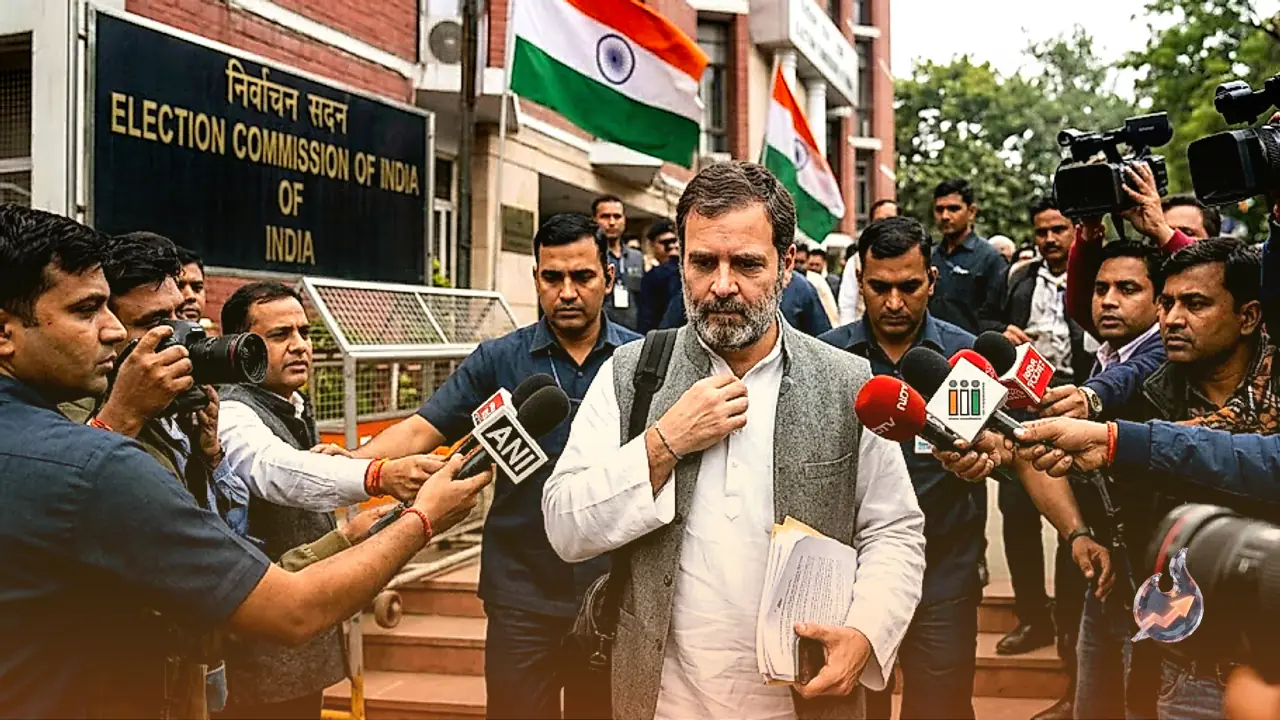






















Uttarakhand Chief Minister Pushkar Singh Dhami addressed a press conference at the Chief Sevak Sadan in the Chief Minister's residence, where he responded extensively to questions concerning the working methodology of the Election Commission, the Special Intensive Revision process, issues relating to the youth, and allegations leveled by the Congress party. The Chief Minister stated that the foundational strength of India's democracy rests upon the nation's constitutional institutions. He emphasized that the Election Commission is an independent constitutional body and its official decisions must be viewed within that specific context. He noted that a full commission meeting took place on September 26, headed by Chief Election Commissioner Gyanesh Kumar alongside Election Commissioners Dr. Sukhbir Singh Sandhu and Dr. Vivek Joshi. The note issued following that meeting received the unanimous endorsement of the entire commission, making it clear that the core order for the Special Intensive Revision, issued on June 24, 2025, was enacted with the absolute consensus of all members.
Unanimity of Election Commission Decisions and Legal Validity
Continuing his address, the Chief Minister detailed that subsequent schedules for the Special Intensive Revision across 12 states and union territories, and later across another 19 states and union territories, were also approved through total commission consensus. He asserted that it is entirely inappropriate to present any internal note or observation as an institutional rift or a disagreement with the commission's final determinations. Responding to a media report claiming that two election commissioners had recorded at least 14 objections on various matters, the Chief Minister reiterated that the official stance of the commission remains that all final orders concerning the revision were adopted unanimously. He remarked that while questions should certainly be asked within a healthy democracy, internal administrative notes ought not to be framed as final verdicts, nor should ordinary objections be sensationalized as institutional breakdowns.
Stressing that facts must be determined by comprehensive files and final institutional decisions rather than flashy headlines, the Chief Minister pointed out that the Supreme Court of India acknowledged the statutory authority and process adopted by the Election Commission regarding the revision in Bihar through its verdict dated May 27, 2026. According to the official judgment summary, the court recognized the revision process in Bihar under Article 324 of the Constitution and Section 21(3) of the Representation of the People Act, 1950, finding the procedure fully consistent with legal provisions and the 1960 rules. Furthermore, addressing communications directed to the Cabinet Secretary, he noted that the Election Commission had already clarified that the matter was purely an administrative issue related to the functioning of an officer on deputation.
Form-6 Regulations and Enhanced Voter Facilitation Measures
Turning to voter registration procedures, the Chief Minister explained that the commission's note from September 26 explicitly confirms that declarations associated with Form-6 during the Special Intensive Revision draw their backing from the Supreme Court's ruling. Conversely, during periods outside the revision, standard forms prescribed under the Registration of Electors Rules, 1960 will continue to apply normally. He announced that the commission has established a doorstep collection mechanism for documents concerning unmapped or logically discrepant voters, sparing citizens the inconvenience of visiting offices for personal hearings by having Booth Level Officers collect paperwork directly from their residences. Additional provisions include setting up dedicated help desks and special camps tailored for homeless individuals, shelter residents, daily wage earners, and impoverished citizens. Special campaigns have also been instituted to successfully enroll first-time voters and locate names that might have been left off previous electoral rolls.
Regarding questions raised about ECINet, the Chief Minister announced that the Election Commission has arranged for an independent technical review of the digital platform. A specialized committee headed by the Senior Deputy Election Commissioner, which includes independent technical experts from IIT and IIIT institutions, will evaluate whether ECINet functions strictly in accordance with existing laws and regulations. Additionally, he noted that the commission has resolved to circulate meeting agendas in advance and formally publish meeting minutes moving forward to foster greater administrative transparency.
Sharp Criticism of Congress and Political Rhetoric
Directing a scathing critique at the Congress party, the Chief Minister declared that the opposition organization has essentially collapsed, reducing one of its prominent leaders to acting merely as a comedic performer. He argued that Congress attempts to utilize administrative matters merely as a convenient shield to conceal its own deep-seated political weaknesses. Asserting that the modern generation is remarkably discerning, he maintained that citizens understand full well what kind of pragmatic politics is genuinely required to secure national development and security. Without naming Rahul Gandhi directly, Dhami remarked that the political strategy of Congress invariably attributes every electoral setback either to electronic voting machines or directly to esteemed constitutional institutions, suggesting that Congress leaders will likely continue anticipating future defeats.
The Chief Minister criticized the Leader of the Opposition for lacking the expected gravity and seriousness in public statements despite holding such a vital constitutional post. Reflecting on past governance under Congress, he stated that their tenure was defined far more by major financial scandals and allegations of systemic corruption than by actual developmental progress. Although governments have changed over time, those old administrative failures remain vividly imprinted in public memory. Accusing the party of having developed a persistent habit of shifting blame for electoral losses onto institutional frameworks, he asserted that a Congress having lost public trust is desperately hunting for fresh excuses to mask continuous political failures.
Crackdown on Examination Malpractices and Youth Employment
Addressing remarks made regarding recruitment examination irregularities during a political visit to Dehradun, the Chief Minister highlighted the stringent administrative actions taken by his administration against cheating mafias within the state. He confirmed that over one hundred individuals involved in examination fraud have been successfully apprehended and sent behind bars. To ensure that public recruitment examinations remain completely secure, fair, and transparent, the state government enacted and enforced a stringent anti-cheating law. Over the past five years, the state has successfully provided government employment to more than 35,000 deserving young candidates, maintaining absolute transparency in hiring as a top administrative priority. He urged critics to thoroughly examine factual records before launching politically motivated accusations concerning the sensitive future of the youth.
Preserving Social Harmony and Demanding Proof on Land Allegations
Referring to recent incidents in Haldwani, the Chief Minister emphasized that proper factual verification is vital before attempting to view any local event through a communal or caste-based lens. The true identity of Uttarakhand has historically been anchored in social harmony, mutual brotherhood, and deep mutual respect across all communities, he noted, warning against any politics that attempts to divide the state along caste or class lines. Preserving the social unity of the Devbhoomi remains the region's greatest collective strength and a shared responsibility for all residents. Addressing land-related allegations leveled by the opposition, the Chief Minister issued a direct challenge, stating that if the opposition possesses any verifiable proof regarding government land being transferred or sold in violation of established rules, those documents must be made public immediately rather than simply repeating unfounded claims.