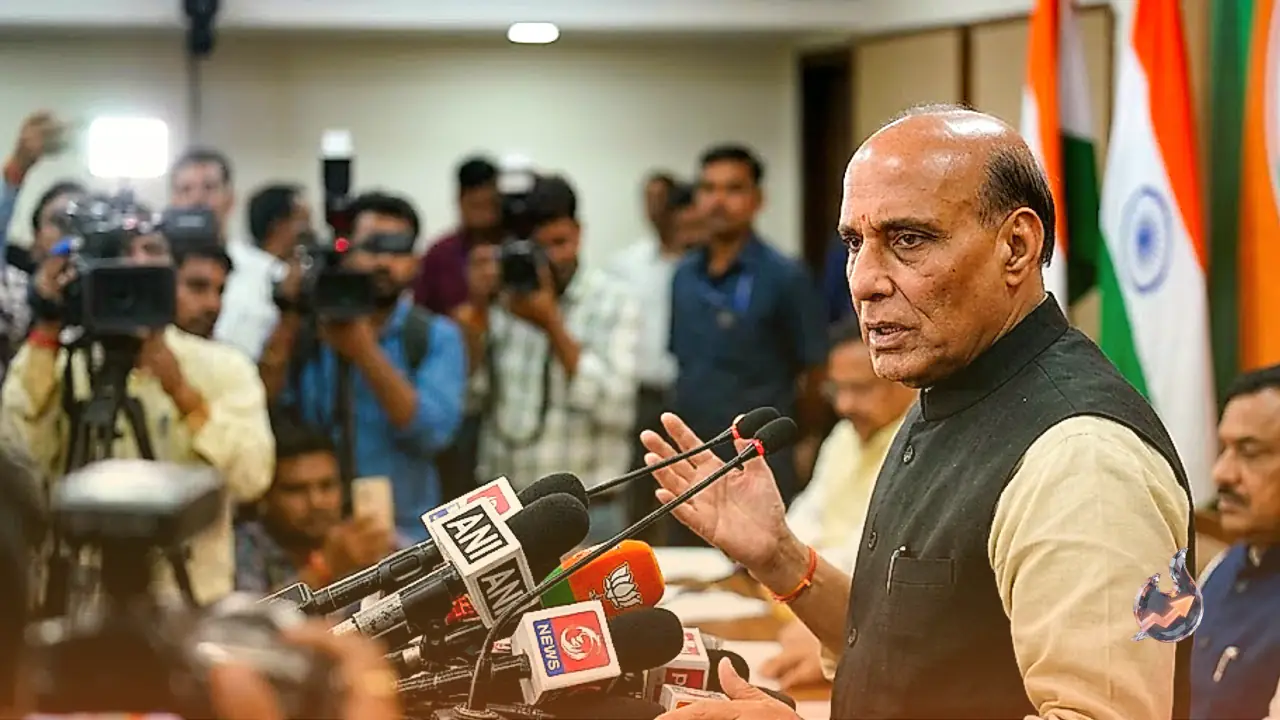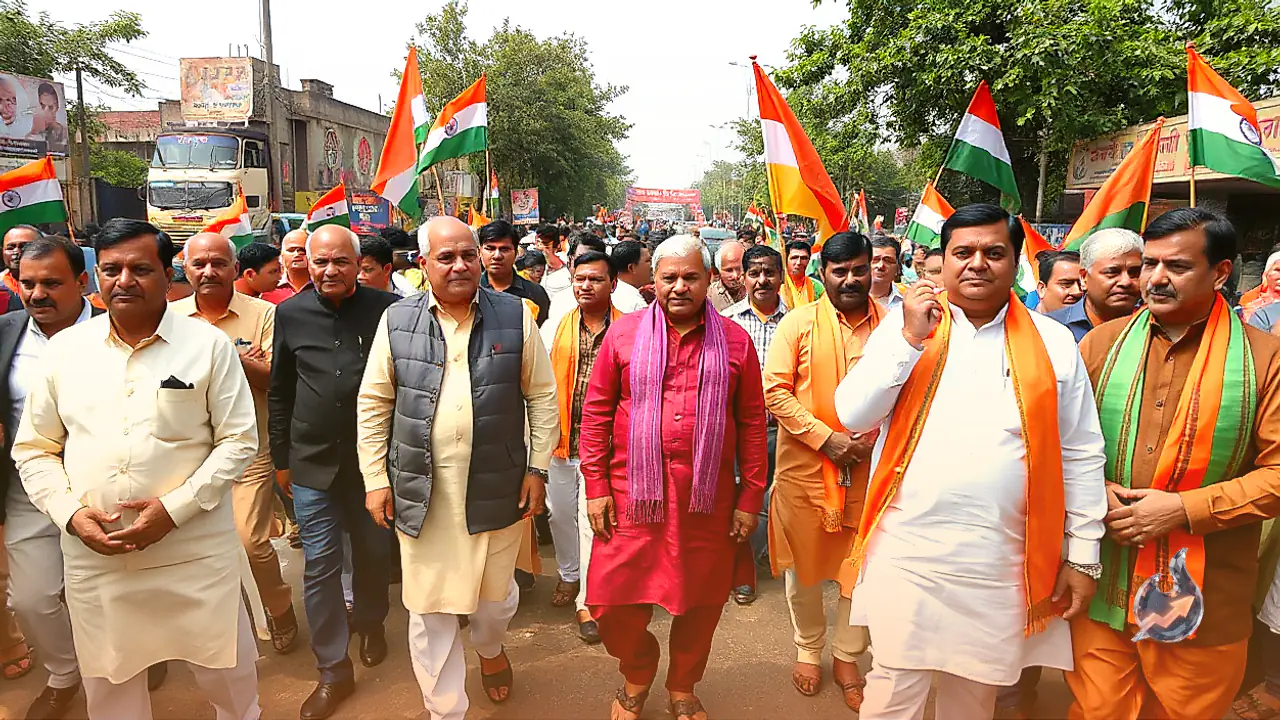





















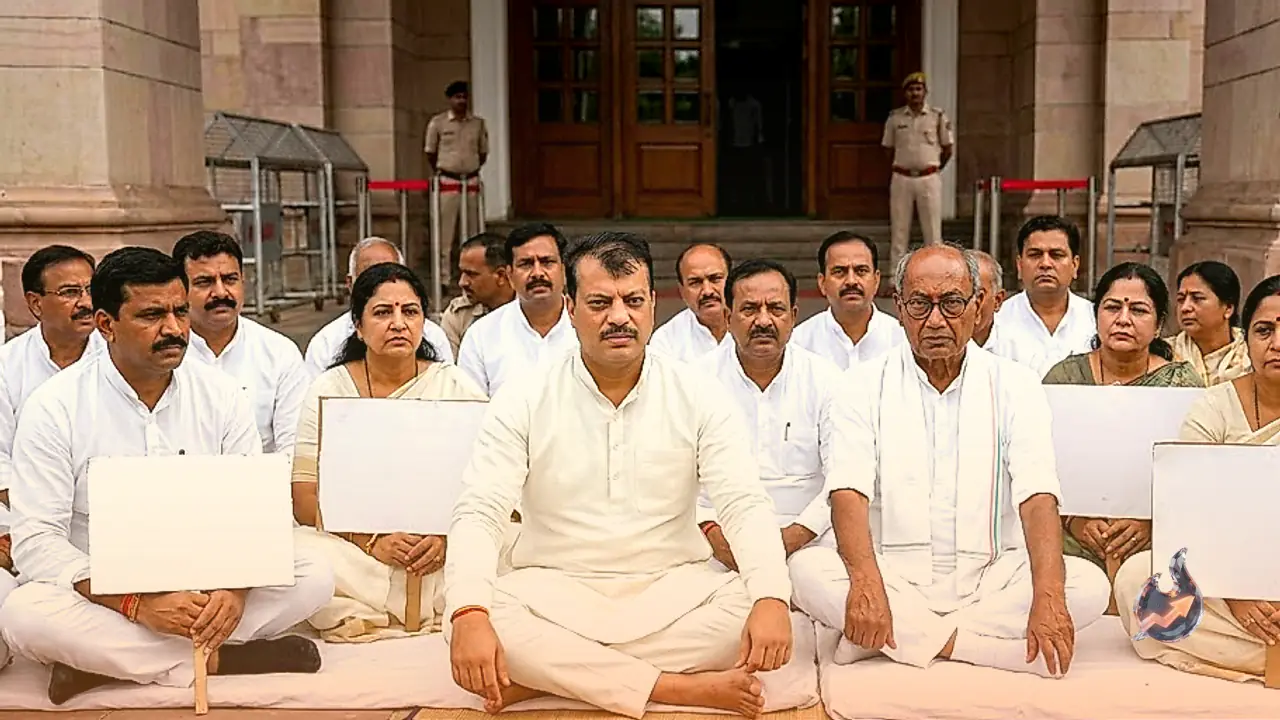

The intense political standoff currently gripping the national capital has quickly triggered a massive ripple effect in Madhya Pradesh. As Leader of Opposition in the Lok Sabha, Rahul Gandhi, continues his high-profile dharna outside the Prime Minister's residence in New Delhi to protest against alleged police brutality, the reverberations are being strongly felt within the Madhya Pradesh state assembly. The outrage over the heavy-handed police action against opposition leaders at Jantar Mantar has now become a major flashpoint in Bhopal. Congress legislators in the state have taken a cue from their central leadership, deciding to escalate their agitation directly to the doorsteps of the state's highest executive office. Led by the state assembly's Leader of Opposition, Umang Singhar, a large group of Congress Members of the Legislative Assembly firmly entrenched themselves outside the Chief Minister's chamber. The protesting leaders resorted to aggressive sloganeering, condemning the state and central governments while demanding immediate accountability for the events unfolding in Delhi. Their demonstration highlights how localized issues are now merging with national grievances, creating a unified opposition front across different political theaters.
Clash Over Kailash Vijayvargiya's Remarks
The immediate trigger for the sit-in at the Chief Minister's office was a heated confrontation on the floor of the Madhya Pradesh legislative assembly. The opposition Congress party had officially moved a demand to hold a detailed discussion regarding the police crackdown on protesting students and political figures at Jantar Mantar. However, this demand was met with sharp resistance from the treasury benches. Senior state cabinet minister Kailash Vijayvargiya intervened during the session, dismissing the opposition's demand by questioning the relevance of the Delhi incident to the Madhya Pradesh assembly. His remark, effectively asking what business the state house had discussing events from another jurisdiction, instantly infuriated the Congress camp. Deeming the minister's attitude as highly insensitive and dismissive of democratic rights, Umang Singhar mobilized his fellow legislators. The lawmakers marched to the Chief Minister's chamber, sat on the floor, and declared they would not budge until Kailash Vijayvargiya issued a public apology for his comments. During the sit-in, senior Congress figures accused the ruling administration of systematically attempting to crush the opposition's voice and blatantly disregarding established democratic traditions.
Digvijaya Singh Mounts Fierce Attack Over NEET Irregularities
While the assembly witnessed chaotic scenes, veteran Congress leader and former Madhya Pradesh Chief Minister Digvijaya Singh launched a separate, scathing offensive against the central government concerning the NEET examination fiasco. Singh reminded the public that the Congress party was the first to demand the immediate resignation of Union Education Minister Dharmendra Pradhan over the widespread irregularities. Leveraging his past experience as the chairman of the parliamentary committee on education, Singh stated that he is intimately aware of the systemic corruption and the precise mechanisms through which examination scams are orchestrated. He expressed deep frustration over the apparent lack of accountability at the top echelons of the National Testing Agency. Singh pointed out that despite the massive scale of the NEET paper leak controversy, no one seems willing or able to interrogate the NTA chairman directly. He recounted a specific parliamentary committee meeting where he personally questioned the NTA chief, only to be met with evasive answers as the official completely washed his hands of any direct responsibility.
Allegations Of Deep-Rooted Corruption In Exam Agencies
Elaborating on the structural failures within the examination system, Digvijaya Singh leveled serious accusations against the NTA, describing the entire operation as a massive money-making racket. He alleged that the corruption is not isolated but involves a deeply entrenched nexus connecting every stage of the process, from the individuals who set the question papers to those responsible for printing them across 13 different languages. The former Chief Minister sharply questioned the central government's reluctance to take decisive action. He demanded to know exactly what is preventing the dismissal or resignation of Union Education Minister Dharmendra Pradhan. Furthermore, Singh criticized the superficial punitive measures taken so far, noting that while millions of students suffer, the government has merely transferred a single bureaucratic officer instead of sacking the NTA chairman. Summarizing his critique, Singh boldly accused the ruling Bharatiya Janata Party of completely commercializing the education sector, transforming what should be a fundamental public service into a highly profitable business enterprise driven by illicit financial gains.
Questions Raised Over Delhi Violence And Praise For Sonam Wangchuk
Shifting his focus to the ongoing student protests in the national capital, Digvijaya Singh raised pointed questions about the sudden outbreak of violence. He questioned the mysterious appearance of stones during the student demonstrations at Jantar Mantar the previous day. Singh demanded a thorough investigation into how trucks loaded with stones managed to reach the protest site, pointedly asking what the Delhi police were doing to prevent such an escalation. Noting that central Delhi is not a place where loose stones are naturally found, he insisted that the Union Home Minister and the Delhi Police Commissioner must provide clear answers to the public. In the same interaction, Singh took a moment to highly praise the renowned social activist Sonam Wangchuk. Recalling his visit to Leh in his capacity as the parliamentary committee chairman, Singh expressed deep admiration for Wangchuk's institutions. He commended the activist's unique educational model, which takes students who have previously failed and guides them to pass with first-class honors. Singh also lauded Wangchuk's innovative use of solar energy to drastically raise indoor temperatures from a freezing minus 40 degrees to a manageable minus 5, 6 degrees in the harsh Ladakh winter. Finally, when pressed for his stance on the potential implementation of a Uniform Civil Code in Madhya Pradesh, Singh maintained a cautious approach. He acknowledged that the Uniform Civil Code is technically a part of the constitutional framework but stated that he cannot offer a definitive opinion until he has seen the actual draft of the proposed legislation.