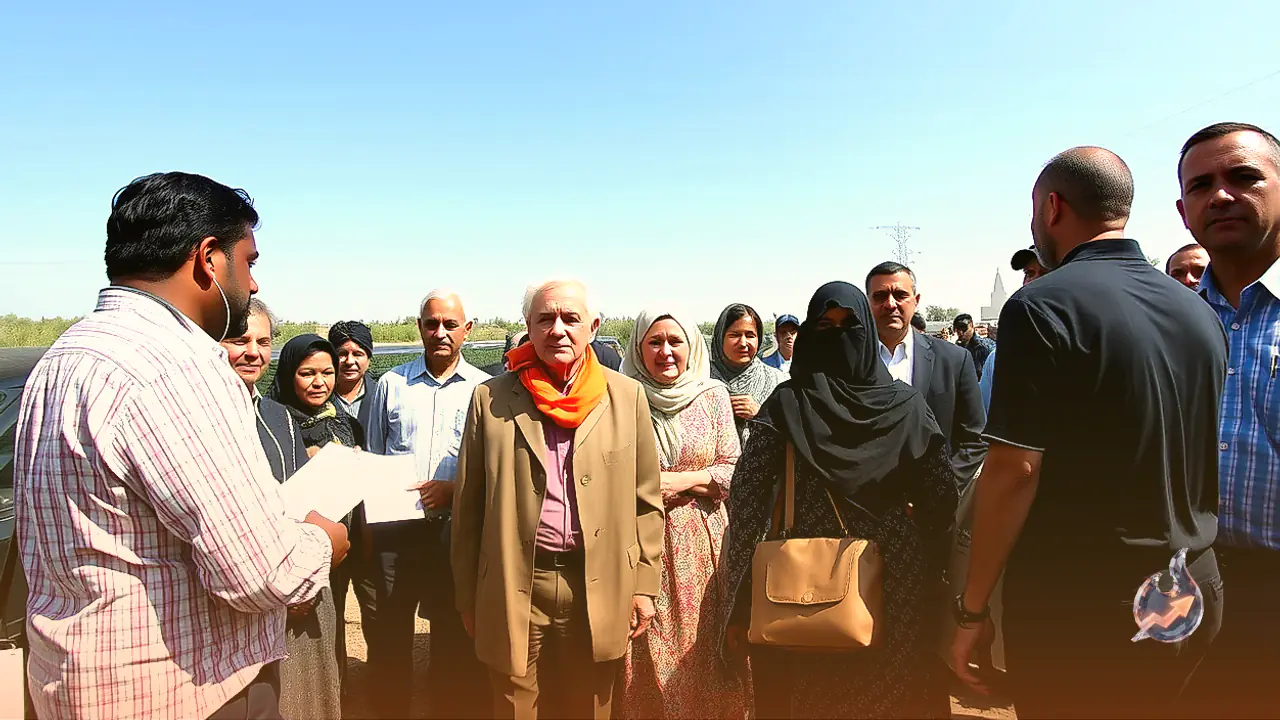
























A tranquil rural setting where families invested modest savings to establish modest homes and cultivate small plots of land is now the site of a sprawling military weapons complex. In Rio Rancho Estates, New Mexico, construction is rapidly advancing on Project Ranger, an expansive campus where defense technology startup Castelion plans to operate the nation's largest dedicated hypersonic manufacturing facility. Scheduled for completion by the close of the year, the mega-facility sits barely 1,000 yards from roughly 450 residential parcels, positioning existing households squarely inside potential danger boundaries should hazardous propellants and volatile chemicals ignite.
Project Ranger's Location and Residential Proximity
Residents chose this semi-rural expanse because affordable plots allowed them to place trailers, raise crops like corn, squash, and green chile, and build a quiet life close to local parks and elementary schools. For community member Schultz, the modest land represented an opportunity for stability, but the rapid arrival of a missile production complex has created deep unease. Schultz noted that having already weathered substantial hardship, the prospect of having to relocate amidst profound uncertainty is particularly distressing. Fellow resident Laura Lundberg expressed similar alarm, observing that her household now directly borders a facility tasked with manufacturing military weaponry.
Although more than a year has elapsed since the company commenced formal arrangements in New Mexico, unresolved questions regarding community safety remain. Official hazard analyses indicate that in the event of an active structural blaze, local emergency protocols call for letting certain buildings burn completely to avoid exposing firefighters to deadly chemical risks, a scenario that would discharge corrosive hydrochloric acid vapor across the surrounding atmosphere. Municipal correspondence reveals that discussions regarding specific firefighting infrastructure and water-flow standards were still ongoing well after physical ground operations were underway.
Valuation Surge and Expanding Defense Contracts
Established in November 2022 by three former SpaceX executives, Castelion has rapidly ascended within the defense technology sector. The company recently reached a valuation of $13 billion, marking a fourfold jump from its $2.8 billion Series B valuation recorded the prior year. Over an 18-month span, the firm secured more than $500 million in military contracts, cementing its position among defense procurement suppliers supporting national weapons initiatives.
A cornerstone of Castelion's commercial appeal has been its pledge to manufacture hypersonic strike platforms—weapons capable of maintaining speeds exceeding five times the speed of sound—at a fraction of prevailing market prices. By comparison, the Dark Eagle system developed for the US Army represents the most mature domestic hypersonic asset, carrying an estimated production expense of $41 million per missile according to an analysis published in 2023 by the Congressional Budget Office. Castelion initially pitched its primary solid-fueled missile, named Blackbeard, at an estimated target price of $384,000 per unit.
Escalating Unit Costs and Weapon Testing Secrecy
Subsequent military awards indicate that actual procurement figures for the Blackbeard platform have climbed significantly above early projections. The company initiated the year with an award of nearly $50 million from the Navy to produce full-scale prototypes. By June, naval authorities broadened the scope by allocating an additional $23.4 million to manufacture the first batch of 50 operational prototypes. In August, an additional $90 million manufacturing services contract was authorized for the identical 50 units, elevating cumulative funding for the initial run to $163.4 million, which translates to approximately $3.3 million per missile.
Procurement commitments deepened further in September when the Navy granted Castelion its largest single award to date, valued at up to $200 million. While the company recently circulated an initial photograph of the Blackbeard hypersonic strike missile, verified technical performance specifications and validation metrics remain undisclosed. The firm has not released public testing data to independently demonstrate the operational reliability of the missile platform.
Strategic Pivot from Nevada to New Mexico
Spanning 1,000 acres, Project Ranger represents Castelion's primary testing and mass-production complex. Groundbreaking took place on January 21, with corporate leadership targeting high-volume manufacturing output as early as next year. However, New Mexico was not the company's initial choice for the facility.
In August 2023, the startup sought approvals to construct a rocket production plant in Churchill County, Nevada, operating under the entity name Pallas Industrials. A special use filing signed by chief financial officer Andrew Kreitz detailed intentions to assemble rocket motors and conduct static ground testing up to eight days per month. In response, Churchill County administrators issued an eight-page staff review requiring explicit testing parameters, operational safety limits, and emergency protocols. Shortly thereafter, the company abandoned its Nevada application, rebranded as Castelion, and shifted site-selection activities toward western Rio Rancho to conduct soil assessments.
By the spring of 2025, when soil-sampling equipment appeared across the terrain, local officials and corporate representatives were already deep in negotiations regarding land usage and industrial siting for the missile campus.
Sandia National Laboratories Hazard Assessment
In June 2025, a hazard evaluation was compiled by Sandia National Laboratories through the New Mexico Small Business Assistance Program, an initiative designed to provide local commercial ventures with technical support from Los Alamos and Sandia National Laboratories. When the report was later released under a Freedom of Information Act disclosure, redacted sections containing sensitive safety calculations were obscured using black visual formatting that left the underlying digital text intact and readable upon extraction.
The findings inside the assessment underscored substantial hazards tied to manufacturing operations. The document classified a major fire within propellant storage structures as the worst-case scenario. Castelion intends to maintain massive quantities of energetic materials across the campus, publicly confirming plans to handle heat-reactive oxidizers such as ammonium perchlorate, with permitted storage reaching up to 250,000 pounds inside fortified magazines and earth-covered bunkers. Beyond storage bunkers, the report detailed that up to 81,000 pounds of active explosive compounds may be present simultaneously inside hazardous integration buildings during assembly workflows.
Should an accidental detonation consume the maximum permitted quantity of explosive materials, an isolation buffer equivalent to nearly nine football fields would be required to protect adjacent inhabited structures. Computational modeling by Sandia indicated that a maximum-credible blast could shatter large window panes at distances approaching four miles and create a 3.2 percent probability of minor eardrum trauma for individuals situated 400 yards away. Meg Davidson, a co-author of the Sandia hazard evaluation, subsequently departed the laboratory and took a role as senior manager of strategic partnerships at Castelion.
Chemical Exposure Risks and Emergency Response Limitations
The safety assessment identified a test-stand fire as the most probable hazardous operational occurrence. Combusting chemical compounds would generate a toxic plume carrying corrosive byproducts, specifically hydrogen chloride and chlorine. Both gases inflict severe chemical burns on skin, eyes, and respiratory passages, while brief exposure to concentrated vapor can lead to acute pulmonary injury and asphyxiation.
Internal records show that the Rio Rancho Fire Department concluded that 17 out of 26 planned structures across the Project Ranger footprint would be left to burn without intervention during an active chemical blaze due to extreme hazards facing first responders. Emergency personnel would be restricted from entering designated high-risk integration facilities entirely.
Similar industrial hazards have materialized at other aerospace manufacturing locations. An incident in June at an Anduril facility in Mississippi involving static testing of an ammonium perchlorate rocket motor resulted in an explosive failure, illustrating the inherent risks associated with expanding solid propellant manufacturing. Additionally, in May, an overheating storage vessel containing roughly 7,000 gallons of methyl methacrylate at a GKN Aerospace plant in Garden Grove, California, forced municipal authorities to mandate precautionary evacuations for more than 40,000 local residents.
Regulatory Negotiations and Municipal Approvals
Even as foundational site construction moved forward between March and May, communications show company leadership continued negotiating essential fire-safety compliance criteria. Castelion site developer Bryce Barlow informed municipal staff on March 23 that fire-flow calculations remained unfinalized, suggesting direct telephone or in-person conferences to settle the matter.
City Manager Matt Geisel subsequently adjusted the procedural requirements, noting that definitive numerical standards could be incorporated into later project phases. Formal progress was enabled through a signed memorandum of understanding, supported by a municipal resolution and utility serviceability documentation. In written correspondence, CFO Andrew Kreitz welcomed the streamlined approach, stating it eliminated substantial legal expenses and procedural hurdles.
Financial Subsidies and Community Fallout
Public financing mechanisms played a central role in facilitating Project Ranger. In August 2025, prior to the public announcement of the site selection, Republican State Senator Jay Block addressed the Sandoval County Commission to advocate for financial incentives supporting the project. Block, a former county commissioner whose legislative district encompasses Rio Rancho, stated that Sandoval County possessed the skilled workforce, infrastructure, and defense industry background needed to support Castelion's operational goals.
County commissioners approved $125 million in industrial revenue bonds, assumed administrative authority over the designated state land, and granted a 95 percent abatement on standard property taxes. Furthermore, compensating taxes on out-of-state capital equipment were abated to minimize upfront relocation expenditures for the company.
Public engagement occurred well after formal development parameters were established. Castelion held its initial public informational session in October 2025. Resident Zachary Darden, who previously campaigned for mayor on a platform critical of the project, remarked that negotiations were finalized behind closed doors before community members received notice. Economic development officials later coordinated executive networking visits in November, including participation in local business mixers.
When the ceremonial groundbreaking took place in January, nearby homeowners were omitted from the guest list, which featured prominent figures including State Senator Jay Block, US Senator Martin Heinrich, former Rio Rancho Mayor Gregg Hull, and Governor Michelle Lujan Grisham. Rob Black, New Mexico's secretary of economic development, described Project Ranger as a demonstration of what public-private partnerships can achieve for local economic expansion.
For residents of Rio Rancho Estates, however, the financial barriers to relocating are severe. Community member Jason Clifford stated that the affordable land provided essential housing opportunities for lower-income households, voicing frustration that local leaders prioritized industrial development over neighborhood stability. With moving costs out of reach, many residents remain in place, confronting persistent concerns over the industrial hazards next door.